
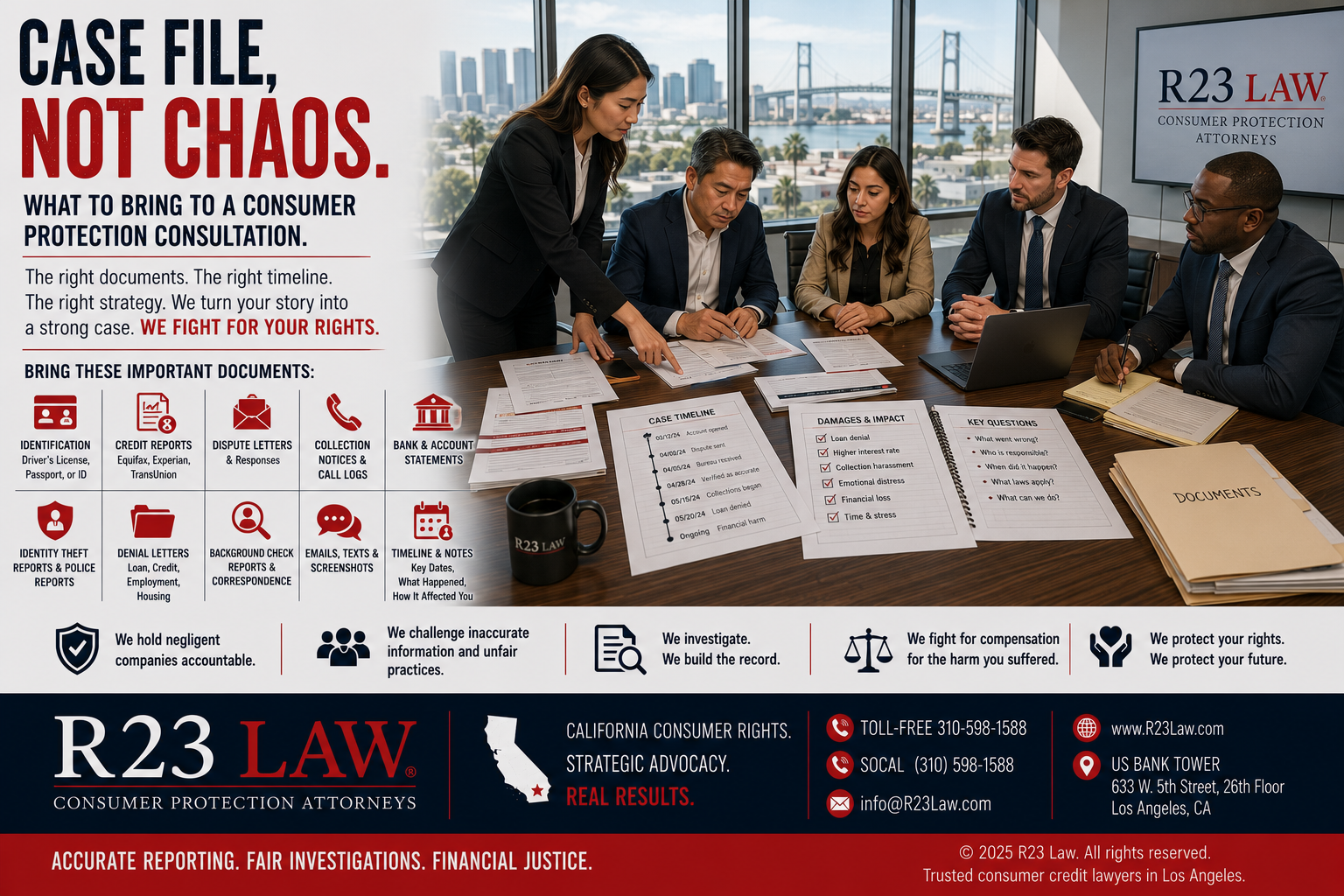
Consumer protection problems rarely arrive neatly packaged
A false account appears on your credit report. A debt collector will not stop calling. A background check blocks a job. A bank mishandles a fraud claim. A creditor verifies information you already proved was wrong. An identity thief leaves you explaining accounts you never opened.
By the time a consumer contacts a lawyer, the facts may be scattered across emails, credit reports, phone screenshots, denial letters, bank statements, text messages, dispute results, and months of frustration.
That is normal.
But preparation can turn the chaos into a case file.
The attached source emphasizes that a productive consumer law consultation depends on accurate documents, a clear timeline, and records showing when the problem began and how it developed. At R23 Law, R23 Law's California Consumer Protection Attorneys review consumer protection matters involving credit reporting errors, identity theft, debt collection abuse, background check mistakes, financial fraud, and other unlawful consumer practices.
The right documents can sharpen the legal issues, preserve key deadlines, and show the real-world harm caused by the company’s conduct.
Why Preparation Matters Before A Consumer Protection Consultation
A consultation is not just a conversation. It is the first legal review of what happened, who may be responsible, which laws may apply, and what evidence exists.
The attached article explains that preparation allows a lawyer to understand the specifics of the case, assess the situation more clearly, and build a precise timeline supported by records and communications.
For consumer protection cases, that timeline can be critical. Many laws turn on dates: when the dispute was sent, when the company received it, when the consumer reporting agency responded, when the collector called, when the fraud was reported, when the denial occurred, and when damages began.
A strong consultation file should answer four basic questions:
What happened?
Who was involved?
When did each event occur?
What harm did it cause?
The more complete the record, the easier it is for R23 Law's California Consumer Protection Attorneys to evaluate potential claims under federal and California consumer protection laws.
Start With Identification And Basic Case Information
Bring basic personal identification, such as a driver’s license, state ID, passport, or other government-issued ID. The attached source specifically recommends bringing personal identification like a driver’s license or passport.
Also prepare a short case summary with:
Your full legal name
Current address
Phone number and email
Any prior names or aliases relevant to the dispute
Last four digits of your Social Security number, when relevant
Names of companies involved
Account numbers or reference numbers
Key dates
A brief summary of the problem
For credit reporting, identity theft, background check, and debt collection matters, identifiers matter. A wrong address, wrong date of birth, wrong account number, or mixed file may be the heart of the case.
Credit Reports And Financial Records
For credit reporting cases, bring the most complete credit reports available from Equifax, Experian, and TransUnion. Do not bring only screenshots from a credit monitoring app if full reports are available.
The attached source recommends gathering credit reports from major credit bureaus, information showing credit score changes, and financial records that show inaccuracies or the impact of the financial issue.
Useful credit-reporting documents include:
Full credit reports from all three major credit bureaus
Prior versions of your credit reports
Credit monitoring alerts
Dispute results from credit bureaus
Creditor or furnisher responses
Account statements
Payment history
Settlement letters
Charge-off notices
Collection letters
Bankruptcy documents, if relevant
Loan denial letters
Interest rate quotes or approval conditions
The Fair Credit Reporting Act gives consumers the right to dispute inaccurate information, and the credit reporting company must investigate, forward the dispute and relevant information to the company that supplied the information, and report results back to the consumer.
When a credit bureau or furnisher fails to conduct a reasonable investigation, the documents you bring may become the foundation of an FCRA claim.
Credit Dispute Records
If you disputed an error, bring every dispute letter and every response.
The attached source specifically identifies credit dispute records as key consultation documents, including dispute letters sent to credit bureaus or creditors and their official responses.
Important dispute materials include:
Dispute letters sent to Equifax, Experian, or TransUnion
Disputes sent directly to creditors, furnishers, debt buyers, or collectors
Certified mail receipts
Delivery confirmations
Online dispute confirmations
Attachments submitted with the dispute
Credit bureau investigation results
Updated credit reports after the dispute
Letters stating the item was verified as accurate
Notes from phone calls
The FCRA generally requires a consumer reporting agency to conduct a reasonable reinvestigation within 30 days after receiving a dispute, with a possible 15-day extension when the consumer submits relevant additional information during that initial 30-day period.
For direct disputes, Regulation V requires furnishers to conduct a reasonable investigation of qualifying disputes involving liability for an account, account terms, payment status, balances, dates, and other information that bears on creditworthiness or reputation.
Identity Theft Documents
Identity theft cases are document-heavy because the consumer often needs to prove a negative: that the account, transaction, address, application, or debt was not theirs.
The attached source recommends bringing identity theft documents, including reports filed with the Federal Trade Commission and local police.
Bring:
FTC IdentityTheft.gov report
Police report
Fraud affidavits
Credit freeze confirmations
Fraud alert confirmations
Identity theft dispute letters
Account applications, if available
Unauthorized account statements
Bank fraud claim documents
Credit card fraud claim documents
Emails from companies involved
Screenshots of unauthorized transactions
Proof of address during the relevant time
Proof that you did not receive goods, services, or account benefits
The FTC explains that IdentityTheft.gov can create an identity theft report, and that report can make it easier to fix problems caused by identity theft.
Debt Collection Communications
Debt collection cases often depend on what was said, when it was said, and how often it happened.
The attached article recommends bringing all debt collection correspondence, including letters, detailed phone call logs, and digital messages from debt collectors.
Bring:
Collection letters
Validation notices
Settlement offers
Emails from collectors
Text messages
Voicemails
Call logs showing dates, times, and phone numbers
Notes of conversations
Proof the debt is not owed or was already paid
Bankruptcy discharge records, if relevant
Cease-and-desist letters
Complaints filed with regulators
A simple call log can matter. Write down the date, time, caller, phone number, company name, representative name, and what was said. If the collector contacted your employer, family, friends, or neighbors, preserve those details too.
Background Check And Employment Screening Records
If a background check cost you a job, delayed hiring, blocked housing, or damaged your reputation, bring the complete screening file.
Useful documents include:
Job posting
Application materials
Conditional offer letter
Background check authorization
Background check disclosure forms
Full background check report
Pre-adverse action notice
FCRA Summary of Rights
Adverse action notice
Emails from the employer
Hiring portal messages
Dispute letters to the screening company
Court records showing dismissal, expungement, sealing, or correct disposition
Proof that the record belongs to someone else
Wage loss records
R23 Law’s archive emphasizes that background check errors can affect employment and housing opportunities, and that California consumers may have added protection under state background check laws.
Billing Records, Payment History, And Account Documents
Bring records that show what you paid, what you owed, what was charged, and what the company claimed.
The attached source recommends collecting billing records and payment history to confirm the legitimacy of payments made.
Helpful records include:
Monthly statements
Receipts
Canceled checks
ACH confirmations
Debit card or credit card records
Loan payment histories
Account agreements
Billing dispute letters
Refund requests
Chargeback documents
Emails about cancellation or account closure
Payment arrangement letters
For many consumer claims, the truth is in the transaction history.
Evidence Of Harm And Damages
A consumer protection case is not only about proving that the company broke the rules. It is also about showing the harm.
The attached source recommends bringing evidence of harm or impact, including denial letters and costs incurred while trying to resolve the issue.
Bring documents showing:
Loan denials
Housing denials
Job denials
Higher interest rates
Increased deposits
Lost wages
Delayed start dates
Out-of-pocket costs
Postage and mailing costs
Credit monitoring costs
Bank fees
Late fees
Emotional distress evidence
Medical or counseling records, if relevant and comfortable to provide
Notes describing stress, lost sleep, embarrassment, or time spent fixing the problem
R23 Law’s prior consumer protection materials note that credit reporting errors can cause economic damages, non-economic damages, and reputational harm.
Build A Timeline Before The Consultation
A written timeline may be the most valuable document you bring.
The attached source recommends creating a written timeline of events that outlines key dates and summarizes past efforts to resolve the issue.
Your timeline does not need to be perfect. It should be clear.
Example format:
January 4: Applied for apartment.
January 8: Received denial letter based on credit report.
January 10: Pulled Experian report and found account I did not recognize.
January 12: Sent dispute to Experian and creditor by certified mail.
February 15: Experian verified account as accurate.
February 20: Sent second dispute with FTC identity theft report.
March 5: Denied auto loan due to same account.
A timeline turns scattered documents into a story that can be evaluated.
Organize Documents By Category
Before sending documents to a lawyer, organize them into categories if possible:
Credit reports
Dispute letters
Company responses
Identity theft documents
Debt collection communications
Background check records
Billing and payment records
Damages evidence
Timeline
Label files with dates and company names. For example:
2026-02-15 Experian Dispute Results.pdf
2026-03-01 Capital Bank Response.pdf
2026-03-10 Auto Loan Denial Letter.pdf
A clean file name can save time and prevent important evidence from getting buried.
R23 Law's California Consumer Protection Attorneys Review The Record
Consumer protection cases are built on records: reports, notices, disputes, responses, denials, call logs, and proof of harm.
R23 Law's California Consumer Protection Attorneys evaluate matters involving credit report errors, identity theft, inaccurate background checks, debt collection harassment, creditor verification failures, consumer finance abuse, and related California consumer protection violations.
A stronger consultation file can lead to a stronger legal review.
Bring the records. Build the timeline. Put the paper trail to work
Disclaimer: This article provides general information and is not legal advice. Legal rights depend on the facts of each situation.
