
CREDIT REPORT COMEDY OF ERRORS — When Your File Gets The Plot Wrong
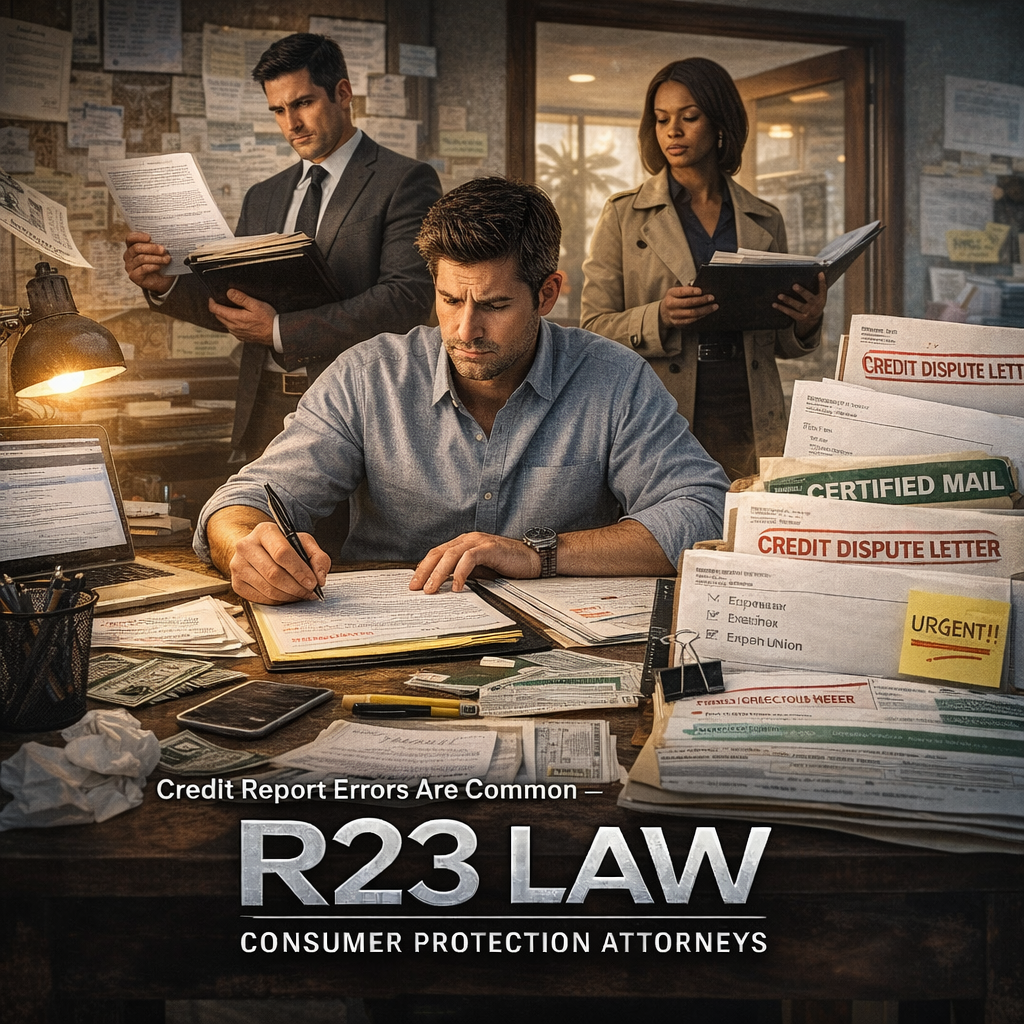
Credit report errors can trigger denials, higher interest rates, and identity theft headaches
Your credit report is supposed to be a financial résumé. But when the information is wrong, it can start making decisions for lenders, landlords, employers, and insurers that you never agreed to. The frustrating part is how “small” an error can look on paper while it causes very real consequences in the real world.
If you are seeing inaccurate accounts, late payments you do not recognize, or signs of identity theft, the Fair Credit Reporting Act can give you leverage—especially when you document the problem the right way and hold the right company to the right deadline.
This guide breaks down what the FCRA protects, what a strong dispute looks like, and when it is time to talk with R23 Law’s California Consumer Protection Attorneys about next steps.
The FCRA In Plain English — What It Protects And Why It Matters
The FCRA is designed to prevent credit reporting from turning into a permanent rumor mill.
In practical terms, it gives you three core rights:
The right to accurate reporting — Credit bureaus and data furnishers must use reasonable procedures to keep information current and correct.
The right to access your reports — You can obtain free copies from the major bureaus once every 12 months through AnnualCreditReport.com, so you can actually see what is being reported about you.
The right to dispute inaccuracies — When you dispute information, the credit bureau must investigate within 30 days (45 days for complex cases). If the information is inaccurate, it must be corrected or deleted and you must be notified within five business days after the investigation concludes.
Those are not “nice to have” rights. They are the framework you use to force a fix when your credit file is working against you.
Why Credit Report Errors Cost More Than Pride
Credit reporting errors do not just hurt your score in the abstract. They can show up at the exact worst moment—when you apply for a mortgage, a car loan, an apartment, or even a job that includes a background check.
A single incorrect late payment can push you into higher interest rates. An account that does not belong to you can lead to outright denial. The stakes are high because credit reports are used as decision-making tools across industries.
The Most Common Credit Report Mistakes — The Repeat Offenders
Some errors are more destructive than others, and two categories show up again and again.
Identity theft and mixed files — the fastest way to wreck a report
Identity theft accounts and mixed credit files can hit hard and fast. When a credit bureau merges your file with another person due to similar identifying information, or when a fraudster opens accounts in your name, your score can drop dramatically in a short time.
One important timing rule stands out—after you notify the bureau of identity theft, the credit bureau must block the fraudulent information within four business days. When that does not happen, the failure can become actionable.
Late payments and duplicate accounts — often negligence, still expensive
Late payments marked incorrectly and duplicate accounts can be just as damaging, even when there is no fraud. Creditors may misreport payment dates, mislabel a settled account, or list the same account twice under slightly different identifiers. A single late payment can reduce your score substantially.
If you spot one of these issues, the right move is not to wait and hope—it is to dispute immediately, with specifics and documentation.
Disputes That Get Results — What To Include So You Are Taken Seriously
A dispute is not a complaint. It is a documented demand for correction.
A strong written dispute letter typically includes:
Your full name and contact information
The confirmation number from your report if available
Each disputed item with account numbers
A clear explanation of what is wrong
The remedy you want—correction or deletion
A copy of the report with the disputed items clearly identified
Copies of supporting documents
Then, send it via certified mail with return receipt, so you can prove delivery and track the response deadline.
You also want to dispute with the furnisher—the bank, creditor, landlord, or collector that supplied the information—because the furnisher must investigate too and update or remove wrong data when it cannot be verified.
The Deadline Trap — What The Timeline Is Really Telling You
The dispute timeline is where a lot of consumers lose leverage, simply because they do not track it.
Key timeframes to keep in mind:
The bureau investigation timeline is generally 30 days, with 45 days for more complex cases.
If an item is inaccurate, it must be corrected or deleted, and you must be notified within five business days after the investigation concludes.
For identity theft, fraudulent information should be blocked within four business days after you notify the bureau.
If your dispute disappears into a black hole, or the bureau verifies information you can clearly prove is wrong, that is when you start thinking beyond the standard dispute cycle.
When Verified Still Means Wrong — The Consumer Statement Option
Sometimes a bureau or furnisher insists something is accurate. If you still disagree after reinvestigation, you can request a brief consumer dispute statement be added to your file. That statement appears on future reports shown to lenders and can help explain the context while you continue pushing for correction.
It is not a replacement for a real fix, but it can reduce harm while the dispute continues.
When The Dispute Process Fails — Legal Action May Be The Next Tool
If you have disputed with multiple bureaus and the error persists, the document is blunt—this is the point where legal help becomes necessary because agencies and furnishers sometimes ignore disputes or conduct inadequate investigations.
The FCRA can also allow you to sue credit bureaus and furnishers for violations, including actual damages and statutory damages up to $1,000 per violation.
A practical trigger noted in the document—if you sent a certified dispute letter and receive no meaningful response within 45 days, or the bureau responds but refuses to correct clear inaccuracies, you may have a claim worth pursuing.
That is where R23 Law’s California Consumer Protection Attorneys can evaluate whether what happened is a paperwork problem—or a compliance violation with consequences.
Why It Often Pays To Act Faster
Waiting is expensive.
Every day an inaccurate item remains on your report can mean lower scores, higher interest rates on loans you do qualify for, or outright denials. If you have certified mail receipts and copies of correspondence, you have the evidence an attorney needs to build a stronger case.
How R23 Law’s California Consumer Protection Attorneys Fit In
When your credit report is wrong, your goal is not to send more letters. Your goal is to force a correction that sticks—and hold the right party accountable when the system refuses to do what the law requires.
R23 Law’s California Consumer Protection Attorneys can help you:
Identify whether the issue is a bureau problem, a furnisher problem, or both
Tighten the dispute record so it is specific, documented, and deadline-driven
Evaluate whether the failure to correct suggests an actionable FCRA violation
Pursue correction and compensation when the facts support it
FAQ — Quick Answers For Common Credit Reporting Questions
How often should I check my credit reports
At minimum, pull your reports from each major bureau once every 12 months through AnnualCreditReport.com and review for identity errors, incorrect account statuses, and wrong balances.
What should I do first when I find an error
Submit a written dispute with documentation and send it certified mail with return receipt. Also dispute with the furnisher responsible for the reporting.
When should I talk to an attorney
If disputes have gone nowhere, if you have proof the information is wrong but it is still being verified, or if you receive no meaningful response within the required timeframe, it is time to talk with counsel about your options.
Contact R23 Law Today
Toll-Free — 310-598-1588
Disclaimer — This article is for informational purposes only and does not constitute legal advice. Reading it does not create an attorney-client relationship. Outcomes depend on the facts of each case.
