
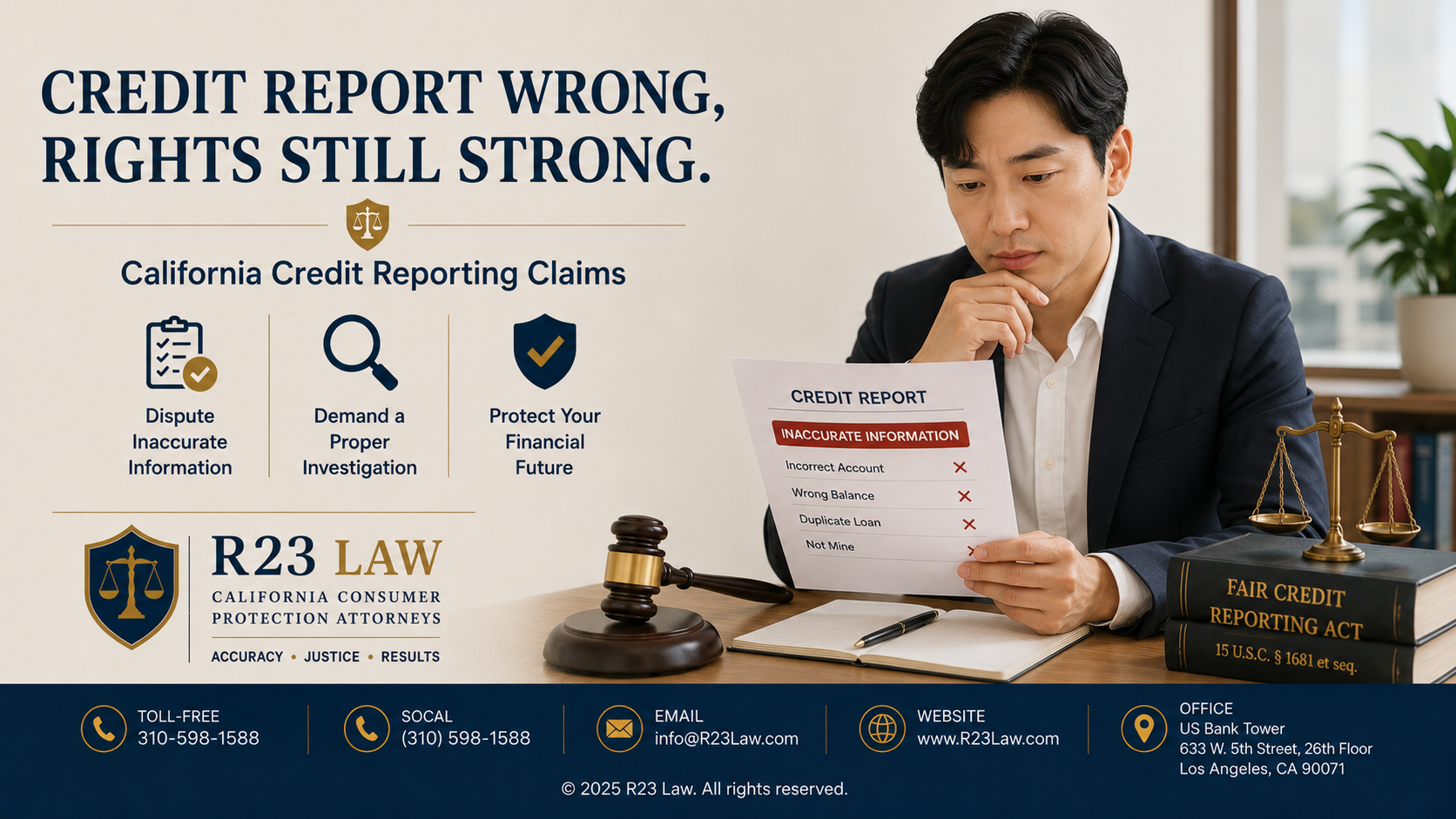
A credit report can influence some of the most important financial decisions in a consumer's life
Lenders, landlords, and employers may rely on consumer reports when deciding whether to approve loans, housing, or employment opportunities. When the information in a credit report is inaccurate, the consequences can reach far beyond a lower credit score.
The attached source explains that consumers have rights when credit reporting agencies publish incorrect information and fail to properly address a dispute. It specifically identifies the Fair Credit Reporting Act, commonly known as the FCRA, as a federal law designed to promote accurate credit reporting and provide consumers with a process for disputing inaccurate information.
For California consumers, unresolved credit reporting errors may create serious financial harm. R23 Law's California Consumer Protection Attorneys handle California cases involving inaccurate credit reports, failed disputes, identity theft-related reporting, and other consumer reporting problems.
CREDIT REPORT ERRORS CAN AFFECT MAJOR FINANCIAL OPPORTUNITIES
A credit report contains information about a consumer's financial history and activity.
According to the source, inaccurate information can affect loan approval, housing opportunities, and even employment.
That means a reporting error is not always a minor inconvenience.
An incorrect account balance, falsely reported delinquency, or account that does not belong to the consumer can affect decisions made by companies reviewing the report.
When inaccurate information continues to be reported, the financial consequences may grow.
COMMON CREDIT REPORT ERRORS
The attached source identifies several types of inaccurate information that may appear on a consumer report, including —
Duplicate loans
Incorrect names or addresses
Incorrect Social Security information
Wrong account balances
Accounts falsely reported as delinquent
Accounts shown as open when they should be closed
Each type of error can create a misleading picture of a consumer's financial history.
For California consumers, these inaccuracies may become particularly important when they affect an application for credit, housing, or employment.
THE FCRA PROVIDES A CREDIT REPORT DISPUTE PROCESS
The Fair Credit Reporting Act gives consumers the right to dispute inaccurate information appearing in their consumer reports.
The source explains that credit reporting agencies must investigate disputed information and address the results of that investigation.
That dispute process is often an important first step when inaccurate information appears on a credit report.
Consumers should carefully identify the specific information they believe is wrong and provide documentation supporting the dispute.
DOCUMENT THE ERROR BEFORE DISPUTING IT
The attached source recommends obtaining a hard copy of the credit report, identifying the inaccurate information, and submitting supporting evidence showing why the information is incorrect.
Consumers should consider preserving records such as —
Copies of the credit report showing the error
Documents supporting the correct information
Copies of dispute letters
Delivery confirmations
Responses from credit reporting agencies
Correspondence from creditors or lenders
Loan, housing, or employment denial notices
Keeping these records can create an important timeline showing what was disputed and how the reporting agency responded.
CREDIT REPORTING AGENCIES GENERALLY HAVE 30 DAYS TO INVESTIGATE
According to the attached source, after receiving a dispute, the credit reporting agency generally has 30 days to investigate the disputed information and either correct the report or explain why it believes the information is accurate.
That investigation can be critical.
If inaccurate information is corrected, the problem may be resolved. But if the agency dismisses the dispute, ignores important evidence, or continues publishing information the consumer believes is inaccurate, the matter may require closer legal review.
REPEATING THE SAME DISPUTE MAY NOT SOLVE THE PROBLEM
A consumer may be tempted to send the same dispute repeatedly when inaccurate information remains.
The source cautions that submitting duplicate disputes without additional information may result in a dispute being treated as frivolous.
For that reason, consumers facing an unresolved dispute should preserve the original documents and responses rather than simply repeating the same submission over and over.
The history of the dispute can become important if the reporting problem later results in a consumer protection claim.
UNCORRECTED CREDIT REPORT ERRORS CAN CAUSE REAL DAMAGES
The attached source emphasizes that inaccurate reporting may cause significant harm when incorrect, outdated, or fraudulent information continues to be provided to lenders and other decision-makers.
Potential consequences identified in the source include denial of —
Loans
Housing
Employment opportunities
A consumer may therefore face more than an inaccurate number on a report.
Credit reporting mistakes can interfere with important financial and personal opportunities, and those consequences may become relevant when evaluating whether damages resulted from the reporting problem.
WHEN A CREDIT REPORTING DISPUTE MAY BECOME A LEGAL CLAIM
Not every incorrect entry automatically results in a lawsuit.
The source focuses on situations where the consumer has disputed inaccurate information and the reporting agency fails to properly remedy the problem.
If inaccurate information continues to be reported after a dispute, particularly when it affects loans, housing, employment, or other financial opportunities, the circumstances may warrant legal review.
The dispute history, supporting evidence, agency responses, and resulting harm can all become relevant.
R23 LAW'S EXPERT LEGAL SERVICES FOR CREDIT REPORTING VICTIMS THROUGHOUT CALIFORNIA
R23 Law's California Consumer Protection Attorneys handle California cases involving inaccurate consumer reports and related financial harm.
A credit reporting matter may involve incorrect account information, fraudulent accounts, inaccurate balances, false delinquency reporting, or information that remains after a consumer dispute.
Depending on the circumstances, the firm's attorneys can evaluate —
The inaccurate information appearing on the report
The consumer's dispute
Supporting documentation
Responses from the credit reporting agency
Continued reporting after the dispute
Financial consequences resulting from the error
Learn more about the firm's attorneys through Our Team and about R23 Law's consumer protection practice through About Us.
WHEN CREDIT REPORTING ERRORS FOLLOW YOU THROUGH CALIFORNIA
An inaccurate credit report can affect a California consumer long after the original mistake appears.
A lender may deny financing. A landlord may reject a housing application. An employer may make a decision based on consumer information that the applicant believes is wrong.
When a credit reporting agency continues publishing disputed information, understanding the consumer's rights becomes increasingly important.
R23 Law's California Consumer Protection Attorneys represent California consumers facing credit reporting errors and related financial injuries.
Consumers dealing with unresolved credit reporting problems can connect directly with the firm through Contact R23 Law.
PROTECT YOUR CREDIT RECORD — PRESERVE YOUR DISPUTE HISTORY
Consumers who discover inaccurate information should address the problem promptly and keep copies of everything connected to the dispute.
The credit report, dispute letter, supporting documents, responses, and evidence of any resulting denial can become important records.
When an agency fails to properly address inaccurate reporting, those documents may provide the clearest history of what occurred.
R23 Law's California Consumer Protection Attorneyshandle California consumer cases involving inaccurate credit reporting and the financial consequences that may follow.
Contact R23 Law Today
If inaccurate information remains on your credit report after a dispute and has affected your finances, housing, employment, or other opportunities, R23 Law's California Consumer Protection Attorneys can evaluate the circumstances surrounding a California consumer protection matter.
Toll-Free — 310-598-1588 SoCal — (310) 598-1588 Email — info@R23Law.com Website —www.R23Law.comOffice — US Bank Tower, 633 W. 5th Street, 26th Floor, Los Angeles, CA
© 2025 R23 Law. All rights reserved. Trusted consumer credit lawyers in Los Angeles.
