
CREDIT REPORT OFF TRACK — Fixing Errors Before They Cost You
Credit reports influence major financial decisions
A mistake can affect whether a California consumer qualifies for a mortgage, secures housing, receives favorable interest rates, or passes certain screening processes.
The attached source explains that credit report errors may result from data-entry mistakes, outdated account information, communication problems between furnishers and credit reporting agencies, or identity theft. It also notes that errors may remain on a report until they are properly addressed.
R23 Law's California Consumer Protection Attorneys handle California consumer matters involving inaccurate credit reporting, identity theft-related accounts, unresolved disputes, and related financial harm.
CREDIT REPORT ERRORS CAN START WITH SYSTEMIC OR HUMAN MISTAKES
Credit reports are built from large amounts of consumer data.
According to the attached source, mistakes can occur at different points in the reporting process. Common causes include —
Human data-entry errors
Outdated account information
Miscommunication between credit furnishers and reporting agencies
Identity theft
Once inaccurate information appears, it may continue affecting a consumer until the problem is corrected.
CREDIT REPORT ERRORS ARE NOT RARE
The attached source emphasizes that credit reporting errors are widespread and cites a study in which 44 percent of participants reported finding at least one error on their credit reports.
The source also notes that many consumers do not discover those errors until after they experience harm, such as a denial involving credit, a loan, or housing.
That is why periodic review of credit reports can be important even when a consumer is not currently applying for financing.
PERSONAL INFORMATION ERRORS CAN CREATE CREDIT FILE PROBLEMS
The source identifies personal information errors as one of the two major categories of credit report mistakes.
Examples include —
Incorrect or outdated addresses
Misspelled names
Merged name variations
Wrong dates of birth
Incorrect Social Security numbers
Mixed credit files containing another person's information
A mixed credit file can be particularly serious because another person's accounts or financial history may become associated with the wrong consumer.
ACCOUNT ERRORS CAN DIRECTLY AFFECT FINANCIAL DECISIONS
The second major category identified in the source involves account-related information.
Examples include —
Closed accounts reported as open
On-time payments reported as late
Current accounts marked delinquent
Accounts created through identity theft
Duplicate debts
Previously disputed errors that remain on the report
These mistakes can make a consumer appear more financially risky than their actual history supports.
FALSE LATE PAYMENTS CAN DAMAGE AN OTHERWISE STRONG CREDIT HISTORY
A payment incorrectly reported as late can create a misleading picture of a consumer's financial habits.
For California consumers who have consistently paid on time, inaccurate delinquency reporting may affect future credit decisions even though the underlying account was properly maintained.
The source specifically identifies incorrect late-payment reporting and delinquent account status as common errors that consumers should watch for.
IDENTITY THEFT CAN APPEAR AS A CREDIT REPORT ERROR
Some credit report mistakes are not simple clerical problems.
The attached source identifies identity theft as one cause of inaccurate reporting and lists fraudulent accounts among common account-related errors.
A consumer may discover a loan, credit card, or other account that they never opened.
When unfamiliar accounts appear, California consumers should consider whether the reporting problem may be connected to unauthorized use of their personal information.
CREDIT REPORT ERRORS CAN AFFECT LOANS AND MORTGAGES
The attached source identifies loan and mortgage denials as potential consequences of inaccurate credit reporting.
A lender may rely on incorrect account balances, false delinquency information, duplicate debts, or another person's information when evaluating the consumer.
That can cause a financially qualified applicant to receive a denial based on inaccurate data.
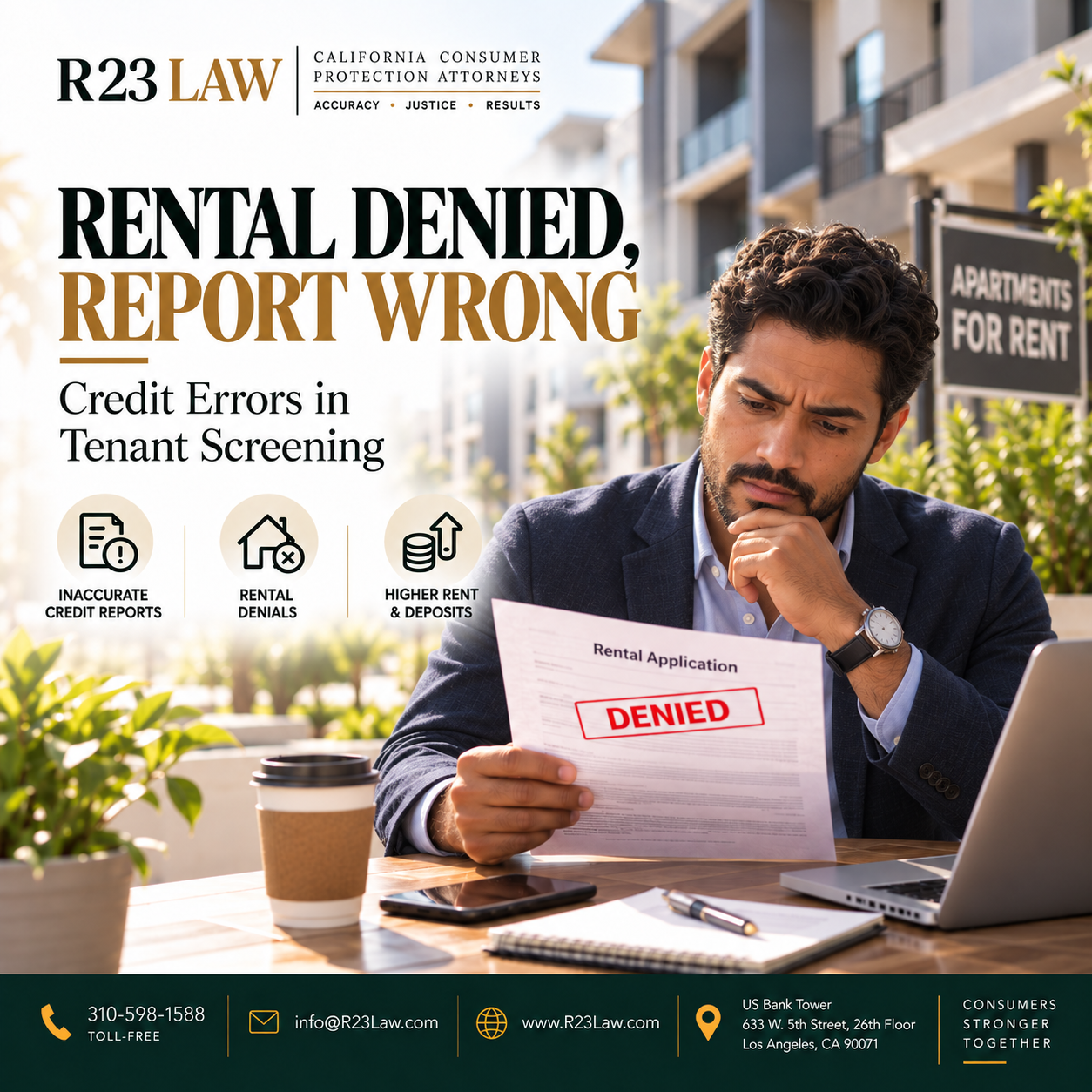
HOUSING APPLICATIONS CAN ALSO BE AFFECTED
Credit information may also influence rental decisions.
The source states that credit reporting errors can contribute to housing application rejections.
For California consumers, inaccurate information can therefore interfere with more than borrowing.
A reporting error may affect where a person is able to live.
HIGHER INTEREST RATES CAN CREATE LONG-TERM COSTS
A consumer may still receive approval for credit while paying more because of inaccurate information.
The attached source identifies higher interest rates as another potential consequence of credit report errors.
That means the financial harm may continue over the life of a loan or other credit obligation.
An error does not need to cause a complete denial to create measurable financial consequences.
EMPLOYMENT, INSURANCE, AND UTILITIES MAY ALSO BE AFFECTED
The source also identifies complications involving employer background checks, insurance qualification, and utility services as potential consequences of credit reporting errors.
For California consumers, inaccurate credit information can therefore touch multiple areas of everyday life.
That makes identifying and correcting errors especially important.
THE FCRA GIVES CONSUMERS THE RIGHT TO DISPUTE CREDIT REPORT ERRORS
The attached source identifies the Fair Credit Reporting Act, commonly known as the FCRA, as providing consumers with the right to dispute inaccurate information appearing on their credit reports.
The source emphasizes that the dispute should be submitted to the credit reporting agency, not only to the company that furnished the information.
That distinction can be important when trying to create a proper dispute record.
A STRONG DISPUTE SHOULD IDENTIFY THE ERROR CLEARLY
According to the source, a credit report dispute should —
Be submitted in writing
Clearly identify the inaccurate information
Explain why the information is wrong
Include copies of supporting documents
Request correction or removal of the inaccurate information
The dispute should be specific enough that the reporting agency can understand exactly what the consumer is challenging.
SEND COPIES, NOT ORIGINAL DOCUMENTS
The attached source recommends sending copies of supporting documentation rather than original records.
Consumers should preserve the original documents for their own files.
Useful supporting records may include —
Account statements
Payment records
Identity theft documentation
Correspondence with creditors
Documents showing correct personal information
Prior dispute records
A complete file can become important if the reporting problem remains unresolved.
CERTIFIED MAIL CAN STRENGTHEN THE PAPER TRAIL
The source also recommends sending a dispute through certified mail.
That can provide a record showing when the credit reporting agency received the dispute.
Consumers should also track responses and preserve all correspondence associated with the dispute process.
FOLLOW UP WHEN THE REPORTING AGENCY DOES NOT RESPOND
The attached source advises consumers to monitor the dispute timeline and follow up if the reporting agency does not respond.
An unresolved dispute should not simply disappear into a file drawer.
Consumers should keep records showing what was submitted, when it was delivered, and what response was received.
REGULAR CREDIT MONITORING CAN LIMIT LONG-TERM DAMAGE
Not every credit reporting error can be prevented.
The source notes that some mistakes originate with reporting agencies or data processes outside the consumer's control.
Still, consumers can reduce the risk of long-term harm by —
Reviewing credit reports from all reporting agencies
Monitoring accounts for unfamiliar activity
Responding promptly to notices
Keeping financial records organized
Addressing identity theft concerns quickly
Early detection can make a reporting problem easier to identify and document.
R23 LAW'S EXPERT LEGAL SERVICES FOR CREDIT REPORTING VICTIMS THROUGHOUT CALIFORNIA
R23 Law's California Consumer Protection Attorneys handle California consumer matters involving inaccurate credit reports and unresolved disputes.
A credit reporting matter may involve —
Mixed credit files
False late payments
Incorrect delinquency reporting
Identity theft-related accounts
Duplicate debts
Errors that remain after a dispute
Loan or housing denials connected to inaccurate reporting
Depending on the circumstances, R23 Law's attorneys can evaluate the credit reports, dispute records, supporting documentation, responses from reporting agencies, and resulting financial harm.
WRONG INFORMATION SHOULD NOT DEFINE YOUR FINANCIAL PROFILE
Credit reporting mistakes can arise from human error, data problems, miscommunication, or identity theft.
The attached source makes clear that those errors can affect loans, housing, interest rates, employment screening, insurance, and utility qualification.
California consumers should review their reports carefully, dispute inaccurate information in writing, preserve supporting documents, and maintain a clear paper trail.
R23 Law's California Consumer Protection Attorneys represent California consumers dealing with inaccurate credit reporting and related financial harm.
Contact R23 Law Today
If inaccurate credit reporting has affected your loan approval, housing, interest rates, employment screening, or other financial opportunities in California, R23 Law's California Consumer Protection Attorneys can evaluate the circumstances surrounding the matter.
Toll-Free — 310-598-1588
SoCal — (310) 598-1588
Email — info@R23Law.com
Website — www.R23Law.com
Office — US Bank Tower, 633 W. 5th Street, 26th Floor, Los Angeles, CA
© 2025 R23 Law. All rights reserved. Trusted consumer credit lawyers in Los Angeles.
