
CREDIT RIGHTS, REPORT WRONGS – FCRA Violations, Failed Investigations, And California Credit Reporting Claims
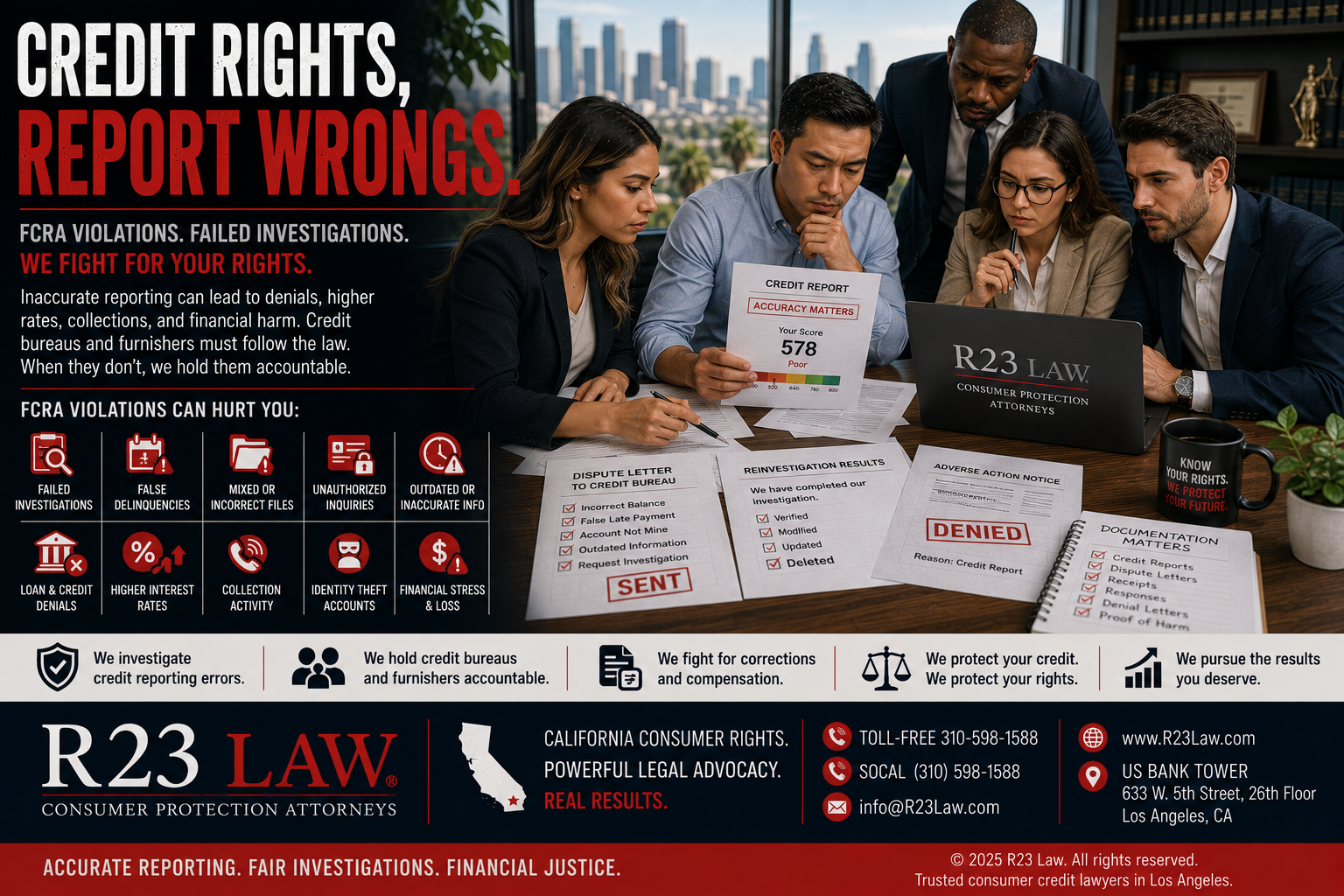
FCRA violations can damage credit, cause denials, raise interest rates, and create financial injury
R23 Law's California Consumer Protection Attorneys represent consumers facing credit report errors and failed investigations. Credit reports influence more than loan approvals. They can affect interest rates, housing applications, employment-related screenings, credit card access, insurance pricing, and financial stability.
When credit reporting agencies, furnishers, lenders, or other companies mishandle consumer information, the consequences can be serious. A false delinquency, mixed file, outdated account, unauthorized inquiry, or ignored dispute can create real financial injury.
R23 Law's California Consumer Protection Attorneys represent consumers throughout California in Fair Credit Reporting Act claims, credit report disputes, identity theft, inaccurate account reporting, and consumer financial injury matters.
The FCRA — Accuracy, Privacy, And Fair Credit Reporting
The Fair Credit Reporting Act is a federal law that governs how consumer information is collected, reported, accessed, and used. The attached source explains that the FCRA is designed to protect fairness, accuracy, and privacy in consumer reporting.
The law applies to credit reporting agencies, furnishers, lenders, background screening companies, and other entities that handle consumer report information.
The FCRA gives consumers important rights, including the right to:
Dispute inaccurate or incomplete credit report information
Request investigations of disputed items
Receive corrected reporting when information is wrong, outdated, or fraudulent
Limit access to credit reports to those with a permissible purpose
Challenge consumer report errors that cause financial harm
When companies fail to follow these rules, consumers may have legal claims.
Common FCRA Violations That Damage Consumers
FCRA violations can take many forms. Some errors are obvious. Others are buried inside account histories, payment dates, balances, or duplicate reporting.
Common violations include:
False delinquency reporting
Incorrect account balances
Outdated negative information
Mixed credit files
Unauthorized credit report access
Failure to investigate disputes
Duplicate collection listings
Failure to report a bankruptcy discharge
Identity theft accounts
Improper hard inquiries
Incorrect account status
These errors can lower credit scores, trigger adverse action notices, and create unnecessary barriers to financial opportunities.
Credit Reporting Errors Can Create Real Financial Injury
A credit reporting error is not just a clerical issue. It can directly affect a consumer’s life.
FCRA violations may lead to:
Loan denials
Higher interest rates
Apartment application denials
Credit card closures
Insurance pricing issues
Employment-related screening problems
Debt collection activity
Stress, embarrassment, and time spent fighting the error
R23 Law's California Consumer Protection Attorneys evaluate the financial and personal impact of credit reporting violations, including how inaccurate information affected approvals, pricing, account access, and consumer reputation.
The Dispute Process — Documentation Matters
When a consumer identifies inaccurate information, a dispute should be filed with the credit reporting agencies. A written dispute is often the strongest approach because it creates a record of what was challenged, when it was sent, and what evidence was provided.
The attached source recommends documenting the violation, preserving screenshots, saving letters from reporting agencies or furnishers, and sending dispute letters by certified mail to confirm receipt.
A strong dispute may include:
A copy of the credit report with the error identified
A clear written explanation of the inaccurate information
Account statements
Payment confirmations
Bank records
Identity theft reports, when applicable
Police reports, when applicable
Bankruptcy discharge documents, when applicable
Certified mail receipts
Credit denial or adverse action letters
The dispute should explain what is wrong, why it is wrong, and what correction is needed.
Credit Bureaus Must Investigate Disputed Information
After a dispute is filed, the credit reporting agency generally must investigate and issue a decision. The attached source notes that credit reporting agencies are legally obligated to investigate disputes and issue a decision within 30 days.
If the disputed information is incorrect, outdated, incomplete, or fraudulent, it should be corrected or removed.
When a credit bureau verifies inaccurate information without a reasonable investigation, legal claims may arise. The same may be true when a furnisher continues reporting false information after receiving notice of a dispute.
Permissible Purpose — Credit Reports Are Not Open Records
The FCRA also limits who can access a consumer’s credit report. Companies generally need a legally valid reason, often called permissible purpose.
Unauthorized access may occur when a company pulls a credit report without a valid credit application, account review, employment-related authorization, collection basis, court order, or other legally recognized purpose.
Improper access can invade privacy and create hard inquiries that affect a consumer’s credit profile.
R23 Law's Expert Legal Services For Financial Injury Victims Throughout California
R23 Law represents financial injury victims throughout California whose credit reports have been damaged by inaccurate information, failed investigations, unauthorized access, identity theft, and unlawful reporting.
R23 Law's California Consumer Protection Attorneys may review credit reports, dispute letters, certified mail receipts, reinvestigation results, furnisher records, denial notices, credit monitoring alerts, and financial loss evidence.
The firm’s consumer protection work includes matters involving:
FCRA violations
Credit report errors
Failed investigations
Mixed credit files
Identity theft accounts
Unauthorized inquiries
False delinquency reporting
Duplicate collections
Bankruptcy discharge reporting errors
Adverse action after inaccurate reporting
R23 Law works to pursue correction, accountability, and compensation where the law allows.
Strong Records Strengthen FCRA Claims
Consumers should preserve every document connected to the violation and its consequences.
Important records may include:
Credit reports from Equifax, Experian, and TransUnion
Dispute letters
Certified mail receipts
Responses from credit bureaus
Responses from furnishers
Adverse action notices
Loan denial letters
Higher interest rate notices
Collection letters
Account statements
Payment records
Screenshots of credit monitoring alerts
Identity theft reports, when fraud is involved
A clear paper trail can show what was reported, when the consumer disputed it, and whether companies failed to conduct a reasonable investigation.
R23 Law's California Consumer Protection Attorneys Enforce Credit Reporting Rights
Consumers deserve accurate credit reports and meaningful investigations. Credit bureaus and furnishers cannot treat disputes as routine paperwork when inaccurate reporting damages a consumer’s financial future.
R23 Law brings focused consumer protection experience to FCRA, identity theft, credit reporting, debt collection, and financial injury claims throughout California.
Contact R23 Law Today
If an FCRA violation, credit report error, failed dispute investigation, or unauthorized credit inquiry damaged your financial future, R23 Law's California Consumer Protection Attorneys can review your rights and discuss potential legal claims.
Toll-Free — 310-598-1588 SoCal — (310) 598-1588 Email — info@R23Law.com Website — www.R23Law.com Office — US Bank Tower, 633 W. 5th Street, 26th Floor, Los Angeles, CA
© 2025 R23 Law. All rights reserved. Trusted consumer credit lawyers in Los Angeles.
