
DENIED ON AUTOPILOT — When Banks Refuse to Refund Unauthorized Debits
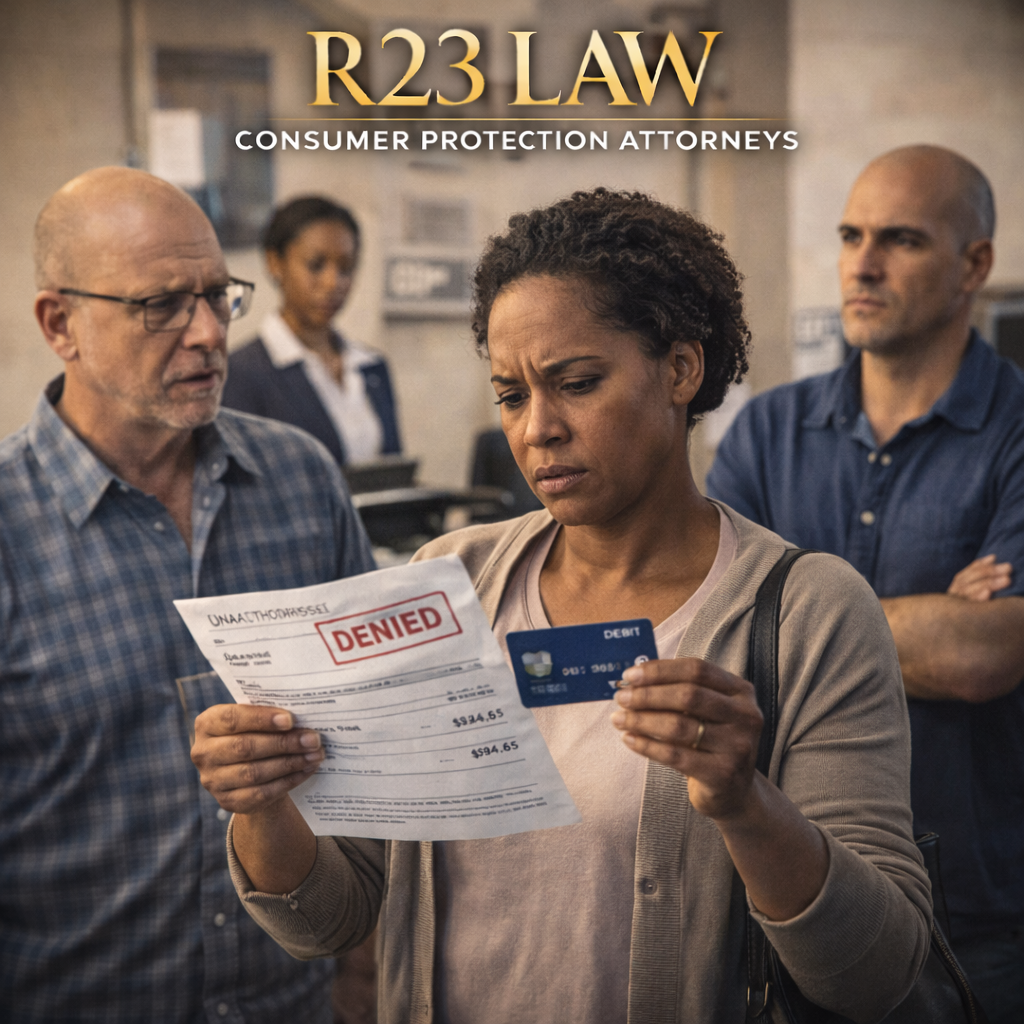
Unauthorized debit card transactions can drain rent money, grocery funds, or an entire paycheck overnight
Consumers often report the fraud immediately, only to receive a familiar response from their bank: “We’ve investigated and found no error.”
That statement sounds decisive. It isn’t.
Federal law places strict obligations on banks when unauthorized debits occur, regardless of internal policy language. R23 Law’s California Consumer Protection Attorneys regularly confront financial institutions that deny claims without following the law.
Federal Law Does Not Allow Shortcut Denials
Unauthorized debit card transactions are governed by the Electronic Fund Transfer Act (EFTA) and Regulation E, which impose mandatory duties on banks.
When fraud is reported, banks are required to:
Conduct a timely investigation, generally within 10 business days
Provide provisional credit if the investigation is not completed on time
Issue a written explanation and supporting documentation if a claim is denied
Limit consumer liability when fraud is reported within 60 days of the statement date
A one-line denial stating that “no error was found” does not satisfy these requirements.
Why Banks Keep Saying No
Every denial benefits the bank financially. Delays and procedural hurdles allow institutions to retain consumer funds while shifting the burden back onto the account holder.
Many banks rely on the assumption that consumers do not understand Regulation E timelines or documentation rules. When those assumptions are challenged, denial strategies often collapse.
Why Timing and Documentation Matter
Unauthorized debit disputes are governed by firm statutory deadlines. Key steps include:
Submitting disputes in writing and identifying them as Regulation E errors
Tracking the bank’s investigation timeline
Requesting copies of investigative materials relied upon for denial
Reporting all fraudulent activity within 60 days of the statement date
Failure to follow these steps can weaken a claim. Failure by the bank to meet its statutory duties can create legal liability. Regulation E does not reward delay, confusion, or boilerplate denials—it requires accuracy, documentation, and timely action.
When Denials Cross the Line Into Violations
Banks are not permitted to close investigations simply because doing so is cheaper or faster. When institutions deny unauthorized debit claims without:
Reviewing transaction-level data
Producing investigation records
Issuing provisional credit when required
Meeting statutory timelines
they may be violating federal consumer protection law.
Under the EFTA, banks that fail to comply can be required to refund stolen funds, correct account records, and pay damages and attorneys’ fees.
R23 Law’s California Consumer Protection Attorneys focus on enforcing these obligations when banks substitute automation and templates for real investigations.
Accountability Is Built Into the Law
The EFTA includes fee-shifting provisions that place financial responsibility on the institution—not the consumer—when violations occur. This structure exists for one reason: banks control the data, the systems, and the investigation process.
When they misuse that control, the law provides consequences.
Contact R23 Law Today
If a bank denied reimbursement for unauthorized debit card transactions or failed to comply with Regulation E, experienced consumer protection counsel matters.
SoCal: (310) 598-1588
Email: info@R23Law.com
