
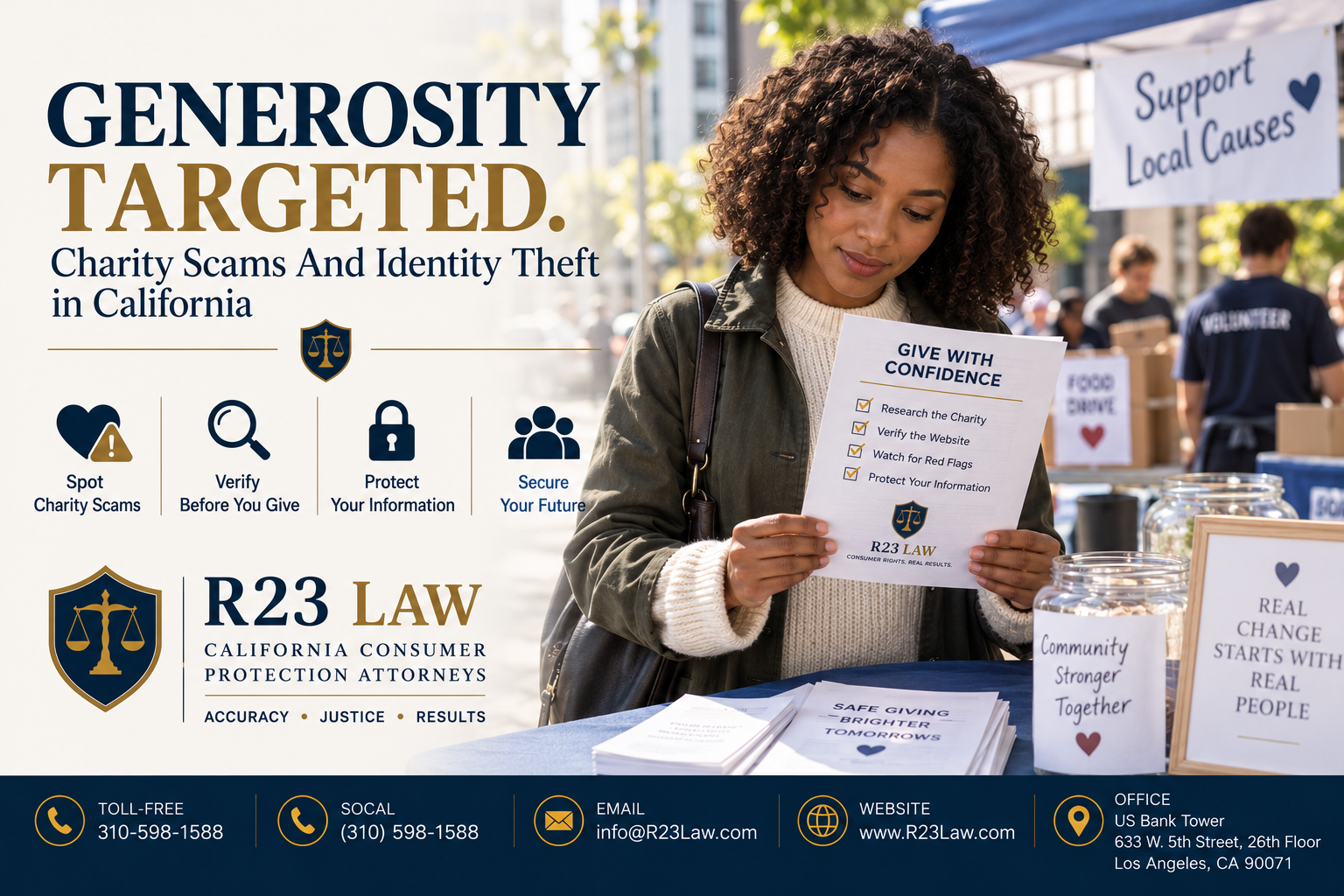
Giving to a meaningful cause should feel rewarding
Unfortunately, scammers may take advantage of that generosity by creating fake charities designed to collect money and personal information.
The attached source explains that charity scams can become especially common around the holidays or after natural disasters, when consumers may be more motivated to donate quickly. Scammers may use convincing caller ID information, fake websites, or names that closely resemble legitimate organizations.
For California consumers, a fraudulent donation can lead to more than the loss of money. Personal information submitted during the donation process may also be used for identity theft.
R23 Law's California Consumer Protection Attorneys handle California consumer matters involving identity theft, fraudulent accounts, and related financial harm.
FAKE CHARITIES CAN LOOK LEGITIMATE
One reason charity scams can be effective is that they may appear credible at first glance.
According to the attached source, scammers may manipulate caller ID so that an incoming call appears to come from a charity. They may also create duplicate websites designed to look like those of legitimate organizations.
A familiar logo, professional-looking website, or recognizable name does not necessarily mean the organization is authentic.
Consumers should verify a charity independently before providing personal or financial information.
SIMILAR NAMES CAN CREATE CONFUSION
Scammers may also create fake organizations with names that closely resemble legitimate charities.
The source gives an example of a fraudulent organization using a name similar enough to a well-known charity that a donor might not immediately notice the difference.
That tactic can make a fake charity appear credible while relying on the consumer to assume the organization is legitimate.
Before donating, California consumers should carefully review the full name of the organization and verify that they are dealing with the intended charity.
A DONATION CAN EXPOSE MORE THAN YOUR MONEY
Charity scams may target both financial information and identifying information.
The attached source explains that consumers may provide details such as —
Full name
Address
Email address
Phone number
Credit card information
Banking information
When that information is submitted to a fraudulent organization, a scammer may be able to use it for identity theft.
The financial loss from the donation itself may therefore be only the beginning of the problem.
RESEARCH THE ORGANIZATION BEFORE DONATING
The source recommends researching an organization before making a contribution.
Consumers can ask for the charity's full name, email address, and website and then independently verify that information.
That extra step can be especially important when the charity is unfamiliar or when the solicitation arrives unexpectedly.
A legitimate-looking donation page should not replace independent verification.
EXAMINE THE WEBSITE FOR RED FLAGS
The attached source also recommends reviewing the charity's website carefully before submitting information.
Potential warning signs identified in the article include —
Inconsistent information
Addresses that do not appear legitimate
Spelling problems or unusual wording
A fraudulent website may be designed to resemble a legitimate organization's site while still containing details that do not add up.
Consumers should pay attention to those inconsistencies before entering personal or financial information.
PRESSURE TO DONATE IMMEDIATELY CAN BE A WARNING SIGN
A legitimate charitable contribution should not require a consumer to make an instant decision.
The source identifies repeated pressure to donate immediately during a phone call as a potential indication that the organization may not be legitimate.
Scammers may rely on urgency to prevent consumers from taking time to verify the organization.
When a caller insists that a donation must be made right away, slowing down and researching the charity can be an important precaution.
CHARITY SCAMS CAN BECOME IDENTITY THEFT CASES
A fake charity may disappear once it has collected a donation.
The personal information provided to the scammer does not necessarily disappear with it.
A California consumer may later discover suspicious financial activity or other signs that their information has been misused.
That is why a charity scam should be treated as a potential identity theft risk when sensitive information was provided.
R23 Law's California Consumer Protection Attorneys handle California matters involving identity theft and related financial harm.
R23 LAW'S EXPERT LEGAL SERVICES FOR IDENTITY THEFT VICTIMS THROUGHOUT CALIFORNIA
R23 Law's California Consumer Protection Attorneys represent California consumers dealing with identity theft and the financial consequences that may follow.
A fake charity scam may expose personal and financial information that is later used in fraudulent activity.
Depending on the circumstances, R23 Law's attorneys can evaluate the resulting consumer harm and the records connected to the matter.
Learn more about the firm's attorneys through Our Team or about R23 Law through About Us.
GIVE SMART — PROTECT YOUR INFORMATION
Consumers do not need to stop giving to worthwhile causes.
They should, however, take the time to confirm that the organization receiving their money and information is legitimate.
Researching the charity, verifying its name and website, watching for inconsistencies, and resisting pressure to donate immediately can reduce the risk of falling victim to a scam.
When a fraudulent charity leads to identity theft affecting a California consumer, R23 Law's California Consumer Protection Attorneyshandle California consumer matters involving the resulting financial harm.
Consumers dealing with suspected identity theft can connect directly with the firm through Contact R23 Law.
Contact R23 Law Today
If a charity scam has exposed your personal or financial information and resulted in identity theft or related financial problems in California, R23 Law's California Consumer Protection Attorneys can evaluate the circumstances surrounding the matter.
Toll-Free — 310-598-1588 SoCal — (310) 598-1588 Email — info@R23Law.com Website —www.R23Law.comOffice — US Bank Tower, 633 W. 5th Street, 26th Floor, Los Angeles, CA
© 2025 R23 Law. All rights reserved. Trusted consumer credit lawyers in Los Angeles.
