
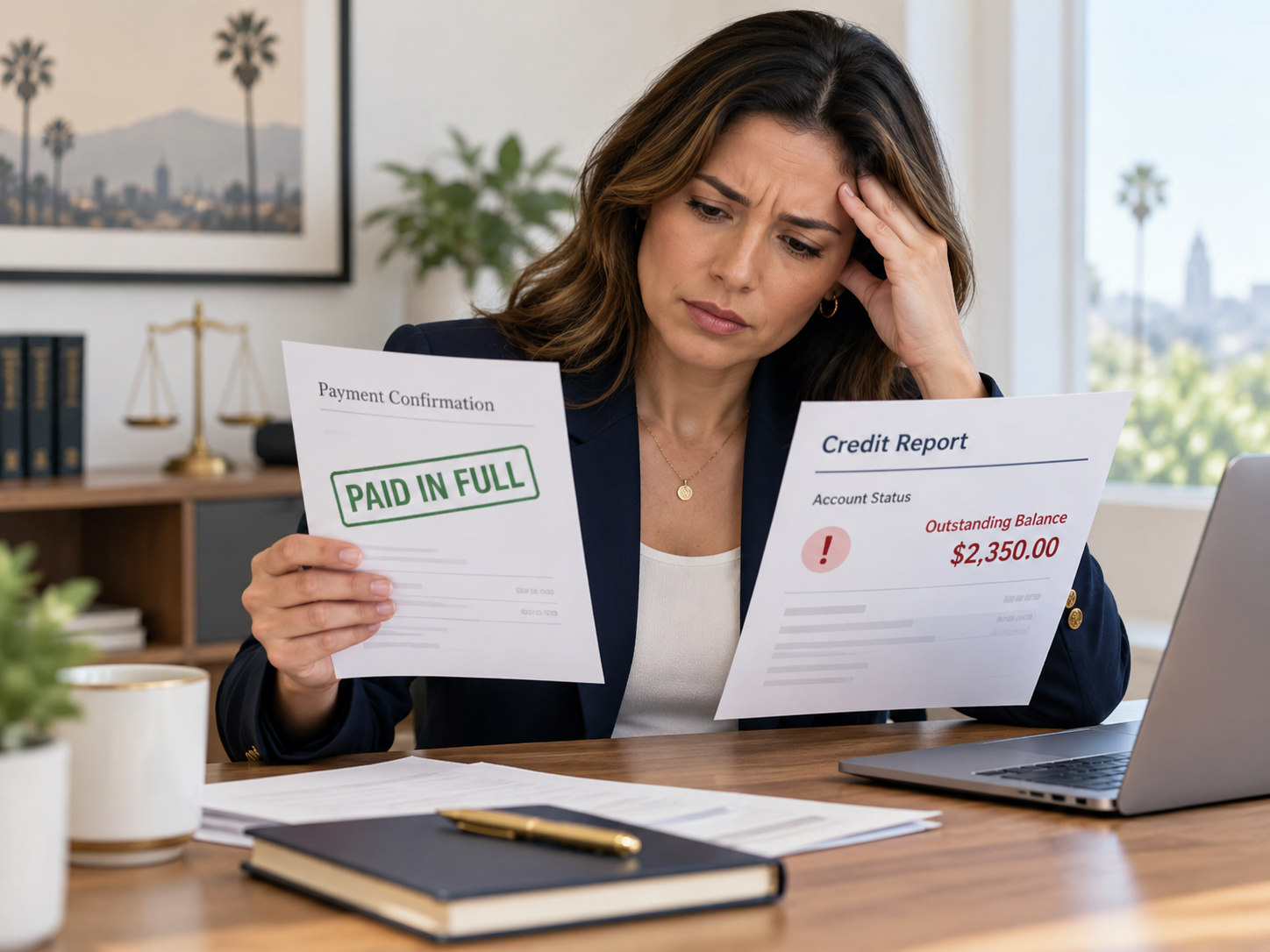
Paying off a debt should bring financial relief, not another obstacle to your creditworthiness
Unfortunately, some California consumers discover that even after making their final payment, their credit reports continue showing the debt as unpaid.
An inaccurate outstanding balance can negatively affect your credit score, increase borrowing costs, and interfere with loan approvals. Whether caused by delayed reporting, administrative mistakes, or a creditor's failure to update account information, these errors can create serious financial consequences.
Fortunately, the Fair Credit Reporting Act (FCRA) provides consumers with important rights to dispute inaccurate credit information.
At R23 Law, our experienced California Consumer Protection Attorneys advocate for consumers facing inaccurate credit reporting, unresolved disputes, and potential violations of federal and California consumer protection laws.
PAID BUT NOT UPDATED — Why Settled Debts Still Appear Unpaid
Discovering an outstanding balance on a debt you already paid can be frustrating, particularly when your financial records clearly confirm the payment.
Several common reporting problems may explain the discrepancy.
Credit Reporting Delays
Creditors and credit reporting agencies do not always update account information immediately after payment.
Depending on reporting schedules, it may take approximately 30 to 60 days for updated account information to appear on a consumer's credit report.
However, a reporting delay does not automatically justify maintaining inaccurate information indefinitely, particularly after a consumer properly disputes the error.
Administrative And Reporting Errors
Credit reporting inaccuracies may also result from:
Clerical Mistakes — Incorrectly recorded payments or account balances.
Computer Errors — Technical problems preventing updated information from appearing.
Creditor Oversight — Failure to communicate completed payments to credit reporting agencies.
Collection Agency Errors — Debt collectors failing to update accounts after payment or settlement.
These mistakes may leave consumers facing negative credit information despite satisfying their financial obligations.
A paid debt may remain on a credit report when its historical information is accurate, but its current balance and payment status should accurately reflect the account's condition.
CREDIT SCORE CONSEQUENCES — The Financial Impact Of Unpaid Debt Errors
Your credit report plays an important role in determining your access to loans, credit cards, and favorable financing terms.
Payment history accounts for approximately 35% of a FICO credit score, making accurate payment information especially important.
When a paid debt is incorrectly reported as outstanding or delinquent, the consequences may include:
Lower Credit Scores — Inaccurate negative information may affect creditworthiness.
Denied Loan Applications — Lenders may reject mortgage, auto loan, or credit applications.
Higher Interest Rates — Consumers may receive less favorable borrowing terms.
Reduced Financial Opportunities — Credit reporting errors can complicate future financing decisions.
The actual effect depends on the type of error and the consumer's overall credit history.
Importantly, paying off a previously delinquent debt does not automatically remove legitimate historical late payments. However, incorrectly reporting an outstanding balance after an account has been fully satisfied may create grounds for a dispute.
R23 Law's California Consumer Protection Attorneys recognize that inaccurate credit reporting can create significant financial consequences for consumers throughout California.
SET THE RECORD STRAIGHT — Disputing Paid Debts Reported As Unpaid
Under the Fair Credit Reporting Act (FCRA), consumers have the right to dispute inaccurate or incomplete information appearing on their credit reports.
If a paid debt continues appearing as unpaid, consider the following steps.
1. Review Your Credit Reports
Obtain copies of your reports from Equifax, Experian, and TransUnion through AnnualCreditReport.com.
Review each report carefully because creditors may provide different information to different reporting agencies.
Identify the inaccurate balance, account status, or payment information.
2. Gather Proof Of Payment
Collect documentation demonstrating that the debt has been satisfied.
Relevant evidence may include:
Bank statements
Payment receipts
Account statements showing a zero balance
Debt settlement agreements
Letters confirming payment in full
Keep copies of all records supporting your dispute.
3. Submit A Formal Credit Reporting Dispute
File a dispute with each credit reporting agency displaying the inaccurate information.
Clearly identify the account, explain the error, and include copies of relevant documentation.
Disputes may generally be submitted online or by mail.
Sending a written dispute through certified mail with return receipt requested can establish a useful record of when the agency received your complaint.
4. Monitor The Investigation Results
Credit reporting agencies generally must investigate qualifying disputes within 30 days, subject to certain statutory exceptions and extensions.
After receiving the results, examine your updated credit report to confirm that the account information has been corrected.
If the inaccurate balance remains, additional action may be appropriate.
YOUR CREDIT, YOUR RIGHTS — Federal And California Consumer Protections
The Fair Credit Reporting Act (FCRA) requires consumer reporting agencies to follow reasonable procedures designed to assure the maximum possible accuracy of consumer credit information.
It also establishes obligations concerning the investigation of qualifying credit reporting disputes.
California consumers receive additional protections under the California Consumer Credit Reporting Agencies Act (CCRAA), which regulates consumer credit reporting practices under state law.
When credit reporting agencies or information furnishers fail to comply with applicable legal requirements, consumers may have grounds to pursue legal remedies.
Depending on the circumstances, qualifying violations may result in compensation for financial losses, emotional distress, statutory damages in certain cases, and attorney's fees where authorized by law.
However, an inaccurate credit report does not automatically establish a legal violation or entitlement to compensation.
PROTECTING YOUR CREDIT — R23 Law's California Consumer Protection Attorneys
An inaccurate credit report should not stand between you and your financial opportunities.
At R23 Law, our California Consumer Protection Attorneys represent consumers affected by paid debts incorrectly reported as unpaid, unresolved credit disputes, and potential violations of the FCRA and CCRAA.
Our attorneys evaluate credit reporting inaccuracies, investigate potential statutory violations, and pursue available legal remedies when appropriate.
Our experienced legal team is committed to protecting consumers from unlawful financial reporting practices.
PAID DEBTS DESERVE ACCURATE REPORTING — Protect Your Financial Future
Paying off a debt should represent financial progress, not continued complications caused by inaccurate credit information.
If your credit report incorrectly shows an outstanding balance, reviewing your records, documenting the error, and submitting a formal dispute are important steps toward protecting your financial reputation.
When inaccuracies remain unresolved, federal and California consumer protection laws may provide additional remedies.
R23 Law's California Consumer Protection Attorneys are committed to advocating for consumers whose financial opportunities have been affected by unlawful credit reporting practices.
Contact R23 Law Today
If you have paid off a debt but your credit report continues showing an inaccurate outstanding balance, your consumer protection rights may have been violated.
Contact R23 Law's California Consumer Protection Attorneys to discuss unresolved credit reporting errors and explore your legal options under the FCRA and CCRAA.
Toll-Free: 310-598-1588
Email: info@R23Law.com
Website: www.R23Law.com
Office: US Bank Tower, 633 W. 5th Street, 26th Floor, Los Angeles, CA
© 2025 R23 Law. All rights reserved. Trusted consumer credit lawyers in Los Angeles.
