
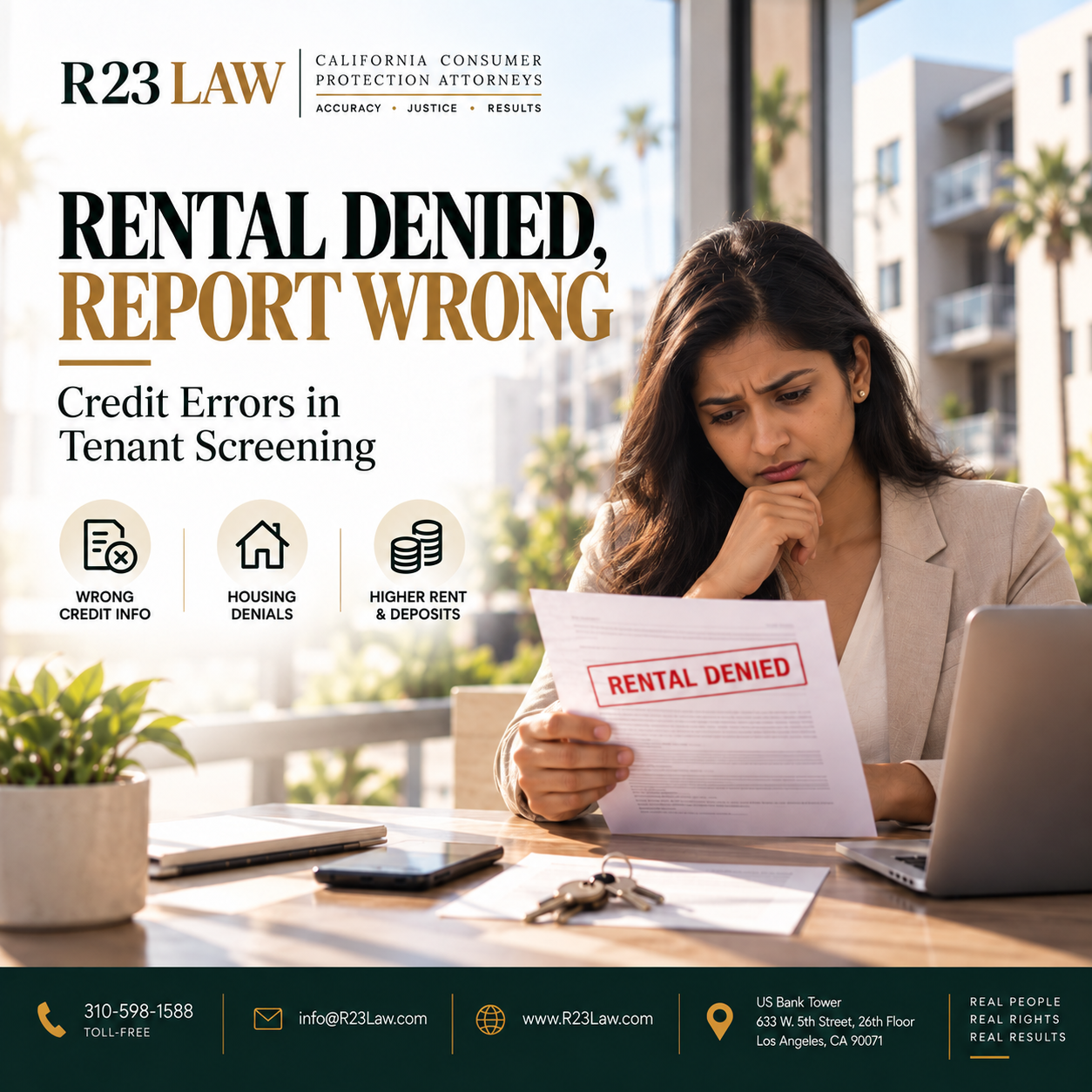
RENTAL DENIED, REPORT WRONG — Credit Errors in Tenant Screening
Finding the right apartment can take time, money, and patience
After locating a property that fits the budget and submitting an application, a denial can be especially frustrating when the decision is based on information that should never have appeared in the consumer's credit report.
The attached source explains that tenant screening problems may arise from identity theft, mixed credit files, or information that a credit reporting agency incorrectly includes in a consumer's report. Those errors can affect whether someone is approved for housing and may even lead to higher rent or a larger security deposit.
For California consumers, inaccurate credit information can turn an ordinary rental application into a serious consumer protection issue. R23 Law's California Consumer Protection Attorneys handle California matters involving credit reporting errors, identity theft-related information, housing denials, and resulting financial harm.
CREDIT REPORT ERRORS CAN DERAIL A RENTAL APPLICATION
Tenant screening often involves reviewing an applicant's financial history.
When that information is wrong, a landlord or leasing manager may make a decision based on a credit profile that does not accurately belong to the applicant.
The attached source identifies several situations that may create this problem, including —
Identity theft
Mixed credit files
Incorrect information added by a credit reporting agency
False late-payment reporting
Bankruptcy information belonging to someone else
These mistakes can make a financially responsible applicant appear far riskier than they actually are.
FALSE LATE PAYMENTS CAN MAKE A RENTER LOOK UNRELIABLE
The source gives the example of late payments appearing on a report even though the consumer never actually missed a payment.
A leasing manager reviewing that information may believe the applicant has a history of paying obligations late.
According to the source, that could lead the landlord to worry that rent payments will also be late and deny the application as a result.
An inaccurate payment history can therefore affect housing even when the applicant's actual financial record is strong.
MIXED CREDIT FILES CAN PUT SOMEONE ELSE'S FINANCIAL HISTORY ON YOUR REPORT
A mixed credit file can create particularly serious problems.
The attached source describes a situation where one consumer's report becomes mixed with another person's information.
If the other person recently filed for bankruptcy, for example, a leasing agent may mistakenly believe the applicant presents a greater financial risk.
The denial is then based not on the applicant's actual financial history, but on information belonging to someone else.
IDENTITY THEFT CAN ALSO AFFECT TENANT SCREENING
Identity theft may create another path to inaccurate tenant screening information.
If someone uses a consumer's personal information to open accounts or engage in other fraudulent activity, the resulting information may appear in records used during the housing application process.
The attached source also notes that identity thieves may, in some circumstances, commit crimes using another person's identity. That kind of misuse can affect not only housing applications but employment opportunities as well.
For California consumers, identity theft-related reporting can therefore have consequences far beyond a single fraudulent account.
CREDIT ERRORS CAN COST MORE EVEN WHEN THE APPLICATION IS APPROVED
Not every inaccurate tenant screening report results in an outright denial.
The source explains that a consumer may still be approved but face less favorable rental terms because of incorrect credit information.
Those consequences may include —
Higher rent
A larger security deposit
Other increased financial requirements connected to the rental
That means inaccurate credit reporting can cost a consumer money even when housing is ultimately obtained.
DISPUTE THE INACCURATE CREDIT INFORMATION
When a rental application is negatively affected by incorrect information, the attached source recommends filing a dispute with the credit reporting agency.
The consumer can provide evidence showing that the information is wrong and request that the reporting error be corrected.
Depending on the circumstances, useful documentation may include —
A copy of the credit report
The inaccurate item
Records showing the correct information
Identity theft documentation
Other evidence demonstrating that the reported information does not belong to the consumer
Keeping copies of the dispute and supporting records can create an important paper trail.
PROVIDE CORRECT INFORMATION TO THE LANDLORD OR LEASING OFFICE
The source also notes that a consumer may be able to provide evidence directly to the landlord or leasing office showing that the information in the credit report is inaccurate.
That can be especially important when the rental decision is happening quickly.
Apartment availability can change rapidly, and correcting a reporting error may take longer than the landlord's application timeline.
Providing documentation directly to the leasing office may give the consumer an opportunity to explain that the negative information being relied upon is disputed or incorrect.
RENTAL APPLICATION FEES CAN BECOME REAL FINANCIAL LOSSES
Applying for housing can be expensive.
The attached source notes that renters may pay application fees or amounts intended to hold a unit while the application is being reviewed.
If the application is denied because of inaccurate credit information, the consumer may lose those funds.
The source states that consumers may be able to pursue compensation for economic damages resulting from the credit reporting error.
Those losses can become especially significant when a consumer applies for several apartments after repeated denials.
EMOTIONAL HARM MAY ALSO FOLLOW A HOUSING DENIAL
Housing is a basic and deeply personal part of financial stability.
The attached source also identifies emotional damages as a potential consequence when a consumer is denied housing because of inaccurate reporting.
The stress of losing an apartment, paying repeated application fees, or being incorrectly labeled as a high-risk renter can extend beyond the direct financial loss.
Whether compensation may be available depends on the circumstances of the particular matter.
PRESERVE THE TENANT SCREENING AND DENIAL RECORDS
Consumers dealing with inaccurate housing-related reporting should consider keeping every document connected to the application.
That may include —
The rental application
Tenant screening results
Credit reports
Denial notices
Application fee receipts
Security deposit information
Correspondence with the landlord or leasing office
Credit reporting disputes
Documents showing the correct financial information
The attached source centers on the connection between inaccurate reporting and the resulting housing decision. Preserving those records can make that connection easier to document.
R23 LAW'S EXPERT LEGAL SERVICES FOR TENANT SCREENING AND CREDIT REPORTING VICTIMS THROUGHOUT CALIFORNIA
R23 Law's California Consumer Protection Attorneys handle California consumer matters involving inaccurate credit reporting and the financial consequences that may follow.
A tenant screening matter may involve —
False late-payment information
Mixed credit files
Identity theft-related reporting
Incorrect bankruptcy information
Housing denials
Higher rent or security deposit requirements
Lost application or holding fees
Other financial harm connected to inaccurate reporting
Depending on the circumstances, R23 Law's attorneys can evaluate the credit reports, tenant screening records, housing denial, supporting documentation, and resulting consumer harm.
WHEN BAD CREDIT DATA BLOCKS A GOOD RENTAL
A housing denial does not always mean the applicant's financial history was the problem.
The attached source makes clear that identity theft, mixed credit files, false late payments, and other reporting errors can interfere with tenant screening and potentially cost consumers both housing opportunities and money.
California consumers should review the information used in the screening, dispute inaccuracies, preserve the denial and application records, and document any financial losses that followed.
R23 Law's California Consumer Protection Attorneys represent California consumers dealing with inaccurate credit reporting and related housing harm.
Contact R23 Law Today
If inaccurate credit information has caused a California rental application to be denied, increased your security deposit, raised your housing costs, or resulted in other financial harm, R23 Law's California Consumer Protection Attorneys can evaluate the circumstances surrounding the matter.
Toll-Free — 310-598-1588
SoCal — (310) 598-1588
Email — info@R23Law.com
Website — www.R23Law.com
Office — US Bank Tower, 633 W. 5th Street, 26th Floor, Los Angeles, CA
Contact R23 Law
© 2025 R23 Law. All rights reserved. Trusted consumer credit lawyers in Los Angeles.
