
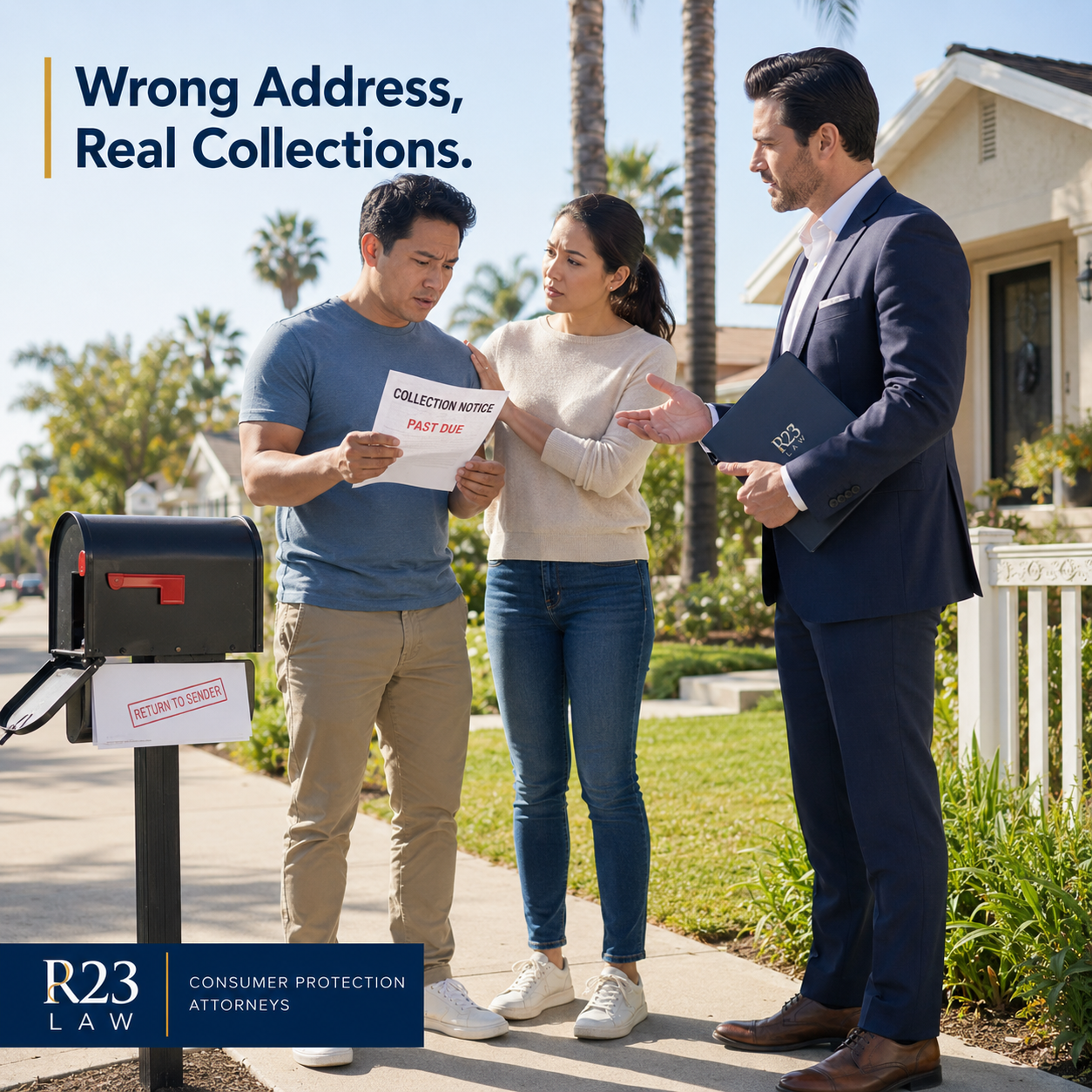
A bill sent to the wrong address can still become a collection account and damage credit
R23 Law's California Consumer Protection Attorneys represent California consumers facing wrongful collections, credit report errors, and debt collector violations.
Wrong Address, Real Collections
A bill sent to the wrong address can create a frustrating chain reaction. The consumer never receives the original notice. The creditor treats the account as unpaid. The account gets sent to collections. Then the collection account may appear on a credit report, lowering a score and threatening access to credit, housing, insurance, or financing.
The attached source material explains that a debt may still reach collections even when the consumer never received notice because mail or billing communications went to the wrong address. It also emphasizes that consumers should request proof of the debt, check whether the account is valid, review credit reports, and dispute inaccurate collection reporting.
R23 Law's California Consumer Protection Attorneys represent consumers throughout California when wrong-address billing, false collections, credit report errors, and debt collector violations cause financial harm. Learn more at AboutUs, meet Our Team, or begin a confidential review through ContactUs.
Wrong Address Billing Can Become Credit Damage
A missed bill is not always a missed responsibility. Sometimes the consumer never received the bill because the creditor, medical provider, utility company, lender, landlord, or collector used the wrong address.
That mistake can still become serious. A collection account may be reported to Equifax, Experian, TransUnion, or another consumer reporting agency. Once reported, it may affect loan approvals, rental applications, credit card limits, mortgage pricing, and other financial decisions.
R23 Law's Expert Legal Services for Collection Injury Victims Throughout California
R23 Law's California Consumer Protection Attorneys evaluate whether creditors, debt collectors, furnishers, and credit bureaus followed the law after a bill went to the wrong address and later appeared in collections.
These cases may involve:
Wrong-address billing
Collection accounts with no prior notice
Medical bills sent to outdated addresses
Utility accounts sent to collections
Debt validation failures
False or unverified collection accounts
Identity theft concerns
Credit reporting errors
Collector harassment
Ignored disputes
Request Proof Before Paying a Collection Account
A collection account should not be paid blindly. The attached material notes that the debt may not belong to the consumer, may be old, may have been handled by other collection agencies, or may involve a credit reporting error or identity theft issue.
Under the Fair Debt Collection Practices Act, a debt collector generally must send written validation information within five days after the initial communication unless that information was already provided in the initial communication or the consumer already paid the debt. The notice must include key information such as the amount of the debt, the creditor’s name, and the consumer’s dispute rights.
The 30-Day Dispute Window Matters
Debt validation rights are time-sensitive. Under federal law, the validation notice must tell the consumer that unless the consumer disputes the debt within 30 days after receiving the notice, the debt collector will assume the debt is valid. If the consumer disputes in writing within that period, the collector must obtain verification of the debt or a judgment copy and mail it to the consumer.
A wrong address can complicate that timeline. If a validation notice went to the wrong address, the consumer may have missed important dispute rights through no fault of their own.
Credit Report Disputes After Wrongful Collections
If a collection account appears on a credit report because a bill was sent to the wrong address, the consumer should dispute the inaccurate reporting with the credit bureaus and the company that furnished the information.
The CFPB advises consumers to dispute credit report errors in writing and to include supporting documents. It also recommends sending disputes to furnishers by certified mail. The FTC explains that credit bureaus generally have 30 days to investigate disputes and must notify consumers if they stop investigating because they consider a dispute frivolous or irrelevant.
When the Debt Is Valid but the Reporting Is Wrong
Sometimes the underlying bill may be legitimate, but the reporting may still be unfair, incomplete, or inaccurate. A consumer may have never received the original bill. The amount may be wrong. The account may have been sent to collections before proper notice. The address may be outdated. The collector may be unable to verify the account. The credit report may fail to show the account as disputed.
R23 Law's California Consumer Protection Attorneys review the full record to determine whether the collection reporting is accurate, complete, and legally compliant.
When the Debt Is Not Valid
If the collector cannot substantiate the debt, continued collection activity may raise legal concerns. The attached material states that if the debt is not substantiated, the collector must stop contacting the consumer.
Invalid debts may arise from identity theft, mixed files, clerical errors, duplicate accounts, balance errors, wrong consumer matching, paid accounts, insurance processing mistakes, or debts placed with collectors using outdated data.
R23 Law's California Consumer Protection Attorneys for FDCPA and FCRA Claims
Wrong-address collection cases may involve both debt collection law and credit reporting law.
The FDCPA protects consumers from abusive, deceptive, and unfair collection practices. The FCRA protects consumers from inaccurate, incomplete, or misleading credit reporting and gives consumers dispute rights when collection accounts are wrong.
R23 Law's California Consumer Protection Attorneys evaluate whether collectors, credit bureaus, and furnishers violated the FDCPA, FCRA, Rosenthal Fair Debt Collection Practices Act, California Consumer Credit Reporting Agencies Act, or other consumer protection laws.
Records That Can Strengthen a Wrong-Address Collections Case
Consumers should preserve every document connected to the account. Important records may include collection letters, envelopes showing the address used, billing statements, account records, proof of residence, credit reports, dispute letters, certified mail receipts, emails, screenshots, payment records, insurance documents, denial letters, and call logs.
A strong timeline can show where the notice failed, when the consumer first learned of the debt, what proof was requested, what the collector provided, and whether the credit report remained inaccurate.
A Bad Address Should Not Ruin Good Credit
A wrong address can turn one missed notice into months of financial damage. When companies fail to verify debts, report inaccurate collection accounts, ignore disputes, or pressure consumers to pay debts they do not owe, the paper trail matters.
R23 Law's California Consumer Protection Attorneys follow that record and pursue accountability for California consumers facing wrongful collections and credit report harm.
Contact R23 Law Today
When a bill sent to the wrong address becomes a collection account, damaged credit, denied applications, or debt collector pressure, R23 Law's California Consumer Protection Attorneys can evaluate the records and pursue accountability under consumer protection law.
Toll-Free — 310-598-1588
