
ACCOUNT HIJACKED — Recovering After Bank Fraud
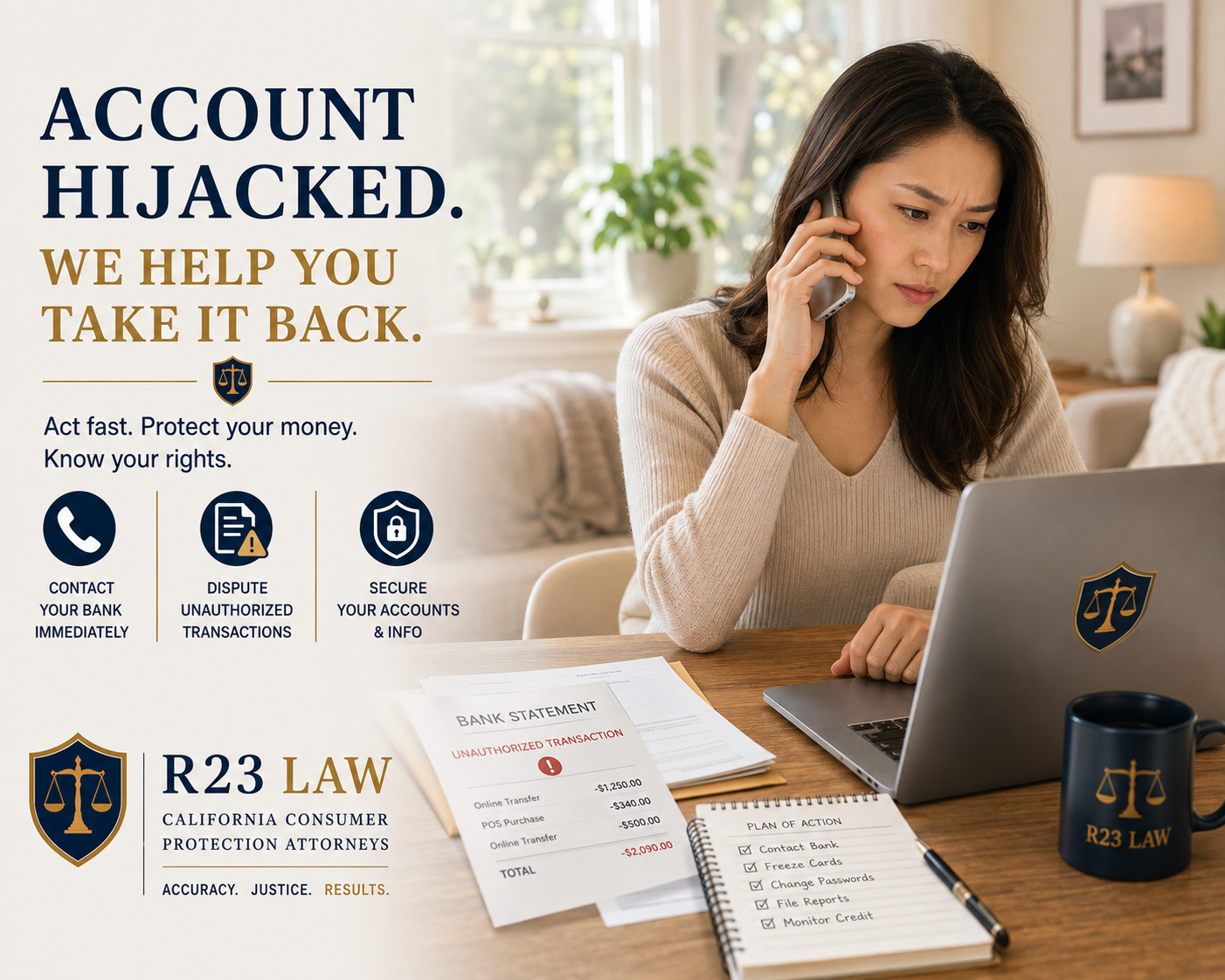
Discovering that someone has accessed your bank account can turn an ordinary day into a financial emergency
Unauthorized purchases may begin appearing, money may be transferred without permission, login credentials may suddenly stop working, or an account may be drained before the consumer realizes a criminal gained access.
Modern bank account fraud can involve phishing messages, stolen passwords, malware, compromised email accounts, public Wi-Fi, card skimmers, fraudulent calls, and other techniques designed to obtain financial credentials. The attached source emphasizes both the growing sophistication of account hacking and the importance of acting quickly once suspicious activity is discovered.
For qualifying consumer electronic fund transfers, federal protections under the Electronic Fund Transfer Act and Regulation E may limit a consumer's liability and require financial institutions to follow specific error-resolution procedures. Timing and the circumstances of the transfer matter.
R23 Law's California Consumer Protection Attorneys represent consumers dealing with hacked bank accounts, unauthorized electronic transfers, identity theft, fraudulent transactions, and disputes with financial institutions throughout California.
Contact the Bank Immediately After Discovering Fraud
The first priority after detecting unauthorized bank activity is notifying the financial institution.
The attached source recommends contacting the bank's fraud department as soon as suspicious transactions are discovered. The FTC likewise advises consumers to report lost, stolen, or compromised debit and ATM cards to the issuing bank or credit union promptly.
When contacting the bank, document:
The unauthorized transactions
When the suspicious activity was discovered
When the bank was notified
The representative's name
Any fraud claim or dispute number
What action the bank agreed to take
Whether access to the account was restricted or credentials were changed
Do not rely only on telephone conversations. Preserve statements, emails, fraud claim notices, and other records showing what was reported and when.
Regulation E Can Protect Consumers From Unauthorized Electronic Transfers
Federal Regulation E applies to many electronic fund transfers involving consumer accounts. Its protections include rules concerning consumer liability for unauthorized electronic fund transfers and procedures financial institutions must follow when consumers report qualifying errors.
An unauthorized electronic fund transfer generally involves a transfer initiated by someone other than the consumer without actual authority and from which the consumer receives no benefit. CFPB regulations specifically recognize that an access device obtained through fraud or robbery can be involved in an unauthorized EFT.
This distinction can be critical in hacked bank account cases.
A criminal who steals credentials and independently transfers money from an account may present different legal issues from a transaction the consumer personally initiated after being deceived.
The exact method used to move the money matters.
Reporting Deadlines Can Affect Consumer Liability
Timing is one of the most important issues after unauthorized electronic activity.
The source emphasizes that consumers should report fraudulent transactions quickly because federal protections can contain strict notice requirements.
Regulation E establishes different potential liability rules depending on the circumstances, including when the consumer learns of an unauthorized transfer and when the financial institution receives notice. Delays can affect the amount of unauthorized activity for which a consumer may potentially be responsible.
Consumers should therefore avoid waiting to see whether another fraudulent transaction appears before notifying the institution.
A Bank Must Follow Error-Resolution Procedures for Qualifying Claims
Simply reporting that money is missing is not always the same as asserting a formal error.
Regulation E establishes procedures for financial institutions to investigate qualifying error notices, including claims involving unauthorized electronic fund transfers.
Consumers should clearly communicate that they are disputing the transaction as unauthorized.
Preserve:
The written dispute
Bank statements
Transaction records
Fraud claim documents
Supporting evidence
Bank investigation results
Any correspondence explaining whether the claim was approved or denied
A complete record becomes particularly important if the financial institution refuses to return disputed funds.
Check the Email Account Connected to Your Bank
A compromised bank account may begin with a compromised email account.
The attached source recommends reviewing email settings for unexpected forwarding rules or filters because criminals who gain access to an email account may attempt to redirect messages and intercept password-reset communications.
Consumers should inspect:
Forwarding settings
Recovery email addresses
Recovery telephone numbers
Logged-in devices
Recent login activity
Security alerts
Password reset messages
An attacker who retains control of the connected email account may be able to regain access even after the bank password is changed.
Change Compromised Passwords
After confirming that account-recovery channels are secure, change passwords associated with the compromised account.
The source also recommends changing passwords on other accounts when the same credentials were reused.
Password reuse creates a serious problem after one account is compromised. A criminal who obtains one username-and-password combination may attempt the same credentials elsewhere.
Consumers should prioritize:
Bank accounts
Email accounts
Payment applications
Credit card accounts
Financial services
Any account using the same or similar password
Use unique passwords rather than simply making a minor variation of the compromised one.
Sign Out of Other Devices and Sessions
Changing a password may not always terminate every existing account session.
The source recommends logging the compromised account out of all devices and applications when that option is available.
Review the account's security settings for unfamiliar:
Computers
Phones
Browsers
Applications
Locations
Active sessions
Removing unauthorized sessions can reduce the chance that someone who already gained access remains connected.
Enable Multifactor Authentication
The source identifies two-step verification as another important account security measure.
Multifactor authentication generally requires something beyond a password before access is granted.
Depending on the service, verification may involve:
An authentication application
A security key
A code sent to a trusted device
Another secondary verification method
Even when a criminal knows the password, an additional authentication requirement can make unauthorized access more difficult.
Review Every Bank Transaction
Do not limit the investigation to the transaction that first caught your attention.
The source recommends carefully reviewing account statements for unauthorized purchases, transfers, new-account activity, and other suspicious transactions.
Look for:
Purchases you never made
ATM withdrawals you do not recognize
ACH transfers you did not authorize
Wire transfers
Transfers to unfamiliar recipients
Small unexplained transactions
Purchases from unfamiliar locations
Small transactions deserve attention.
The source notes that some criminals may initially attempt minor transactions before making larger withdrawals or purchases.
Warning Signs of a Hacked Bank Account
A hacked account does not always begin with a completely drained balance.
The source identifies several warning signs consumers should recognize.
These may include:
Unauthorized purchases
Unfamiliar small transactions
Unexpected inability to access the account
Security communications from the bank
An unexpectedly empty or closed account
Debit card transactions suddenly being denied
Notice that personal information may have been exposed
An unexpected password change, login notification, or authentication message may also indicate that someone is attempting to access the account.
Phishing Can Give Criminals Direct Access to Banking Credentials
Phishing is one of the common hacking methods identified in the source.
Fraudsters may send an email, text, or message designed to resemble a legitimate communication from a financial institution.
The message may direct the consumer to a fake website that imitates the bank's actual login page.
Once the consumer enters:
Username
Password
Account information
Verification credentials
the criminal may obtain the information needed to access the legitimate financial account.
Consumers should independently navigate to their financial institution rather than relying on unexpected links requesting login information.
Fraudulent Calls and Text Messages Can Impersonate Banks
Bank impersonation does not always happen through email.
The source also identifies fraudulent calls and text messages as common methods used to obtain account information.
A caller may claim:
Suspicious activity occurred
The account is about to be frozen
Immediate verification is required
A security code must be provided
Money must be moved for protection
Consumers should avoid providing passwords, PINs, or authentication codes to unexpected callers.
If there is concern about the account, contact the financial institution using independently verified contact information.
Malware Can Capture Financial Information
Malicious software can also expose banking credentials.
The source identifies malware and suspicious websites as potential routes into a consumer's financial information.
Consumers should keep devices and security software updated because software updates may contain security improvements designed to address known vulnerabilities.
The source specifically recommends updating devices promptly after security updates become available.
Public Wi-Fi Can Increase Security Risk
The source advises against conducting sensitive banking activity through unsecured public networks.
Online banking should generally be conducted through trusted devices and secure networks.
Consumers should exercise particular caution when using public connections in locations such as:
Airports
Cafés
Hotels
Shopping centers
Other public spaces
Sensitive financial activity deserves a secure connection.
Card Skimmers Can Capture Debit Card Information
Some bank fraud occurs at physical terminals rather than through online banking.
The source identifies card skimming as another method criminals use to capture card information.
Fraudulent devices may be placed over legitimate card readers at ATMs or other terminals.
Once card information is captured, criminals may attempt unauthorized transactions.
Consumers who notice unusual equipment, loose card readers, or suspicious modifications around a terminal should avoid using it and notify the institution responsible for the machine.
Report Identity Theft When Personal Information Has Been Compromised
A hacked bank account may also be part of a larger identity theft problem.
The source recommends filing appropriate reports and specifically references reporting identity theft through the Federal Trade Commission.
The FTC directs identity theft victims to IdentityTheft.gov, which provides a process for reporting identity theft and obtaining a personalized recovery plan.
Preserve copies of:
FTC identity theft documentation
Police reports, when filed
Bank fraud reports
Credit reports
Fraudulent transaction records
Account statements
These records can create a useful paper trail when disputes involve multiple institutions.
Check Credit Reports After Bank Account Hacking
A hacker who obtained banking credentials may also have obtained enough identifying information to attempt other fraud.
Consumers should review their credit reports for unfamiliar:
Credit cards
Loans
Collection accounts
Hard inquiries
Addresses
Other financial information
A hacked bank account may be the first sign that a broader identity compromise occurred.
The FTC advises identity theft victims to review financial accounts and use IdentityTheft.gov when stolen personal information has been used for fraud.
The Computer Fraud and Abuse Act Addresses Unauthorized Computer Access
The source also discusses the Computer Fraud and Abuse Act — CFAA as a federal anti-hacking law.
The CFAA, codified at 18 U.S.C. § 1030, addresses various forms of unauthorized computer access and computer-related fraud. The U.S. Department of Justice describes it as an important federal law used to prosecute cyber-based crimes.
The existence of criminal laws against hackers, however, does not by itself resolve the consumer's dispute with a financial institution.
Consumers still need to document unauthorized transfers and pursue the applicable banking dispute process.
A Bank Fraud Claim Denial Is Not Necessarily the End of the Dispute
Financial institutions sometimes deny unauthorized transaction claims.
A denial may rely on:
Login credentials
Device records
Authentication codes
Transaction history
Other account information
But the fact that valid credentials were used does not automatically answer every issue involving an unauthorized electronic fund transfer.
CFPB guidance makes clear that Regulation E can apply when a third party obtains account access information through fraud and then initiates an unauthorized transfer. Financial institutions must comply with applicable error-resolution and liability rules.
The facts surrounding who actually initiated the transfer can therefore be critical.
Preserve the Complete Bank Fraud File
A hacked bank account dispute can become evidence-heavy very quickly.
Consumers should preserve:
Bank statements
Transaction histories
Screenshots
Fraud alerts
Emails
Text messages
Password reset notifications
Login alerts
Written disputes
Bank investigation results
FTC documentation
Police reports
Records of telephone conversations
Keep these materials together and organize them chronologically.
The source repeatedly emphasizes prompt reporting, documentation, and review of account activity after a compromise.
R23 Law's California Consumer Protection Attorneys Represent Bank Fraud Victims Throughout California
Hacked bank account cases may involve unauthorized ACH transfers, debit card transactions, account takeovers, identity theft, compromised credentials, phishing, and financial institutions that deny consumer fraud claims.
R23 Law's California Consumer Protection Attorneys evaluate the full transaction history to determine what occurred and which consumer protection laws may apply.
A legal evaluation may examine:
Whether the consumer authorized the transaction
Who initiated the electronic transfer
How account credentials were compromised
Whether the bank received timely notice
Whether Regulation E applies
Whether the institution followed applicable error-resolution procedures
Whether stolen credentials were used
How the bank investigated the dispute
Why the claim was denied
Whether stolen funds remain unreimbursed
What financial losses followed the unauthorized activity
Learn more about the attorneys behind R23 Law through Our Team and the firm's consumer protection practice through About Us.
R23 Law's Legal Services for Hacked Bank Account Victims Throughout California
A bank account takeover can leave consumers dealing with two problems at once — the criminal who stole the money and the financial institution deciding whether to return it.
R23 Law's California Consumer Protection Attorneys review unauthorized transaction disputes, bank investigation records, account security events, and the consumer's documentation to determine whether applicable federal or California consumer protections were violated.
When a financial institution refuses to reimburse qualifying unauthorized transactions or fails to comply with applicable dispute procedures, legal remedies may be available depending on the facts.
Consumers can connect directly with the firm through Contact Us.
Fast Action Can Protect More Than One Bank Account
A hacked bank account can be a warning that additional personal information has been compromised.
Secure the account. Contact the bank. Review the connected email address. Change compromised passwords. Sign out unfamiliar devices. Enable multifactor authentication. Examine account statements. Preserve evidence. Report identity theft when appropriate.
Most importantly, document every step.
When unauthorized transactions remain unresolved after a bank investigation, R23 Law's California Consumer Protection Attorneys can evaluate the dispute and the consumer protection laws that may apply.
Contact R23 Law Today
A hacked bank account can lead to unauthorized withdrawals, electronic transfers, identity theft, and significant financial losses. When a financial institution denies a legitimate fraud dispute, the consequences can continue long after the hacker disappears.
R23 Law's California Consumer Protection Attorneys represent consumers throughout California facing hacked bank accounts, unauthorized electronic fund transfers, identity theft, and related banking disputes.
Toll-Free — 310-598-1588 SoCal — (310) 598-1588 Email — info@R23Law.com Website —www.R23Law.com US Bank Tower, 633 W. 5th Street, 26th Floor, Los Angeles, CA
© 2025 R23 Law. All rights reserved. Trusted consumer credit lawyers in Los Angeles.
