
CARE TAKEN — Caregiver Theft and Elder Financial Abuse
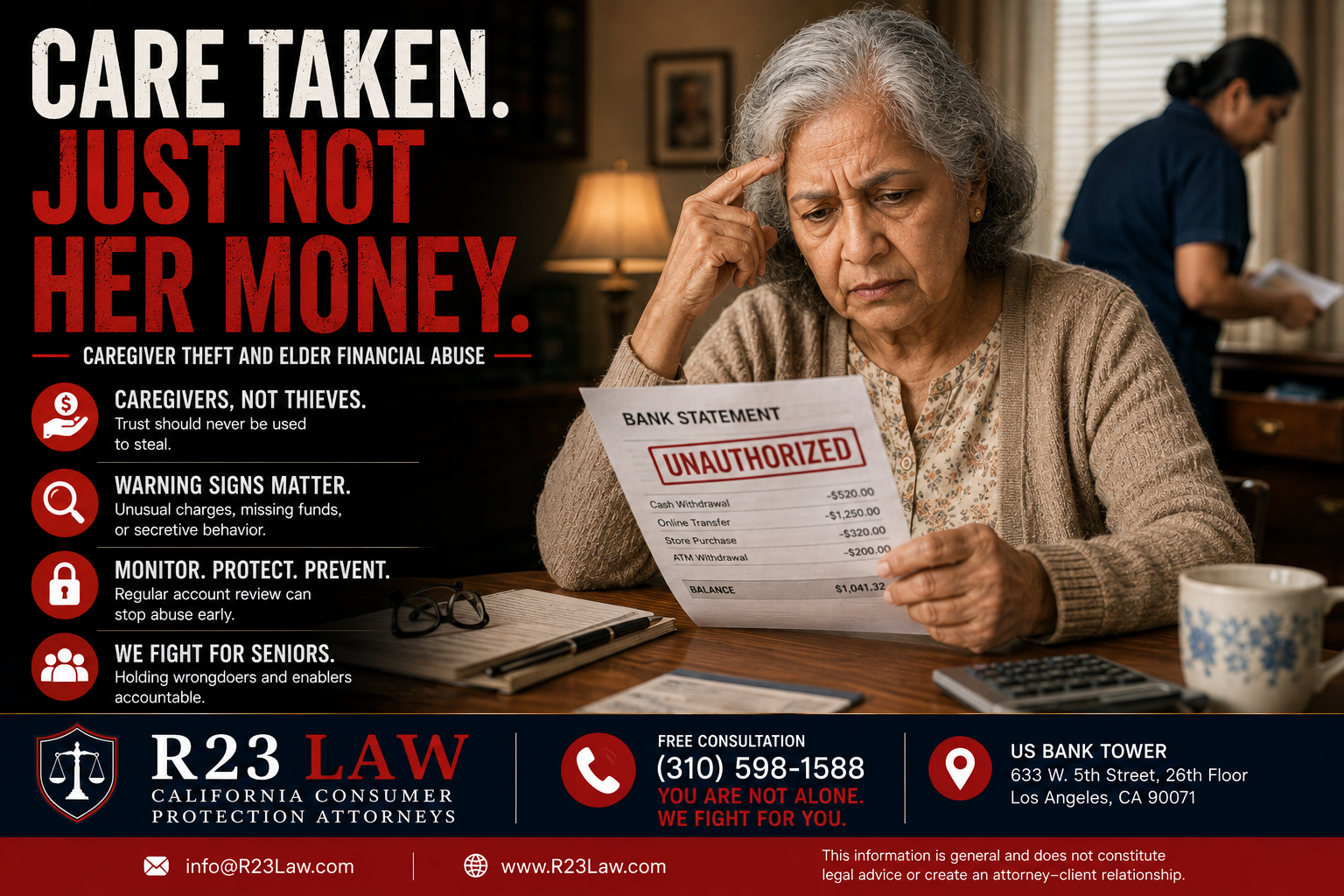
Older adults may face financial exploitation whether they live independently, receive in-home care, or reside in a nursing home or skilled nursing facility
Caregivers often have access to a senior’s living space, personal records, financial information, mail, and daily routines. That access is supposed to support the older adult’s safety and well-being. When it is misused to obtain money or property, the conduct may amount to elder financial abuse.
R23 Law's California Consumer Protection Attorneys represent seniors and families throughout California in matters involving caregiver theft, unauthorized financial transactions, identity fraud, and other forms of financial exploitation.
Caregiver Theft Can Occur in Any Living Arrangement
Financial elder abuse is not limited to seniors who live alone.
A senior residing in a licensed facility may still face exploitation by an employee, caregiver, contractor, visitor, or another person with access to personal information. A facility setting does not eliminate financial risk.
Caregiver theft may involve:
Unauthorized use of a debit or credit card
Accessing a senior’s bank account without permission
Using account information to make personal payments
Taking cash, jewelry, or other property
Obtaining signatures through deception
Redirecting checks or benefit payments
Using a senior’s identity to open accounts
Persuading a senior to transfer property
Assisting another person in taking the senior’s assets
The amount taken does not determine whether the conduct matters. Smaller unauthorized transactions may reveal an ongoing pattern of exploitation.
California Broadly Defines Elder Financial Abuse
California Welfare and Institutions Code section 15610.30 provides a broad definition of financial abuse involving an elder or dependent adult.
The statute includes conduct in which a person or entity:
Takes, conceals, appropriates, obtains, or retains an elder’s real or personal property for a wrongful use or with intent to defraud
Assists another person in taking, concealing, appropriating, obtaining, or retaining the property
Takes or assists in taking property through undue influence
California Penal Code section 368 also addresses certain criminal conduct involving elder and dependent-adult abuse.
These laws recognize that liability may extend beyond the person who directly takes the property. A person or entity that knowingly assists in the wrongful taking may also face legal consequences.
Nursing-Home Residents Remain Vulnerable to Financial Exploitation
The attached source describes a reported case involving a caregiver employee at a skilled nursing facility who was arrested after allegedly obtaining residents’ bank account information and using the accounts to make personal payments.
The allegations included exploitation of vulnerable adults, financial identity fraud, and obtaining property under false pretenses. All of the alleged victims were nursing-home residents at the time of the reported conduct.
The case illustrates an important point — residence in a care facility does not eliminate the need for financial oversight.
Seniors in facilities may be especially vulnerable when they:
Cannot regularly review online accounts
Depend on others to manage mail
Have limited mobility
Experience memory or cognitive difficulties
Rely on caregivers for daily tasks
Have few visitors
Are unable to explain suspicious transactions
Do not understand digital banking systems
Regular family involvement can reduce the opportunity for unauthorized activity to continue unnoticed.
Common Warning Signs of Caregiver Financial Abuse
Financial exploitation may appear as a single suspicious transaction or a series of subtle account changes.
Warning signs may include:
Unfamiliar charges
Cash withdrawals the senior cannot explain
New electronic transfers
Missing checks
Payments to unknown individuals
Purchases unrelated to the senior’s needs
Sudden changes in account access
Missing financial statements
Unexplained account shortages
New beneficiaries or authorized users
A caregiver who resists financial oversight
A caregiver who isolates the senior from relatives
Signatures that appear inconsistent
New debts or collection notices
A family should not dismiss unusual activity merely because the amount appears small. Repeated low-dollar transactions may indicate that someone is testing account access or attempting to avoid detection.
Daily Account Monitoring Can Reveal Unauthorized Activity
The source emphasizes regular review of a senior’s checking account, including online monitoring when available.
Family members or authorized representatives should examine:
Every charge
Every withdrawal
Electronic transfers
Checks
Automatic payments
New payees
Changes to contact information
Password-reset notices
Unfamiliar login alerts
Online and telephone access can be used to remove money without entering a bank branch. A senior living in a facility may be unable to identify or challenge these transactions promptly.
Account alerts can provide notice of:
Withdrawals above a selected amount
Debit card purchases
Transfers to new accounts
Password changes
Unusual login attempts
Low account balances
Changes to mailing addresses
Financial monitoring should be conducted by a trusted and properly authorized person.
Financial Access Should Be Strictly Limited
Caregivers may need access to certain household information, but they should not automatically receive control over a senior’s finances.
The source specifically cautions against giving a caregiver:
A power of attorney
A credit card
A blank check
Financial authority can create serious risk when granted without oversight. Powers of attorney and other legal documents may permit broad control over bank accounts, property, and financial decisions.
Families should carefully consider:
The exact authority being granted
Whether less access would be sufficient
Who will review transactions
Whether dual approval is available
How account statements will be delivered
Whether access can be revoked promptly
Whether an independent person should monitor activity
A caregiver’s convenience should not override the senior’s financial security.
Identity Fraud May Accompany Caregiver Theft
A caregiver who obtains a senior’s financial information may be able to do more than withdraw money from an existing account.
The information may be used to:
Make online purchases
Add new payment recipients
Open credit accounts
Change account credentials
Redirect statements
Obtain loans
Create fraudulent digital payment accounts
Impersonate the senior during telephone calls
Financial identity fraud may continue after the caregiver no longer works for the senior or facility. Passwords, account numbers, and other credentials should be changed immediately when misuse is suspected.
Evidence Should Be Preserved Promptly
Families should retain complete records when caregiver theft or elder financial abuse is suspected.
Important evidence may include:
Bank statements
Credit card statements
Canceled checks
Electronic transfer records
Account alerts
Facility visitor records
Caregiver schedules
Employment records
Emails and text messages
Powers of attorney
Account-access documents
Surveillance footage
Written complaints to the facility
Police or agency reports
Notes describing the senior’s statements
A written timeline should identify when each suspicious transaction occurred, who had access to the senior, and when the activity was discovered.
Facility Residence Does Not Replace Family Involvement
A nursing home or skilled nursing facility is responsible for the resident’s care within the scope of its duties. Family members should nevertheless remain involved in the senior’s life and finances whenever possible.
Consistent contact may make it easier to identify:
Behavioral changes
Fear of a particular caregiver
Missing possessions
Unexplained financial concerns
Sudden isolation
Pressure to sign documents
Changes in account control
Statements suggesting coercion
A senior who receives regular visits and financial oversight may be less attractive to someone seeking an isolated target.
R23 Law’s Expert Legal Services for Elder Financial Abuse Victims Throughout California
R23 Law's California Consumer Protection Attorneys represent seniors and families throughout California in cases involving caregiver fraud, nursing-home financial exploitation, identity theft, and unauthorized transfers.
Our legal services may include:
Reviewing suspicious financial transactions
Examining bank and credit card records
Investigating caregiver access to accounts
Evaluating powers of attorney and financial documents
Identifying individuals or entities that assisted in the taking
Preserving evidence of theft and exploitation
Documenting financial and emotional injuries
Pursuing recovery of wrongfully taken property
Seeking available civil remedies under California law
Learn more about the firm through About R23 Law and meet the attorneys on Our Team.
Prompt Action Can Protect Remaining Assets
Suspected elder financial abuse should be addressed quickly.
Continued account access may allow additional withdrawals, transfers, or fraudulent transactions. Banks, card issuers, and other financial institutions may need to be notified so they can restrict access and preserve records.
Families may also need to:
Change passwords and identification numbers
Cancel compromised cards
Remove unauthorized account users
Review recent transactions
Secure checkbooks and financial documents
Obtain current credit reports
Document missing property
Notify the facility
Report suspected criminal activity
The appropriate response depends on the facts, the senior’s capacity, the type of property involved, and the identity of the suspected wrongdoer.
Contact R23 Law Today
Caregiver theft can threaten a senior’s savings, independence, housing, healthcare, and sense of security. When a trusted person misuses access to obtain money or property, California law may provide a path toward accountability.
R23 Law's California Consumer Protection Attorneys evaluate caregiver fraud, unauthorized financial transactions, identity theft, and related elder financial abuse claims throughout California.
Visit Contact R23 Law to request a consultation regarding suspected caregiver theft or financial exploitation.
Toll-Free — 310-598-1588SoCal — (310) 598-1588Email — info@R23Law.comWebsite —www.R23Law.comOffice — US Bank Tower, 633 W. 5th Street, 26th Floor, Los Angeles, CA
© 2025 R23 Law. All rights reserved. Trusted consumer credit lawyers in Los Angeles.
Disclaimer — This article is provided for general informational purposes and does not constitute legal advice. Reading this article or contacting R23 Law does not, by itself, create an attorney-client relationship.
