
CLEARANCE AT RISK — Credit Report Errors and Security Reviews
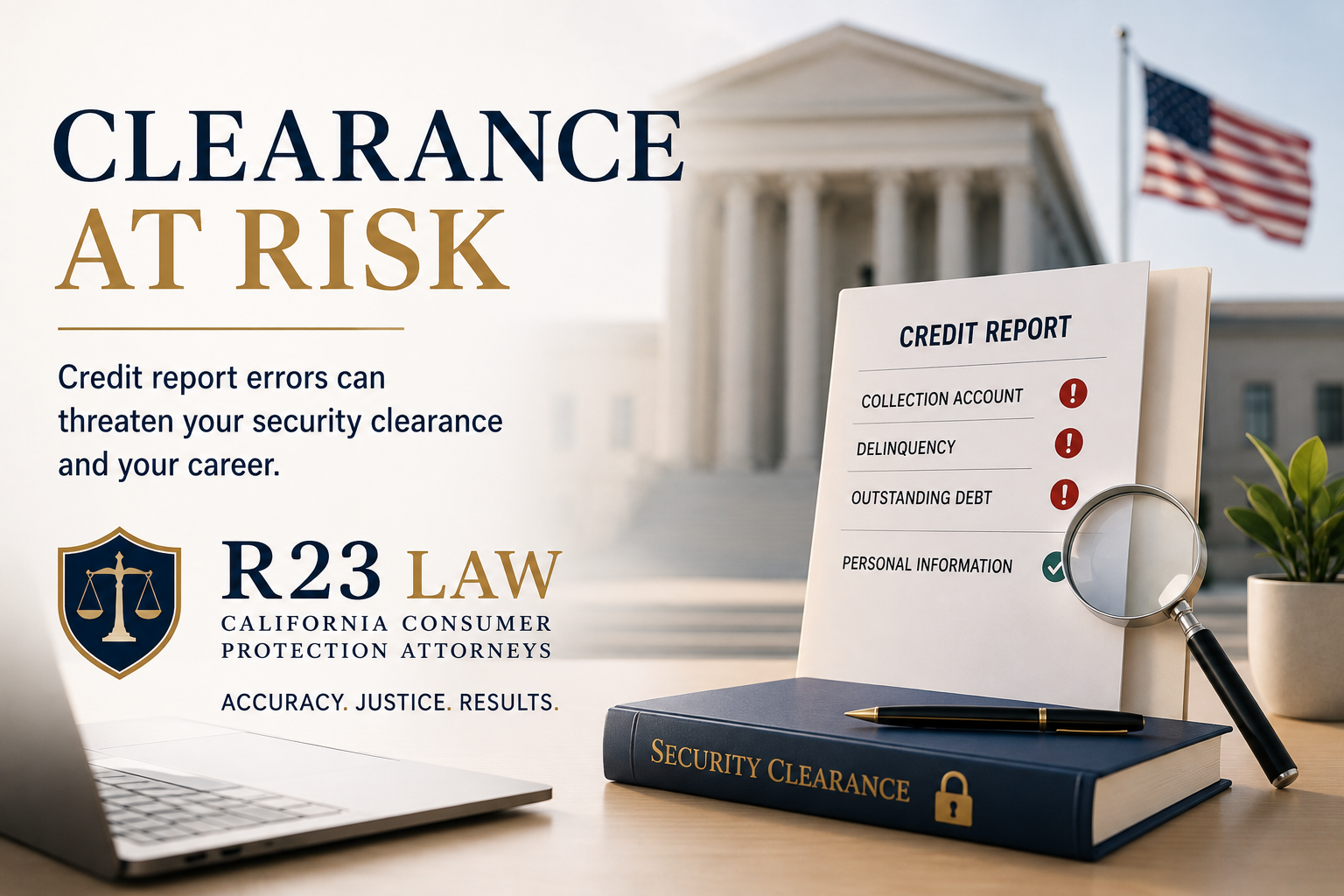
For military service members, government employees, and civilian contractors, a credit report can affect much more than access to loans or favorable interest rates
Inaccurate financial information may also create serious problems during a security clearance investigation.
A security clearance provides authorized access to classified government information. The attached source identifies three primary clearance levels — Confidential, Secret, and Top Secret — and explains that financial history may be examined as part of the background investigation associated with obtaining or maintaining clearance status.
That means an inaccurate collection account, delinquency, unpaid debt, or even incorrect identifying information can become more than a credit reporting problem. For some consumers, it can threaten their professional standing and potentially their employment.
R23 Law's California Consumer Protection Attorneys represent consumers dealing with inaccurate credit reports, identity theft, mixed files, fraudulent accounts, collection errors, and other credit reporting problems that can create consequences beyond a credit score.
Security Clearances Can Be Critical to Employment
Security clearances are especially important for individuals working with classified or sensitive government information.
The source explains that government employees, military personnel, and civilian contractors may depend on clearance eligibility for their work. Losing or failing to obtain the necessary clearance can therefore have significant professional consequences.
Depending on the position, the clearance process may involve examination of an applicant's history and circumstances to evaluate reliability, judgment, and trustworthiness.
Financial information can become part of that evaluation.
Credit History Can Become Part of a Security Clearance Review
According to the source, financial history may be reviewed because investigators can consider whether financial circumstances raise concerns regarding responsibility, judgment, or susceptibility to outside pressure.
Credit reports may contain information concerning:
Outstanding debts
Payment history
Collection accounts
Charge-offs
Delinquencies
Bankruptcies
Credit utilization
Personal identifying information
When those records are accurate, they reflect actual financial history.
When they are wrong, however, they can create a misleading picture of the consumer being evaluated.
Inaccurate Debt Can Create the Appearance of Financial Instability
A credit reporting error does not arrive with a label identifying it as a mistake.
If a report incorrectly shows substantial unpaid debt, collections, missed payments, or charged-off accounts, the person reviewing the report may initially see the information as legitimate.
The source identifies several areas of financial history that may draw attention during a security clearance review.
Payment History
Late payments, collections, charge-offs, and other delinquent obligations can create concerns regarding financial responsibility.
If those entries resulted from identity theft, mixed files, creditor errors, or inaccurate reporting, the consumer may find themselves defending financial conduct that never actually occurred.
Debt Levels
The source explains that significant debt may receive attention because investigators may evaluate whether financial pressure creates vulnerabilities.
An inaccurate balance or fraudulent account can therefore distort the consumer's actual financial condition.
Financial Stability
A report showing repeated delinquencies or unresolved financial problems may create the appearance of financial instability.
That becomes particularly troubling when the underlying information is incorrect.
Trustworthiness
Financial history may also be evaluated in connection with broader considerations of reliability and judgment.
For consumers with inaccurate credit reports, the problem is obvious — an error can potentially influence an assessment of personal qualities even though the information does not accurately describe the individual.
Small Credit Report Errors Can Become Big Clearance Problems
Not every credit reporting problem involves thousands of dollars.
The source notes that even comparatively small errors, such as an incorrectly reported missed payment or delinquency, can become significant when viewed during a clearance review.
That is because the issue may extend beyond the dollar amount itself.
An inaccurate delinquency could potentially be interpreted as evidence of:
Poor financial management
Failure to meet obligations
Instability
Lack of reliability
For a consumer whose professional responsibilities require security clearance, correcting the underlying reporting error can therefore carry unusually high stakes.
Personal Information Errors Can Also Create Concerns
Credit report accuracy is not limited to account balances and payment histories.
The source specifically notes that errors involving previous addresses or Social Security information may also create problems.
Incorrect identifying information can make a credit file appear inconsistent with information provided during a background investigation.
Examples may include:
Addresses where the consumer never lived
Incorrect Social Security information
Name variations belonging to another person
Accounts associated with another consumer
Other identifying data that does not belong to the applicant
These errors can be especially important when they suggest discrepancies between the credit report and the information provided during the clearance process.
Mixed Credit Files Can Create False Financial Histories
One possible source of serious credit reporting errors is a mixed file.
A mixed file occurs when information belonging to another consumer becomes associated with the wrong person's credit report.
That may result in unfamiliar:
Collection accounts
Loans
Credit cards
Late payments
Addresses
Balances
Hard inquiries
For someone undergoing a security clearance review, another person's poor financial history can create consequences that extend far beyond an ordinary credit dispute.
The consumer may need to establish not only that the account is inaccurate but also that the financial history never belonged to them in the first place.
Identity Theft Can Create Similar Clearance Concerns
Identity theft can also generate negative information that appears legitimate on the surface.
A fraudster may open credit cards, obtain loans, generate hard inquiries, or allow fraudulent accounts to become delinquent.
The resulting credit report may show:
High balances
Unpaid accounts
Collections
Delinquencies
Multiple new accounts
Unfamiliar inquiries
For the identity theft victim, those entries do not reflect poor financial management.
They reflect fraud.
But unless the information is identified and corrected, the distinction may not be apparent to someone reviewing the credit report.
Review Credit Reports Before Clearance Problems Appear
The source recommends obtaining detailed credit reports proactively rather than waiting for an investigation to expose an error.
Consumers should review their reports for:
Accounts they do not recognize
Incorrect balances
False late payments
Collection accounts that do not belong to them
Duplicate accounts
Identity theft-related debts
Incorrect addresses
Incorrect identifying information
Other financial information that appears inaccurate
Regular monitoring can be particularly important for consumers whose careers depend on maintaining clearance eligibility.
Finding an error before a clearance investigation provides an opportunity to document and dispute the problem before it creates additional consequences.
Written Credit Disputes Create an Important Record
When an error appears, the source recommends disputing the inaccurate information with the credit reporting agency and providing documentation supporting the correction.
A detailed written dispute can identify:
The inaccurate account or information
Why the information is wrong
The correct information
Supporting documents
Evidence of identity theft when applicable
The source also recommends sending written disputes through certified mail so that the consumer can document delivery.
Consumers should preserve copies of everything sent and received.
Useful records may include:
Credit reports
Dispute letters
Supporting documents
Certified mail receipts
Investigation results
Creditor correspondence
Updated credit reports
Security clearance communications
That documentation may become particularly important if inaccurate information remains after the consumer disputes it.
Clearance Investigators Should Receive Documentation of Known Errors
The source further recommends notifying the agency conducting the background investigation when a consumer discovers credit report errors after beginning the clearance process.
Depending on the circumstances, documentation may allow the consumer to explain why a particular account, balance, delinquency, or identifying detail is inaccurate.
That could include records showing:
The account belongs to someone else
The debt resulted from identity theft
A payment was incorrectly reported
The consumer previously disputed the information
A creditor acknowledged the mistake
The credit reporting agency corrected the account
A documented explanation can provide context when the credit report itself does not tell the complete story.
Credit Reporting Errors Can Affect Careers, Not Just Credit Scores
Credit reporting disputes are often discussed in terms of mortgages, auto loans, credit cards, and interest rates.
For consumers working in national security, defense, military, government, or certain contracting positions, the consequences may be much broader.
An inaccurate report can potentially interfere with:
Security clearance applications
Clearance renewals
Employment eligibility
Professional advancement
Continued access to classified information
Job stability
That makes accuracy especially important.
A collection account belonging to someone else should not become a professional judgment about the wrong consumer.
R23 Law's California Consumer Protection Attorneys Represent Credit Reporting Victims Throughout California
Security clearance-related credit reporting problems can involve credit bureaus, creditors, debt collectors, furnishers, identity theft, and inaccurate personal information.
R23 Law's California Consumer Protection Attorneys evaluate credit reporting disputes to determine how inaccurate information entered the consumer's file, whether the information was properly disputed, and whether it continued to be reported after notice of the problem.
A legal evaluation may include:
False collection accounts
Incorrect late payments
Fraudulent debts
Mixed credit files
Identity theft accounts
Inaccurate balances
Incorrect identifying information
Failed credit disputes
Continuing inaccurate reporting
Professional consequences associated with the reporting error
R23 Law provides experienced consumer protection representation for consumers facing serious credit reporting problems throughout California.
Learn more about the firm's attorneys through Our Team and R23 Law's consumer protection practice through About Us.
Protecting a Security Clearance Starts With an Accurate Credit Record
A security clearance review can carry career-defining consequences.
Consumers whose positions depend on clearance eligibility should know what their credit reports contain before inaccurate information becomes part of a background investigation.
If an account, delinquency, collection, address, or other entry does not belong to you, document it. Preserve your reports. Dispute inaccurate information and maintain records showing the steps taken to correct it.
When errors remain despite a documented dispute, additional legal options may need to be evaluated.
R23 Law's California Consumer Protection Attorneys focus on enforcing consumer rights when inaccurate credit information continues to create financial and professional consequences.
Contact R23 Law Today
An inaccurate credit report can affect far more than borrowing power when a career depends on security clearance eligibility. False debts, delinquent accounts, identity theft, and incorrect personal information can create a misleading picture of financial responsibility.
R23 Law's California Consumer Protection Attorneys represent consumers throughout California facing inaccurate credit reporting and related consumer protection violations.
Connect with R23 Law through Contact Us to discuss credit report errors that may be affecting a security clearance application, renewal, or employment.
Toll-Free — 310-598-1588 SoCal — (310) 598-1588 Email — info@R23Law.com Website — www.R23Law.com US Bank Tower, 633 W. 5th Street, 26th Floor, Los Angeles, CA
© 2025 R23 Law. All rights reserved. Trusted consumer credit lawyers in Los Angeles.
