
WIRE GONE WRONG — Fraudulent Transfers and Consumer Rights
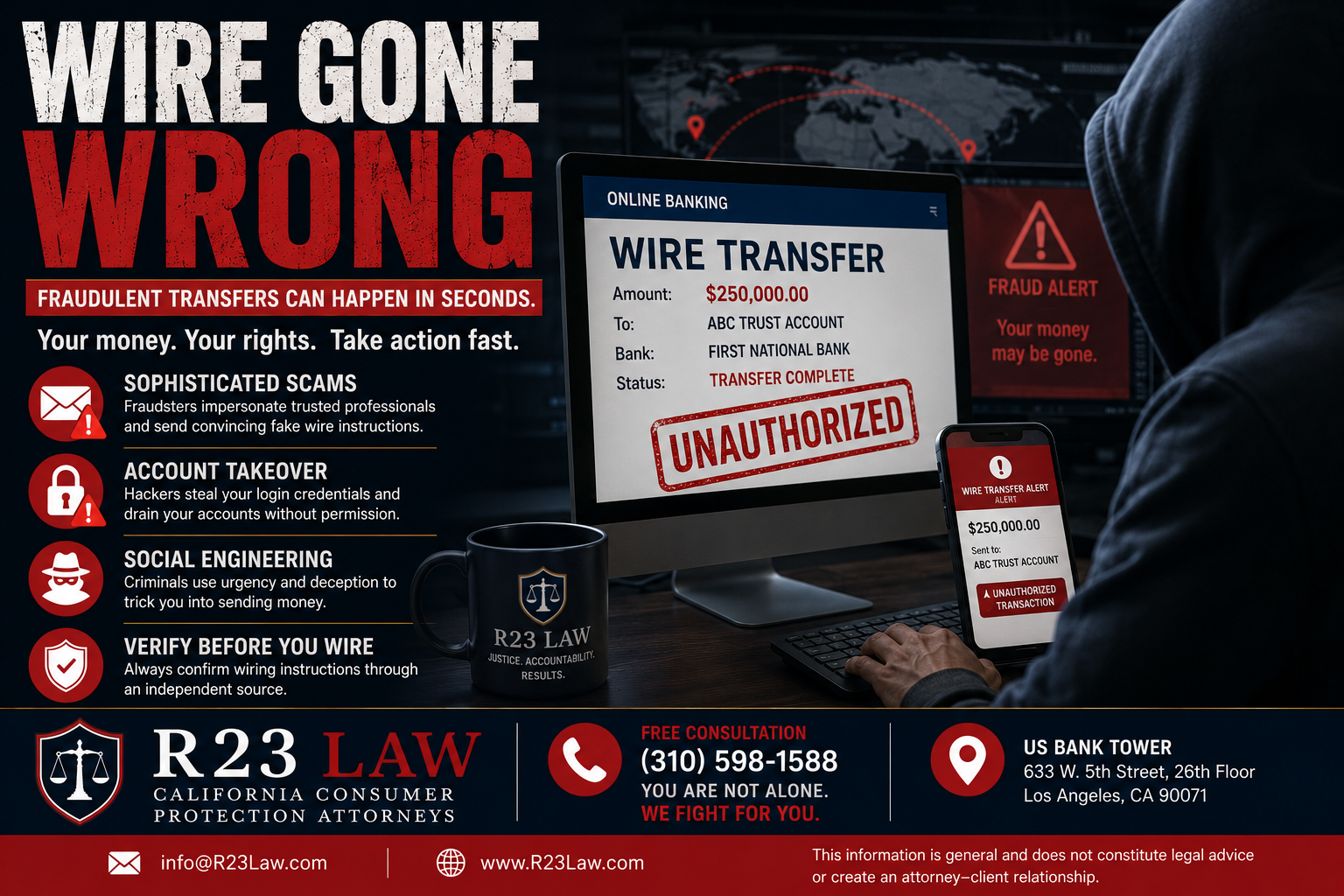
Wire transfer fraud has evolved far beyond the obvious email scams of the early internet
Modern fraudsters can impersonate trusted businesses, compromise legitimate email accounts, recreate banking websites, steal login credentials, and redirect substantial transfers before a victim realizes anything is wrong. The attached source highlights this evolution from early advance-fee scams to sophisticated email compromise and account takeover schemes.
For California consumers and businesses, a fraudulent wire transfer can create an immediate financial crisis. Banks may initially take the position that a transfer was properly authenticated or that the account holder bears responsibility. But liability for an unauthorized wire transfer can depend on important facts, including who initiated the payment, how account credentials were obtained, what security procedures applied, and whether the financial institution followed applicable federal or state law.
R23 Law's California Consumer Protection Attorneys represent consumers facing financial fraud, unauthorized electronic transfers, identity theft, and disputes involving financial institutions. When significant funds disappear through a fraudulent transfer, understanding the transaction and preserving evidence quickly can be critical.
Wire Transfer Fraud Has Become More Sophisticated
Early online fraud often relied on mass emails promising large financial rewards in exchange for an advance payment. Modern wire fraud is frequently much more convincing.
The FBI describes Business Email Compromise as a sophisticated fraud targeting businesses and individuals who make legitimate transfers of funds. Criminals may compromise legitimate email accounts through social engineering or computer intrusion and then redirect money to accounts under their control.
Instead of sending an obviously suspicious request, fraudsters may spend time studying communications, business relationships, invoices, transaction schedules, and writing styles. By the time fraudulent wire instructions arrive, the message may appear almost identical to one sent by a trusted professional.
That appearance of legitimacy is exactly what makes modern wire transfer fraud so dangerous.
Business Email Compromise Can Redirect Legitimate Payments
One common scheme involves compromising or impersonating someone involved in an important financial transaction.
Real estate transactions provide a particularly damaging example. A fraudster may gain access to the email account of a real estate professional, escrow officer, business representative, or other trusted party. The criminal monitors communications until a large payment is expected.
The fraudster then sends altered wiring instructions directing the victim to a different bank account.
The fraudulent email may contain familiar signatures, logos, transaction details, and language. Even the sender's email address may differ from the legitimate address by only one character.
A buyer who believes the instructions came from the correct source may then wire a substantial amount directly into an account controlled by criminals. The FBI has specifically identified impersonation of real estate representatives and other trusted professionals as a recurring Business Email Compromise tactic.
Fake Websites and Account Takeovers Create Another Route to Wire Fraud
Fraudsters do not always persuade the victim to manually send money.
Some schemes use imitation websites or phishing links that resemble legitimate bank, retailer, social media, or financial-service websites. A consumer may unknowingly enter login credentials into the fraudulent site, giving criminals access to sensitive account information.
Other schemes involve malicious links or remote-access techniques that allow criminals to gain control over an account or device.
Once criminals gain unauthorized access to an online financial account, they may rapidly transfer funds to accounts they control. The FBI warns that account takeover fraud can involve unauthorized access to online bank accounts followed by the transfer of money, sometimes through multiple accounts or cryptocurrency channels that make recovery increasingly difficult.
Social Engineering Turns Trust Into a Fraud Tool
Technology is only part of the scheme.
Many fraudulent wire transfers rely on social engineering — manipulating a victim into trusting a fraudulent instruction or surrendering information that gives someone else access to an account.
Fraudsters may impersonate:
Financial institutions
Employers or executives
Business partners
Vendors
Real estate professionals
Government representatives
Family members
Customer support personnel
Urgency is frequently part of the strategy. The victim may be told that payment must be sent immediately, an account is in danger, a transaction is about to fail, or confidential information must be provided to prevent a supposed financial loss.
The pressure to act quickly can prevent the victim from verifying the request through an independent source.
Verification Before a Wire Transfer Can Prevent Major Losses
Large wire transfers deserve independent verification before funds leave the account.
Consumers and businesses can reduce their exposure by taking precautions such as:
Carefully reviewing every character in an email address before relying on wire instructions
Calling the intended recipient at a previously verified telephone number
Confirming wiring instructions through a communication method separate from the original email
Avoiding telephone numbers or links contained only in an unexpected message
Reviewing website addresses carefully before entering financial credentials
Avoiding financial transactions over unsecured public Wi-Fi
Using strong account credentials and current security software
Monitoring financial accounts for unauthorized activity
Confirming promptly that a legitimate recipient actually received the transferred funds
An unexpected change in wiring instructions should receive particular scrutiny. A familiar logo or convincing email signature does not establish that the message is authentic.
Unauthorized Wire Transfer Liability Depends on the Transaction
The original source emphasizes Article 4A of the Uniform Commercial Code as an important legal framework for certain fraudulent wire transfer disputes.
Under UCC Article 4A, the enforceability of a payment order can depend on whether it was authorized and whether an agreed security procedure was commercially reasonable and properly followed. Article 4A defines security procedures as agreed methods intended to verify payment orders or detect errors, including measures such as codes, encryption, identifying information, and callback procedures.
For many commercial funds transfers, Article 4A can therefore become central to determining whether a bank or customer ultimately bears a fraudulent-transfer loss.
Consumer transactions require an additional legal distinction. Article 4A generally does not apply to a funds transfer to the extent the transfer is governed by the federal Electronic Fund Transfer Act.
That distinction can significantly affect the legal analysis.
Regulation E May Protect Consumers After Unauthorized Electronic Transfers
For qualifying consumer accounts, the Electronic Fund Transfer Act and its implementing Regulation E provide protections involving electronic fund transfers.
Regulation E applies to electronic fund transfers involving consumer accounts established primarily for personal, family, or household purposes. Federal regulations also establish limits on a consumer's liability for qualifying unauthorized electronic fund transfers.
Importantly, the CFPB has explained that when a consumer is fraudulently induced to provide account access information and a third party then uses that information to initiate an electronic fund transfer, the transaction can qualify as an unauthorized electronic fund transfer under Regulation E.
The specific facts matter. A transaction personally authorized by a consumer after being deceived into sending money can present different legal issues from a transfer initiated by a criminal who obtained credentials and accessed the account without authority.
For that reason, consumers should preserve exactly what happened — including messages, authentication records, bank communications, login alerts, transfer instructions, and any evidence showing who actually initiated the transaction.
Immediate Action Can Matter After Wire Transfer Fraud
Speed matters after discovering a fraudulent wire transfer.
Contact the Financial Institution Immediately
Notify the originating bank that the transfer is fraudulent or unauthorized and request that the institution attempt to recall or reverse the transaction.
The FBI currently advises victims of account takeover fraud to contact the originating financial institution as soon as the fraud is recognized and request a recall or reversal.
Consumers should document who they spoke with, the date and time of the communication, any case or reference numbers provided, and the institution's response.
Notify the Receiving Institution When Information Is Available
If the receiving financial institution can be identified, provide notice that the transferred funds are associated with suspected fraud.
The faster financial institutions receive notice, the greater the possibility that funds may still be located before they are transferred elsewhere.
Report the Fraud to the FBI Internet Crime Complaint Center
The FBI's Internet Crime Complaint Center — IC3 — accepts reports involving cyber-enabled fraud and scams. The FBI specifically advises victims to report fraudulent wire transfers to both their financial institution and IC3.
Preserve the IC3 submission and any confirmation information with the rest of the fraud documentation.
Send a Detailed Written Dispute
A written dispute creates a record of the consumer's position and the information provided to the financial institution.
The dispute should identify the transaction, explain why it was unauthorized or fraudulent, provide supporting documentation, and state when the fraud was discovered and reported.
Keeping copies and using a delivery method that provides proof of receipt can create valuable evidence regarding the dispute timeline.
Evidence Can Shape a Fraudulent Wire Transfer Claim
A bank dispute should not rely on memory alone.
Preserve materials such as:
Bank statements
Transfer confirmations
Fraudulent wire instructions
Legitimate wire instructions
Emails and text messages
Screenshots
Login alerts
Authentication notifications
IP or device information available to the account holder
Telephone records
Communications with the bank
Fraud claim numbers
IC3 documentation
Certified mail receipts
Copies of written disputes
Communications with the intended recipient
Do not delete suspicious emails simply because the fraud has already occurred. The email address, header information, wording, timestamps, and attachments may become relevant when reconstructing the transaction.
A Bank Denial Does Not Necessarily End the Analysis
Financial institutions may deny fraud claims for a variety of reasons, including authentication records, account credentials, contractual provisions, or a contention that the customer authorized the transaction.
That initial determination does not necessarily answer every legal issue.
Depending on the transaction, further analysis may include whether the transfer was actually authorized, whether another person obtained account credentials through fraud, whether applicable security procedures were commercially reasonable, whether agreed procedures were followed, and whether federal electronic-transfer protections apply. UCC Article 4A and Regulation E address different categories of transactions, making the nature of the account and transfer particularly important.
R23 Law's California Consumer Protection Attorneys Represent Wire Fraud Victims Throughout California
Fraudulent transfer cases can involve banks, payment platforms, identity theft, compromised credentials, business email schemes, and overlapping state and federal laws.
R23 Law's California Consumer Protection Attorneys evaluate the complete transaction history and the financial institution's response to determine what consumer protection rights may apply.
A legal evaluation may examine:
Whether the transfer was actually authorized
Who initiated the payment order
Whether account credentials were stolen or fraudulently obtained
Whether the transaction involved a consumer or commercial account
Whether Regulation E applies
Whether UCC Article 4A applies
What security procedures governed the transaction
Whether those procedures were properly followed
How quickly the fraud was reported
What the bank did after receiving notice
Whether financial losses may be recoverable
Learn more about the firm's attorneys through Our Team and R23 Law's consumer protection practice through About Us.
Fighting Financial Fraud Requires More Than a Fraud Claim Number
A fraudulent wire transfer can move through multiple institutions within a short period of time. Meanwhile, victims may encounter bank investigations, claim denials, unfamiliar legal terminology, and uncertainty over whether the money can still be recovered.
R23 Law focuses on consumer protection matters involving financial institutions, unauthorized transactions, identity theft, and related misconduct. R23 Law's California Consumer Protection Attorneys investigate the facts behind disputed financial transactions and pursue accountability when applicable consumer protection laws have been violated.
Consumers who have experienced a fraudulent or unauthorized wire transfer can connect directly with the firm through Contact Us.
Contact R23 Law Today
When money disappears through wire fraud, time, documentation, and the exact mechanics of the transaction matter. A bank's first response does not necessarily determine the consumer's legal rights.
R23 Law's California Consumer Protection Attorneys represent consumers dealing with unauthorized transfers, banking disputes, identity theft, and financial fraud. Contact the firm to discuss the circumstances surrounding the transaction and the legal protections that may apply.
Toll-Free — 310-598-1588 SoCal — (310) 598-1588 Email — info@R23Law.com Website — www.R23Law.com US Bank Tower, 633 W. 5th Street, 26th Floor, Los Angeles, CA
© 2025 R23 Law. All rights reserved. Trusted consumer credit lawyers in Los Angeles.
