
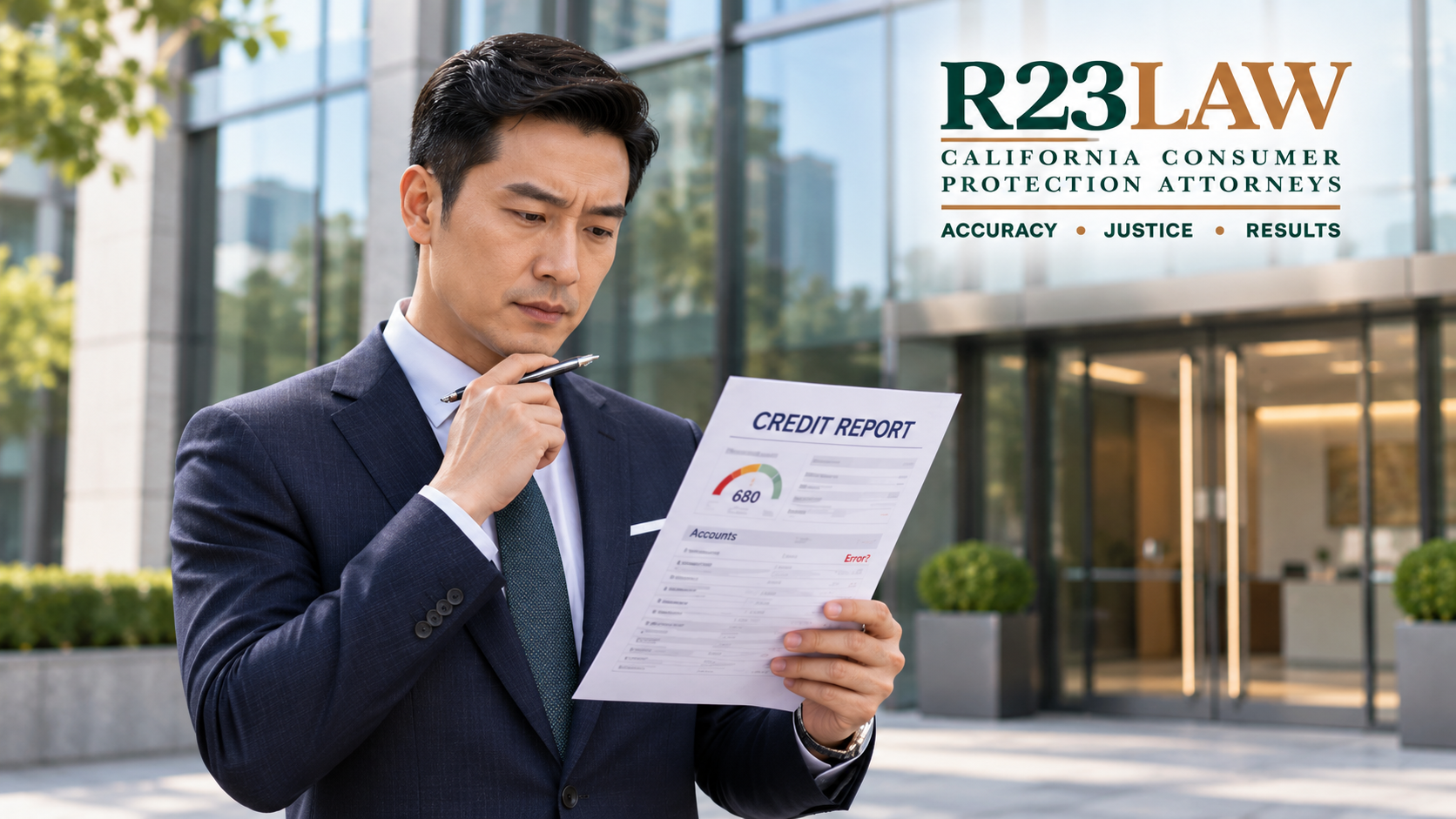
An unfamiliar credit account. A debt you already paid. A late payment that should have disappeared years ago.
Sometimes, the smallest inaccuracies on your credit report can create the biggest financial headaches.
For California consumers, credit reporting errors can affect mortgage approvals, auto financing, interest rates, and other important financial opportunities. Unfortunately, many individuals discover these mistakes only after experiencing a credit denial or another unexpected financial setback.
Credit report errors should never be ignored, especially when they involve inaccurate debts, outdated information, or accounts you never authorized.
At R23 Law, our experienced California Consumer Protection Attorneys advocate for consumers facing inaccurate credit reports, unresolved disputes, and potential violations of federal and California consumer protection laws.
SMALL ERRORS, BIG CONSEQUENCES — Why Credit Report Accuracy Matters
Your credit report plays an important role in determining your financial credibility.
Lenders rely on credit information when evaluating loan applications and establishing borrowing terms. When inaccurate negative information appears, consumers may receive higher interest rates or experience unnecessary credit denials.
Credit reporting mistakes are also more common than many consumers realize.
A 2012 Federal Trade Commission study found that approximately 25% of consumers who participated in the study identified at least one potentially material error on one or more of their credit reports.
Although this finding is historical, it underscores the importance of regularly examining your credit information.
Consumers can request free credit reports from Equifax, Experian, and TransUnion through AnnualCreditReport.com.
Free weekly online reports are currently available from these three nationwide credit reporting agencies.
Because information may differ between credit bureaus, reviewing all three reports is important.
SPOT THE MISTAKES — Common Credit Reporting Errors To Watch For
Credit reports can contain errors involving account ownership, payment histories, personal information, and outdated negative records.
Some common inaccuracies include:
Accounts You Never Opened — Credit cards or loans incorrectly associated with your identity.
Paid Debts Reported As Unpaid — Accounts displaying outstanding balances despite completed payments.
Incorrect Late Payments — Delinquencies that were improperly reported or remain beyond applicable reporting periods.
Inaccurate Account Statuses — Closed accounts incorrectly identified as active or accounts containing inaccurate closure information.
Mixed Credit Files — Financial information belonging to another consumer appearing on your report.
Discharged Bankruptcy Debts — Accounts inaccurately reported as currently owed despite a qualifying bankruptcy discharge.
Incorrect Personal Information — Unfamiliar addresses, incorrect names, or inaccurate identifying details.
Most qualifying negative credit information becomes obsolete after approximately seven years, subject to specific statutory rules and exceptions.
Certain bankruptcy information may remain reportable for up to 10 years.
Although older public records such as tax liens historically appeared on credit reports, the three major nationwide credit bureaus no longer routinely include tax liens in their standard consumer credit reports.
Not every negative entry is an error, but information that is inaccurate, incomplete, or legally obsolete may provide grounds for a dispute.
DISPUTE THE DAMAGE — Steps To Correct Inaccurate Credit Information
Under the Fair Credit Reporting Act (FCRA), consumers have the right to dispute inaccurate or incomplete information appearing on their credit reports.
The dispute process generally involves several important steps.
1. Identify And Document The Error
Review your credit reports carefully and highlight the inaccurate information.
Determine which reporting agencies display the mistake and preserve copies of the affected reports.
2. Gather Supporting Evidence
Collect records demonstrating why the information is inaccurate.
These may include:
Payment confirmations
Bank statements
Account closure letters
Debt settlement agreements
Bankruptcy discharge documentation
Identity theft reports
Submit copies of relevant documentation while keeping the originals for your records.
3. Submit A Written Credit Dispute
Notify each credit reporting agency displaying the inaccurate information.
Clearly identify the disputed account, explain the error, and request the appropriate correction.
Consumers may submit disputes online or by mail. Sending a written dispute through certified mail with return receipt requested can provide valuable documentation of delivery.
If the inaccurate information originated with a creditor or other information furnisher, consider submitting a separate dispute directly to that company.
4. Review The Investigation Results
Credit reporting agencies generally must investigate qualifying disputes within 30 days, subject to certain statutory exceptions and extensions.
After the investigation, review the results and confirm whether the incorrect information has been updated, corrected, or deleted as required by law.
If the error remains unresolved, additional legal options may be available.
THE LAW BACKS ACCURACY — FCRA And California Consumer Protections
The Fair Credit Reporting Act (FCRA) requires credit reporting agencies to follow reasonable procedures designed to assure the maximum possible accuracy of consumer credit information.
It also establishes requirements for investigating qualifying disputes and correcting information found to be inaccurate, incomplete, or unverifiable.
California consumers receive additional protections under the California Consumer Credit Reporting Agencies Act (CCRAA).
Depending on the circumstances, violations of these laws may provide grounds for compensation or other legal remedies.
Potential recovery may include qualifying financial losses, emotional distress damages, statutory damages for certain willful violations, and attorney's fees where authorized by law.
However, an inaccurate report alone does not automatically establish liability. Legal remedies depend on the applicable statutory requirements and the reporting agency's conduct.
PROTECTING YOUR CREDIT — R23 Law's California Consumer Protection Attorneys
When credit reporting agencies fail to properly investigate or correct inaccurate information, consumers may experience lasting financial consequences.
At R23 Law, our California Consumer Protection Attorneys advocate for individuals affected by unresolved credit report errors, inaccurate debt balances, mixed credit files, and identity theft-related reporting problems.
Our attorneys evaluate potential FCRA and CCRAA violations, review disputed credit information, and pursue available legal remedies when appropriate.
Our experienced legal team is committed to protecting consumers from unlawful credit reporting practices.
Learn more about R23 Law and our consumer finance law practice.
DON'T LET ERRORS LINGER — Protect Your Financial Future
Credit reporting errors can interfere with major financial decisions, but consumers have important rights to challenge inaccurate information.
Regularly reviewing your credit reports, documenting discrepancies, and submitting formal disputes can reduce the risk of prolonged financial harm.
R23 Law's California Consumer Protection Attorneys are committed to protecting consumers throughout California and pursuing accountability when credit reporting practices violate the law.
Contact R23 Law Today
If your credit report contains inaccurate accounts, outdated negative information, debts incorrectly reported as unpaid, or errors that remain unresolved after a dispute, your consumer protection rights may have been violated.
Contact R23 Law's California Consumer Protection Attorneys to discuss your circumstances and explore available legal options under the FCRA and CCRAA.
Our legal team is dedicated to protecting California consumers from unlawful credit reporting practices and related financial harm.
Toll-Free: 310-598-1588
SoCal: (310) 598-1588
Email: info@R23Law.com
Website: www.R23Law.com
Office: US Bank Tower, 633 W. 5th Street, 26th Floor, Los Angeles, CA
© 2025 R23 Law. All rights reserved. Trusted consumer credit lawyers in Los Angeles.
