
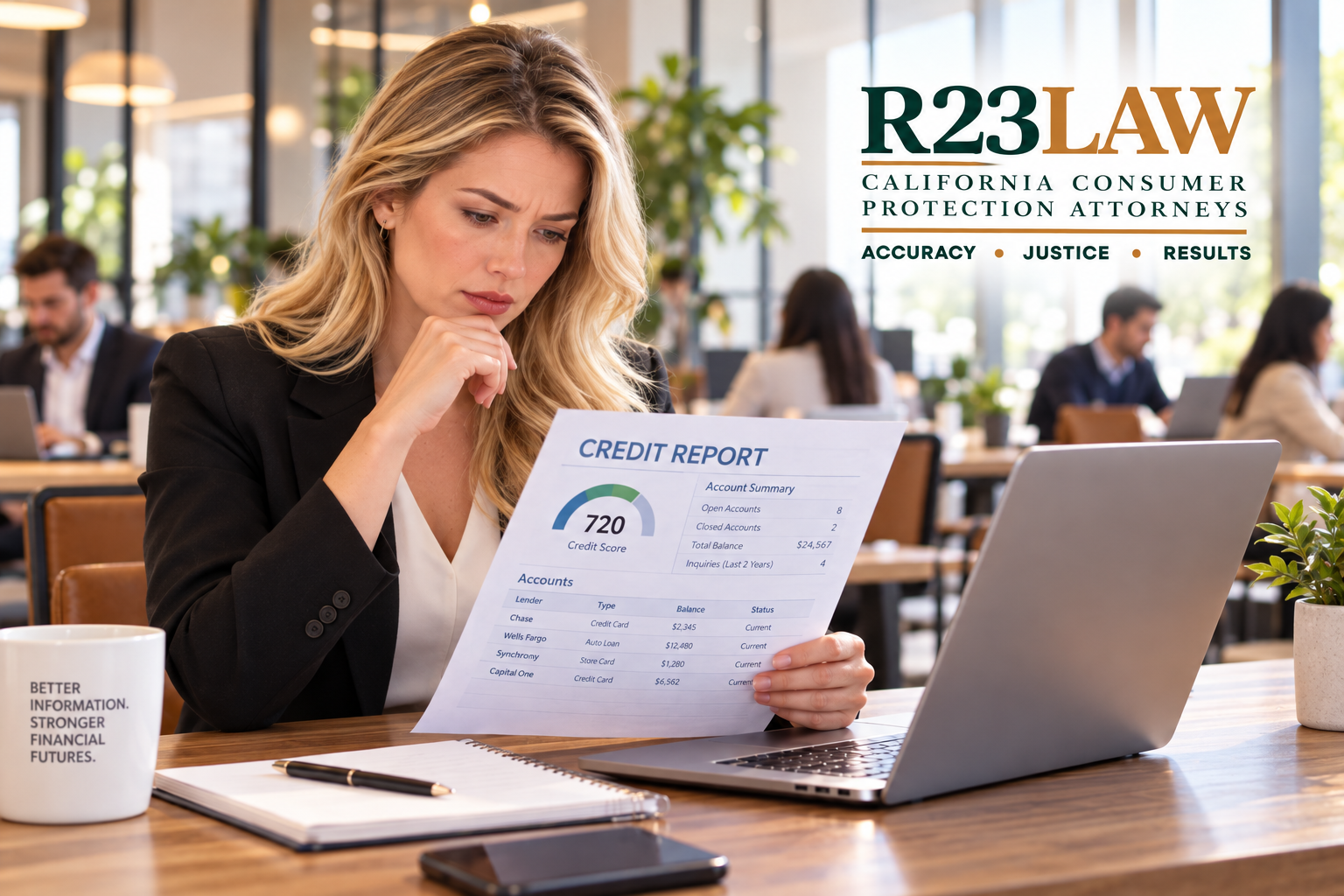
Your credit report contains a detailed record of your financial history
But between unfamiliar account names, payment histories, credit inquiries, and financial records, understanding everything listed can feel overwhelming.
For California consumers, knowing what belongs on a credit report is essential. Inaccurate information can affect credit scores, loan approvals, interest rates, and even housing opportunities. Worse, unfamiliar accounts or suspicious inquiries may indicate identity theft.
Understanding your credit report is the first step toward identifying errors and protecting your financial future.
At R23 Law, our experienced California Consumer Protection Attorneys advocate for consumers facing inaccurate credit reports, identity theft, and potential violations of federal and California consumer protection laws.
CREDIT REPORT BREAKDOWN — Understanding The Four Main Sections
The three major credit reporting agencies — Equifax, Experian, and TransUnion — collect and maintain information about consumers' credit histories.
Although their reports may look different, they generally contain four primary categories of information.
1. Personal Information
This section identifies you and may include your name, current and previous addresses, date of birth, partial Social Security number, and employment information.
Review these details carefully. Incorrect names, unfamiliar addresses, or information belonging to another individual may indicate reporting mistakes or a mixed credit file.
A mixed credit file occurs when information belonging to different consumers becomes improperly combined.
2. Credit Accounts And Trade Lines
Trade lines are records of credit accounts associated with your financial history.
They may include:
Credit cards and retail store accounts
Mortgages and auto loans
Personal loans
Credit limits and outstanding balances
Payment histories and account statuses
Review each account carefully to confirm that it belongs to you and accurately reflects your payment history.
For example, a store credit card you closed years ago may legitimately remain on your report. However, an unfamiliar account showing a large outstanding balance may indicate identity theft or inaccurate reporting.
An account does not automatically become fraudulent simply because it is old or closed. The important consideration is whether the information is accurate.
3. Public Records And Collection Accounts
Credit reports may contain certain public record information, particularly bankruptcy records.
Collection accounts may also appear when debts are reported by collection agencies.
Historically, credit reports included additional public record information, such as civil judgments and tax liens. However, the three major nationwide credit bureaus no longer routinely include those items in their standard consumer credit reports.
Review any bankruptcy or collection information carefully to confirm that it belongs to you and remains legally reportable.
4. Credit Inquiries
Credit inquiries identify businesses that have accessed your credit information.
These generally fall into two categories:
Hard Inquiries — Typically associated with applications for credit and may affect credit scores.
Soft Inquiries — May arise from account reviews, certain preapproved credit offers, or consumers checking their own reports.
Hard inquiries generally remain on credit reports for approximately two years.
Unfamiliar inquiries deserve attention because they may indicate unauthorized credit applications or other reporting issues.
BEHIND THE NUMBERS — Where Credit Bureaus Get Your Information
Credit reporting agencies do not independently create every account record appearing on your credit report.
Much of the information comes from businesses known as information furnishers.
These may include:
Banks and credit card issuers
Mortgage and auto lenders
Loan servicing companies
Debt collection agencies
Other businesses that report qualifying credit information
Under the Fair Credit Reporting Act (FCRA), credit reporting agencies and information furnishers have legal obligations relating to the accuracy and investigation of consumer credit information.
Unfortunately, administrative errors, outdated account records, or incorrect identifying information can cause inaccurate entries.
For example, a creditor may report a debt as unpaid even after receiving payment, or another consumer's account may mistakenly appear on your credit report.
R23 Law's California Consumer Protection Attorneys evaluate potential reporting violations when inaccurate information creates financial consequences for consumers.
ACCESS GRANTED — Understanding Who Can View Your Credit Report
Your credit report contains sensitive financial information, but certain businesses and organizations may legally access it for purposes permitted under the FCRA.
Depending on the circumstances, these may include:
Lenders And Creditors — Evaluating credit applications or reviewing existing accounts.
Debt Collectors — Accessing information for qualifying debt collection purposes.
Insurance Companies — Reviewing information for permitted insurance underwriting purposes.
Landlords — Evaluating rental applications.
Employers — Obtaining consumer reports for employment purposes, subject to applicable consent and legal requirements.
Certain Government Agencies — Accessing information when authorized by law.
Not every business can access your credit report simply because it wants to.
The FCRA generally requires a legally permissible purpose, and additional restrictions may apply under California law.
If you discover unfamiliar credit inquiries, investigate whether they resulted from legitimate account activity or potentially unauthorized access.
SPOT THE ERROR — Protecting Your Rights Under The FCRA
Regularly reviewing your credit reports can reveal inaccurate information before it causes serious financial harm.
Consumers can obtain free credit reports from Equifax, Experian, and TransUnion through AnnualCreditReport.com.
If you discover an error, consider these steps:
Identify The Inaccuracy — Locate the incorrect account, balance, payment history, or identifying information.
Gather Documentation — Collect payment records, account statements, or other supporting evidence.
Submit A Formal Dispute — Notify each credit reporting agency displaying the inaccurate information.
Preserve Your Records — Keep copies of dispute letters, supporting documents, and investigation results.
Review The Outcome — Confirm whether the disputed information has been corrected.
Under the FCRA, credit reporting agencies generally must conduct reasonable reinvestigations of qualifying disputes within 30 days, subject to certain exceptions and extensions.
California consumers may also receive protections under the California Consumer Credit Reporting Agencies Act (CCRAA).
When reporting agencies or information furnishers violate applicable legal requirements, consumers may have grounds to pursue damages or other available legal remedies.
PROTECTING YOUR CREDIT — R23 Law's California Consumer Protection Attorneys
Credit reporting errors can interfere with important financial opportunities, particularly when inaccurate information remains unresolved after a dispute.
At R23 Law, our California Consumer Protection Attorneys advocate for consumers affected by inaccurate credit reports, mixed credit files, identity theft-related accounts, and potential FCRA and CCRAA violations.
Our attorneys evaluate reporting inaccuracies, improper dispute investigations, and potential unlawful access to consumer credit information.
Our experienced legal team is committed to protecting consumer rights and pursuing accountability when credit reporting practices violate applicable law.
Learn more about R23 Law and our consumer finance law practice.
READ BETWEEN THE LINES — Protect Your Financial Future
Understanding your credit report allows you to recognize inaccurate accounts, outdated records, and suspicious inquiries before they create additional problems.
Although credit reports contain extensive financial information, consumers have important rights concerning their accuracy, privacy, and permissible use.
R23 Law's California Consumer Protection Attorneys are dedicated to defending consumers throughout California from unlawful credit reporting practices and related financial harm.
Contact R23 Law Today
If your credit report contains inaccurate accounts, incorrect payment information, suspicious inquiries, or errors that remain unresolved after a dispute, your consumer protection rights may have been violated.
Contact R23 Law's California Consumer Protection Attorneys to discuss your situation and explore available legal options under the FCRA and CCRAA.
Our legal team is committed to protecting California consumers and pursuing accountability when unlawful credit reporting practices cause harm.
Toll-Free: 310-598-1588
SoCal: (310) 598-1588
Email: info@R23Law.com
Website: www.R23Law.com
Office: US Bank Tower, 633 W. 5th Street, 26th Floor, Los Angeles, CA
© 2025 R23 Law. All rights reserved. Trusted consumer credit lawyers in Los Angeles.
