
DISPUTES, DELAYS, AND DOLLARS LOST — The Real Timeline Behind Fixing Credit Report Errors
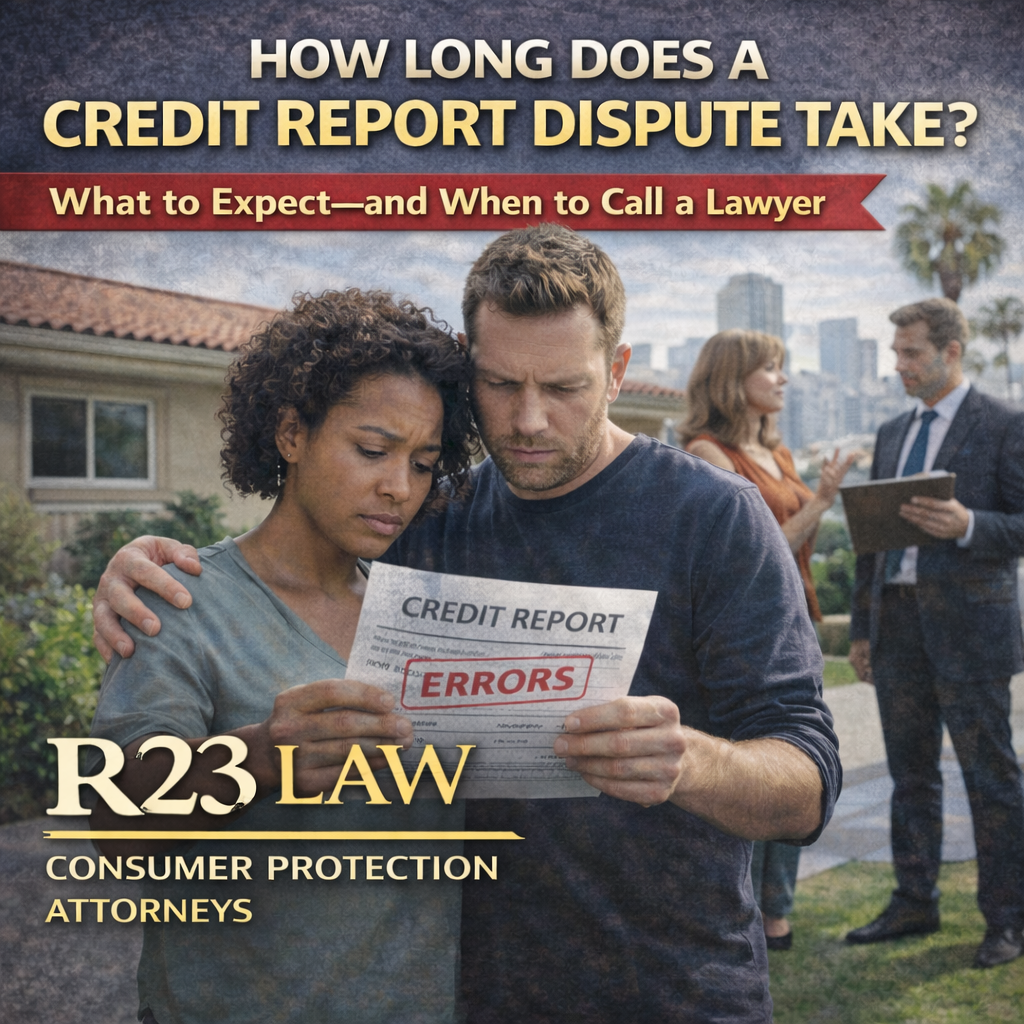
Disputing errors on your credit report?
Learn how long the process takes, how to escalate unresolved disputes, and when R23 Law’s Credit Reporting Attorneys can help you get results.
Finding an error on your credit report can be frustrating—and in many cases, financially damaging. Whether it’s a wrongly reported late payment, a closed account showing as active, or a case of mistaken identity, you have the legal right to dispute the error under the Fair Credit Reporting Act (FCRA).
But how long does a credit dispute take—and what happens if the credit bureau refuses to fix the mistake?
Here’s what you need to know, straight from R23 Law’s California Credit Reporting Attorneys.
How Long Do Credit Bureaus Have to Respond?
Under the FCRA, the major credit bureaus (Experian, Equifax, and TransUnion) are legally required to complete their investigation within 30 to 45 days of receiving your dispute.
30 days for standard disputes
45 days if you provide additional documentation during the process
While the law sets a timeline, that doesn’t guarantee the bureaus will resolve the issue in your favor—or correctly.
Credit Dispute Timeline: What to Expect
Here’s a breakdown of the typical steps:
Step 1: Get Your Credit Report
Visit AnnualCreditReport.com to get your free reports from all three bureaus. Check thoroughly for any inaccurate, outdated, or duplicated items.
Step 2: Identify the Error
Make note of all incorrect entries—no matter how small. Even a misspelled name or wrong account date can cause issues.
Step 3: Gather Documentation
Examples include:
Payment confirmations
Discharge papers
Lease agreements
Court documents
Step 4: Write and Send a Dispute Letter
Use certified mail to preserve your rights. Include supporting evidence, and request either a reinvestigation or correction. Sample letters are available from the FTC or through your attorney.
Step 5: Wait for Bureau Response
They must respond in 30–45 days. But if they reject your dispute—or ignore clear proof—you’ll need to escalate.
What If the Credit Bureau Refuses to Fix the Error?
Unfortunately, many disputes are improperly denied. Here’s what you can do next:
Request investigation records and verify the steps they took.
Submit new or additional evidence.
File a complaint with the CFPB or your state attorney general.
Consult a credit reporting attorney to explore your legal options.
If a bureau repeatedly fails to correct an error, you may be able to sue for:
Actual damages (e.g., lost housing, job, or credit opportunities),
Statutory damages up to $1,000 per violation,
Punitive damages for willful misconduct, and
Attorney’s fees.
Why Work With R23 Law?
Credit bureaus don’t always play fair—and consumers often give up too early. At R23 Law, we’ve seen every type of credit reporting issue and fought back against every major bureau.
We help clients:
Fix persistent or denied credit errors
Escalate disputes with proper documentation
File lawsuits under the FCRA when necessary
Recover financial compensation for credit harm
We only bill the companies we sue—never our clients.
Don’t Let Credit Errors Control Your Financial Future
If your credit dispute has stalled or been wrongly denied, we’re here to help. Our R23 Law California Credit Report Dispute Lawyers know how to get results—whether through negotiation, litigation, or both.
📞 Free case evaluations. No fees unless we win.
📄 Let us take the stress out of credit disputes—so you can move forward with confidence.
