
RÉSUMÉ CLEAN, REPORT DIRTY — What Employment Background Checks Really Show
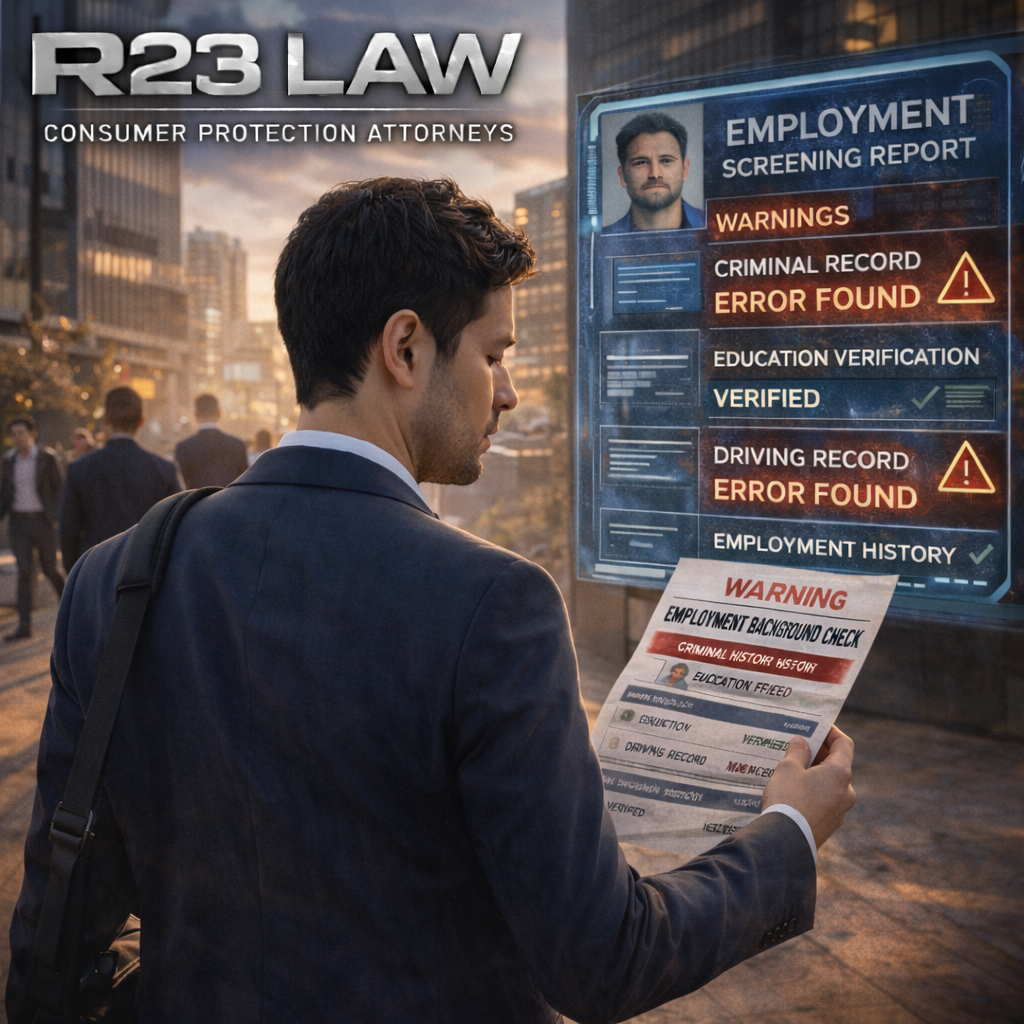
Employment background checks can include job history, education, criminal records, and driving history—and errors can cost offers
Learn FCRA and California rights with R23 Law’s California Consumer Protection Attorneys.
An employment background check is supposed to confirm that your application matches reality. In practice, it’s often a bundle of data pulls—some accurate, some incomplete, and sometimes flat-out wrong. The attached overview breaks down the most common categories employers screen for: employment verification, education verification, criminal history, and driving records—often through a third-party employment screening company.
When that screening report contains negative information (or inaccurate information that looks negative), your career can stall fast. That’s where federal consumer reporting rules and California protections matter—and where R23 Law’s California Consumer Protection Attorneys focus when a report becomes a roadblock.
What an Employment Background Check Typically Includes
Most screening packages pull from a few standard buckets. The attached piece lists the core “types of background checks” that show up in routine employment screening.
Employment verification
Employment verification generally checks what you claimed about prior jobs—such as job titles, start and end dates, responsibilities, and sometimes pay information, and employers may also request references.
Where things go sideways:
merged files (you and someone with a similar name)
outdated employer records
staffing agency confusion (who “employed” you vs. where you worked)
Education verification
Education verification can include confirming degree type, graduation date, transcripts, honors, and whether you have certain certifications or licenses required for the role.
Common problems:
schools reporting under a different name (maiden name, hyphenated name)
international transcripts being misread
a certification renewal not reflected in the database
Criminal history background check
A criminal history check may scan federal, state, and local records and can show items like arrests, convictions (felonies/misdemeanors), court records, warrants, sex offenses, and incarceration records, depending on what’s available and what’s searched.
High-impact error patterns:
mistaken identity (same/similar name)
missing dispositions (a case shows up without the outcome)
records that should not be reported in the way they appear
Motor vehicle and driving record report
For jobs involving driving, deliveries, heavy machinery, or use of a company vehicle, employers may review driving violations or accidents and may verify that you hold the appropriate commercial license. The attached overview notes employers may look back as far as seven years for certain driving information.
The FCRA: Accuracy Standards and Notice Rules in Plain English
Many employment screening reports are “consumer reports” governed by the Fair Credit Reporting Act (FCRA). Under the FCRA, consumer reporting agencies must follow reasonable procedures to assure maximum possible accuracy.
The attached overview also highlights a core consumer principle: screening agencies shouldn’t “grade” you with opinions—they report data—and you have the right to review what’s being reported and challenge inaccuracies.
Pre-adverse action and adverse action
If an emke adverse action based on a consumer report—like rejecting your application—FCRA rules generally require a pre-adverse action step: providing you a copy of the report and a summary of your rights, before the final decision.
This matters because it creates a window to catch obvious mistakes before a “no” becomes final.
California Overlay: The Fair Chance Act Timing Rule
In California, the Fair Chance Act (Gov. Code § 12952) generally restricts employers with five or more employees from asking about conviction history before a conditional offer (with certain exceptions).
That timing rule often changes when and how a background check becomes part of the hiring process—especially for roles where employers use a standardized screening vendor.
When a Background Check Error Costs an Offer
The attached overview is blunt about reality: errors on employment reports happen, and you have the right to dispute incorrect or incomplete information.
From a consumer protection standpoint, the most damaging situations usually involve:
wrong person criminal records
missing dispositions that make a resolved case look worse than it is
incorrect license staeducation mismatches caused by outdated databases
These aren’t “small mistakes” when the consequence is unemployment, lost wages, or a stalled career track.
A Clean Paper Trail After a Denial
If you suspect an employment background check error, documentation is leverage. Consider compiling:
the full report (not a portal summary)
the pre-adverse action notice and adverse action notice (if provided)
screenshots of hiring portal status changes
proof documents (diploma, license status, court disposition, prior pay stubs/W-2s, offer emails)
And if you dispute, do it in a way that preserves timing and content (keeping copies of what you sent and what you received).
Where R23 Law’s California Consumer Protection Attorneys Focus
Background screening is consumer reporting. When a screening report is inaccurate, incomplete, or mishandled—and it affects hiring decisions—R23 Law’s California Consumer Protection Attorneys evaluate potential claims under the FCRA and applicable California protections, with an eye toward accountability and financial recovery where the facts support it.
If you lost a job opportunity because a report didn’t reflect reality, the legal question often isn’t just “was it corrected later?” It’s whether the reporting and notice process complied with the rules—and what the harm was when it didn’t.
Disclaimer: This content is for informational purposes only and does not constitute legal advice.
