
DOES NOT COMPUTE – When Impossible Credit Report Errors Defy Reality
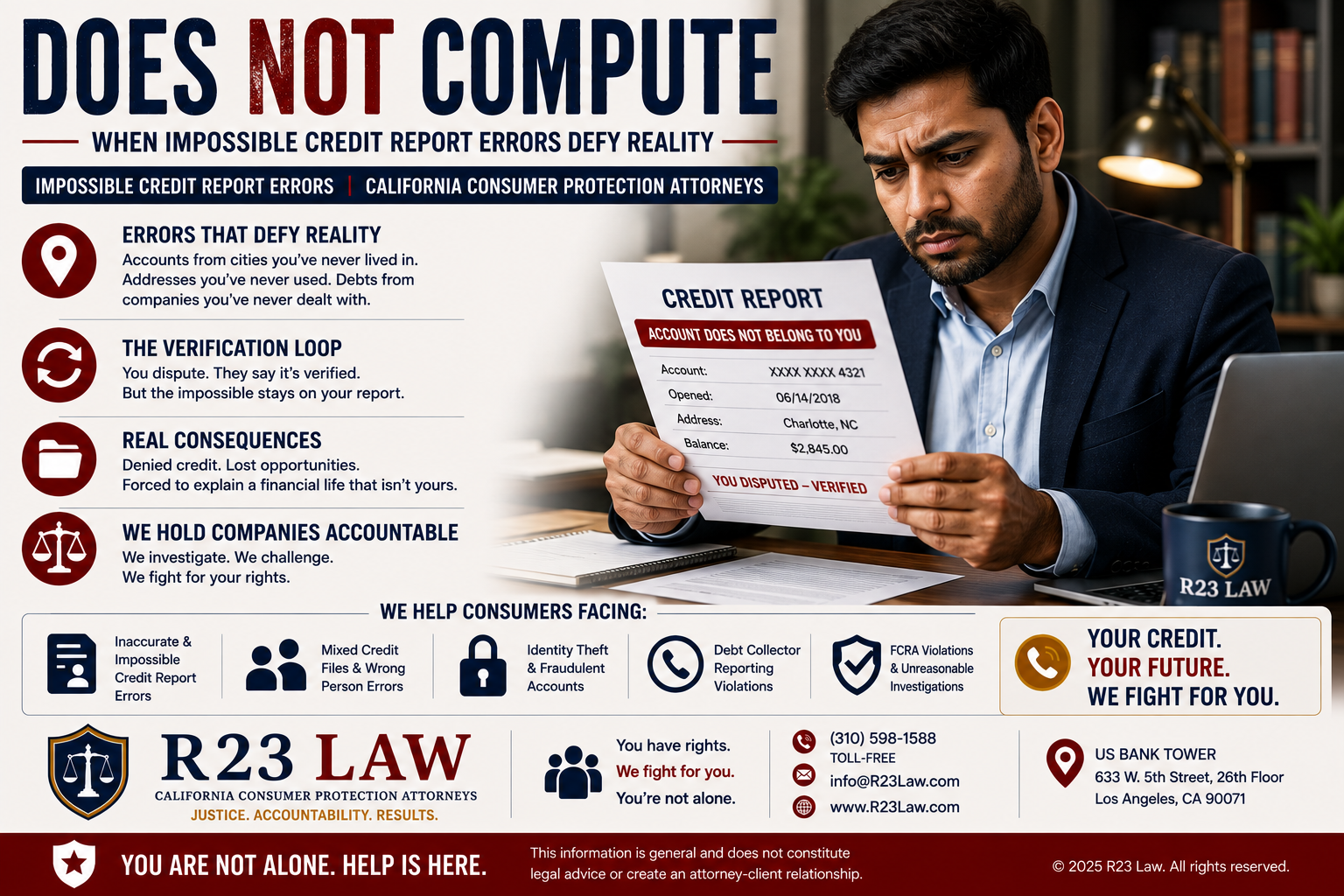
Impossible Credit Report Errors | California Consumer Protection Attorneys
Credit report errors involving accounts, addresses, debts, or timelines that cannot belong to you can cause serious financial consequences. Learn what makes these errors different and when R23 Law’s California Consumer Protection Attorneys may be able to pursue accountability.
Some credit report errors are minor. Others are frustrating. Then there are errors so obviously wrong that they seem to belong in someone else’s life entirely.
An account appears from a city where you have never lived. A creditor reports activity from a time or place that does not fit your history. An address you have never used suddenly appears on your credit file. A debt from a company you have never dealt with is presented as yours.
These are not simply unfamiliar entries.
They are credit report errors that contradict basic facts about your life.
Yet even when an error looks impossible, a credit reporting system may continue treating it as accurate.
For California consumers, that disconnect can create very real consequences. Inaccurate credit information can surface when applying for housing, credit, insurance, employment, phone service, or other opportunities that depend on consumer reporting.
When obviously inaccurate information refuses to disappear, R23 Law’s California Consumer Protection Attorneys focus on the conduct behind the reporting, the dispute process, and the harm the error has caused.
IMPOSSIBLE ERRORS – Credit Information That Does Not Fit Your Life
An “impossible” credit report error goes beyond an account you simply do not recognize.
The information conflicts with objective facts about you.
Examples may include:
Accounts opened in cities or states where you never lived.
Addresses you never used.
Debts involving companies you never did business with.
Account activity occurring during a period when you could not have opened or used the account.
Reporting histories that do not match where you lived, worked, or banked.
Financial information apparently belonging to another consumer.
From the consumer’s perspective, these errors can seem simple to resolve. If the account could not possibly belong to you, the reporting should reflect that reality.
Credit reporting systems, however, may not evaluate information in the same way a person would.
DATA VERSUS REALITY – Why Obviously Wrong Information Can Remain
Credit reporting systems process enormous amounts of information.
They rely on identifying data supplied by creditors, furnishers, and other sources. Names, addresses, Social Security numbers, account numbers, and reporting histories can all be used to associate financial information with a consumer.
That process can create a serious problem.
A system may see enough matching data points to continue associating an account with you even when the surrounding circumstances make no sense.
The system sees matching data. You see a financial history that is not yours.
That difference matters.
An incorrect address or account may look credible inside a database while remaining completely incompatible with the consumer’s actual life.
WRONG PERSON, WRONG FILE – The Connection To Mixed Credit Reports
Impossible errors can overlap with what is commonly described as a mixed credit file.
A mixed credit file can occur when information belonging to another person becomes associated with your consumer report. Similar names, identifying information, addresses, or other data can contribute to information being placed in the wrong file.
The result can feel surreal.
A lender may ask you to explain an account you never opened.
A landlord may question an address you have never seen.
A collector may demand payment for a company you have never dealt with.
You may suddenly find yourself defending another person’s financial history as though it were your own.
VERIFIED AGAIN – When The Credit Reporting Dispute Becomes A Loop
Consumers often expect obvious facts to carry obvious weight.
If an account was supposedly opened somewhere you never lived, or activity occurred during a timeline that cannot fit your circumstances, it may seem that providing those facts should end the dispute.
That does not always happen.
The dispute process may rely heavily on the same data sources responsible for reporting the information in the first place. If those sources continue connecting the account to the consumer, the disputed information may return as “verified.”
That can create a frustrating cycle:
The consumer identifies information that plainly does not belong.
The consumer disputes the inaccurate information.
The system checks existing reporting sources.
Those sources repeat the same connection.
The information returns as verified.
The consumer is attempting to correct reality.
The system may simply be confirming consistency with information already in its databases.
“VERIFIED” DOES NOT ALWAYS FEEL LIKE INVESTIGATED
IMPOSSIBLE ERRORS – Credit Information That Does Not Fit Your Life
An “impossible” credit report error goes beyond an account you simply do not recognize.
The information conflicts with objective facts about you.
Examples may include:
Accounts opened in cities or states where you never lived.
Addresses you never used.
Debts involving companies you never did business with.
Account activity occurring during a period when you could not have opened or used the account.
Reporting histories that do not match where you lived, worked, or banked.
Financial information apparently belonging to another consumer.
From the consumer’s perspective, these errors can seem simple to resolve. If the account could not possibly belong to you, the reporting should reflect that reality.
Credit reporting systems, however, may not evaluate information in the same way a person would.
DATA VERSUS REALITY – Why Obviously Wrong Information Can Remain
Credit reporting systems process enormous amounts of information.
They rely on identifying data supplied by creditors, furnishers, and other sources. Names, addresses, Social Security numbers, account numbers, and reporting histories can all be used to associate financial information with a consumer.
That process can create a serious problem.
A system may see enough matching data points to continue associating an account with you even when the surrounding circumstances make no sense.
The system sees matching data. You see a financial history that is not yours.
That difference matters.
An incorrect address or account may look credible inside a database while remaining completely incompatible with the consumer’s actual life.
WRONG PERSON, WRONG FILE – The Connection To Mixed Credit Reports
Impossible errors can overlap with what is commonly described as a mixed credit file.
A mixed credit file can occur when information belonging to another person becomes associated with your consumer report. Similar names, identifying information, addresses, or other data can contribute to information being placed in the wrong file.
The result can feel surreal.
A lender may ask you to explain an account you never opened.
A landlord may question an address you have never seen.
A collector may demand payment for a company you have never dealt with.
You may suddenly find yourself defending another person’s financial history as though it were your own.
VERIFIED AGAIN – When The Credit Reporting Dispute Becomes A Loop
Consumers often expect obvious facts to carry obvious weight.
If an account was supposedly opened somewhere you never lived, or activity occurred during a timeline that cannot fit your circumstances, it may seem that providing those facts should end the dispute.
That does not always happen.
The dispute process may rely heavily on the same data sources responsible for reporting the information in the first place. If those sources continue connecting the account to the consumer, the disputed information may return as “verified.”
That can create a frustrating cycle:
The consumer identifies information that plainly does not belong.
The consumer disputes the inaccurate information.
The system checks existing reporting sources.
Those sources repeat the same connection.
The information returns as verified.
The consumer is attempting to correct reality.
The system may simply be confirming consistency with information already in its databases.
“VERIFIED” DOES NOT ALWAYS FEEL LIKE INVESTIGATED
For consumers, the word “verified” can be especially frustrating.
It sounds as though someone carefully reviewed the dispute, examined the evidence, compared the disputed account with the consumer’s actual history, and independently concluded that the information was correct.
But when the same impossible information continues appearing, the consumer may reasonably wonder whether the substance of the dispute was ever meaningfully considered.
A verification result does not change the basic problem:
Information that does not belong to the consumer is still being reported as though it does.
For consumers facing repeated credit reporting errors, maintaining a clear record of what was disputed, what evidence was provided, and how the companies responded can become especially important.
PAPER TRAIL MATTERS – Documents Consumers Should Preserve
When a credit report contains information that clearly conflicts with your life, preserve the evidence.
Useful records may include:
Copies of credit reports showing the inaccurate information.
Dispute letters and supporting documents.
Credit bureau responses.
Creditor or furnisher correspondence.
Applications affected by the inaccurate information.
Credit, housing, employment, or other denial notices.
Documents showing your actual address history.
Records demonstrating where you lived, worked, or banked during the disputed period.
Any materials demonstrating why the reported account or activity could not belong to you.
Keep complete copies rather than relying solely on online portals or account access that may later change.
A documented timeline can show both why the information is impossible and what occurred after the consumer brought the error to the companies’ attention.
OBVIOUS ERROR, REAL DAMAGE – The Consequences Can Extend Beyond A Credit Score
An impossible credit report error is not merely a technical inconvenience.
Inaccurate consumer reporting may arise at exactly the moment someone is trying to move forward financially.
The problem may surface during:
A mortgage or credit application.
An apartment application.
An employment screening process.
An insurance application.
A phone or utility application.
A collection demand involving an unfamiliar debt.
The consumer may then be forced to explain information that should never have appeared in the first place.
And when inaccurate information survives repeated disputes, the issue can become much more serious than a simple database mistake.
R23 LAW’S CALIFORNIA CONSUMER PROTECTION ATTORNEYS TAKE CREDIT REPORT ERRORS SERIOUSLY
Consumers should not have to accept a financial identity that does not belong to them.
When accounts, addresses, debts, or timelines appear on a consumer report despite being fundamentally inconsistent with the consumer’s real history, the dispute deserves meaningful attention.
R23 Law’s California Consumer Protection Attorneys represent consumers confronting credit reporting errors, mixed credit files, identity theft-related reporting problems, and other consumer financial disputes.
Our attorneys examine the reporting history, dispute records, company responses, supporting documentation, and resulting consumer harm to determine what legal options may be available.
If inaccurate credit information continues appearing after you have challenged it, preserving your documents and obtaining a legal evaluation may be important.
Contact R23 Law’s California Consumer Protection Attorneys for a free consultation regarding inaccurate credit reporting and related consumer protection claims.
Your credit report should describe your financial history—not someone else’s.
It sounds as though someone carefully reviewed the dispute, examined the evidence, compared the disputed account with the consumer’s actual history, and independently concluded that the information was correct.
But when the same impossible information continues appearing, the consumer may reasonably wonder whether the substance of the dispute was ever meaningfully considered.
A verification result does not change the basic problem:
Information that does not belong to the consumer is still being reported as though it does.
For consumers facing repeated credit reporting errors, maintaining a clear record of what was disputed, what evidence was provided, and how the companies responded can become especially important.
PAPER TRAIL MATTERS – Documents Consumers Should Preserve
When a credit report contains information that clearly conflicts with your life, preserve the evidence.
Useful records may include:
Copies of credit reports showing the inaccurate information.
Dispute letters and supporting documents.
Credit bureau responses.
Creditor or furnisher correspondence.
Applications affected by the inaccurate information.
Credit, housing, employment, or other denial notices.
Documents showing your actual address history.
Records demonstrating where you lived, worked, or banked during the disputed period.
Any materials demonstrating why the reported account or activity could not belong to you.
Keep complete copies rather than relying solely on online portals or account access that may later change.
A documented timeline can show both why the information is impossible and what occurred after the consumer brought the error to the companies’ attention.
OBVIOUS ERROR, REAL DAMAGE – The Consequences Can Extend Beyond A Credit Score
An impossible credit report error is not merely a technical inconvenience.
Inaccurate consumer reporting may arise at exactly the moment someone is trying to move forward financially.
The problem may surface during:
A mortgage or credit application.
An apartment application.
An employment screening process.
An insurance application.
A phone or utility application.
A collection demand involving an unfamiliar debt.
The consumer may then be forced to explain information that should never have appeared in the first place.
And when inaccurate information survives repeated disputes, the issue can become much more serious than a simple database mistake.
R23 LAW’S CALIFORNIA CONSUMER PROTECTION ATTORNEYS TAKE CREDIT REPORT ERRORS SERIOUSLY
Consumers should not have to accept a financial identity that does not belong to them.
When accounts, addresses, debts, or timelines appear on a consumer report despite being fundamentally inconsistent with the consumer’s real history, the dispute deserves meaningful attention.
R23 Law’s California Consumer Protection Attorneys represent consumers confronting credit reporting errors, mixed credit files, identity theft-related reporting problems, and other consumer financial disputes.
Our attorneys examine the reporting history, dispute records, company responses, supporting documentation, and resulting consumer harm to determine what legal options may be available.
If inaccurate credit information continues appearing after you have challenged it, preserving your documents and obtaining a legal evaluation may be important.
Your credit report should describe your financial history—not someone else’s.
