
ERRORS WITH INTEREST — Long-Term Credit Report Damage
An error on a credit report may look like a small clerical problem
Its financial consequences can be anything but small.
An incorrect balance, false late payment, duplicate account, or debt belonging to another consumer can affect lending decisions for months or even years. Consumers may face higher interest rates, repeated credit denials, collection activity, or difficulty obtaining a mortgage or vehicle loan.
Some consumers do not discover these mistakes until a lender has already denied an application or offered substantially less favorable terms. By then, the error may have affected several financial decisions.
R23 Law's California Consumer Protection Attorneys represent consumers throughout California when inaccurate credit reporting causes financial harm and companies fail to properly correct documented errors.
Credit Report Errors Rarely Stay Contained
Credit reports influence how lenders evaluate a consumer’s creditworthiness. Credit scores are also calculated using information found in credit files, which means inaccurate reporting can unnecessarily lower a score.
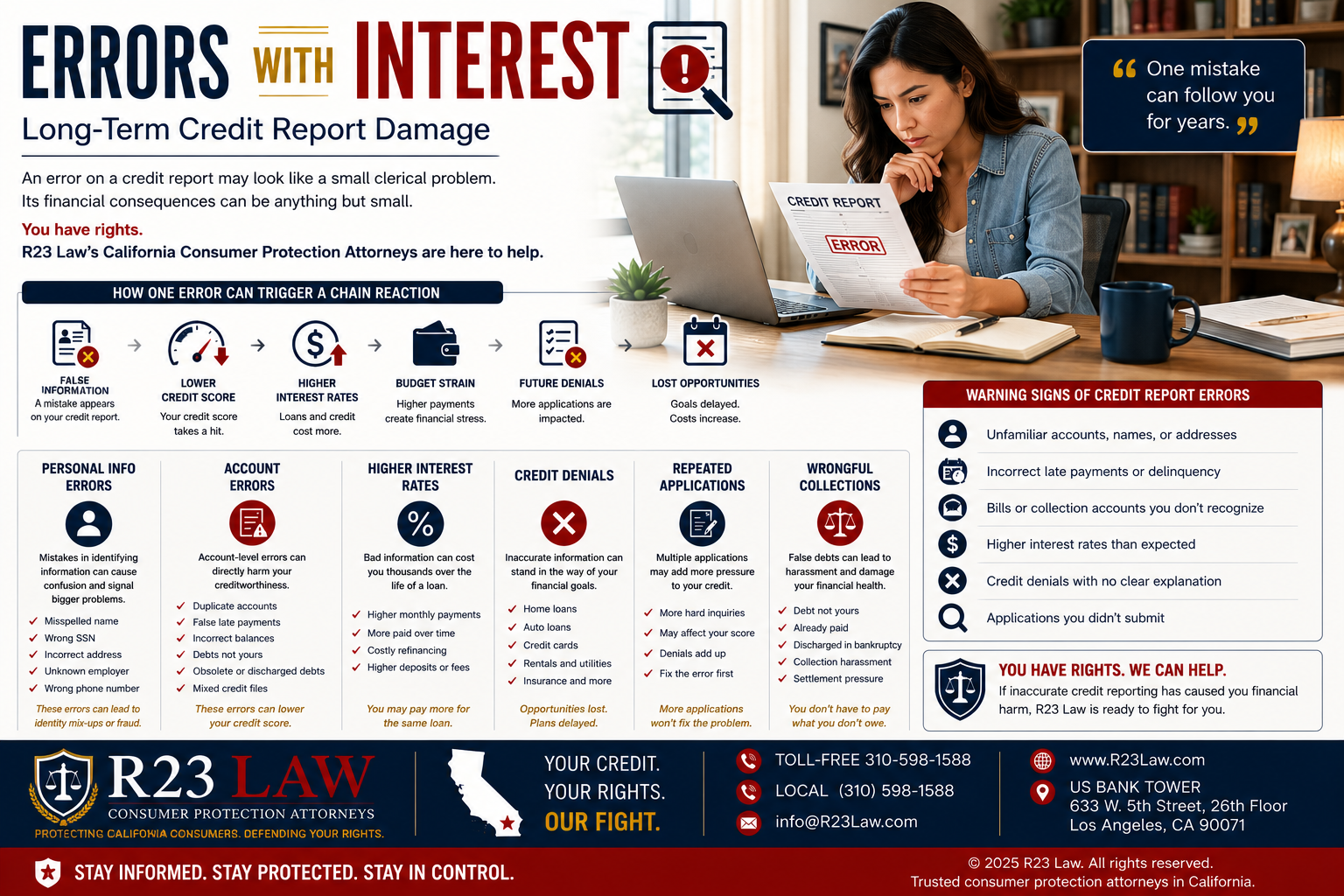
A single mistake can create a chain reaction—
A false delinquency lowers a credit score
A lower score results in a higher interest rate
The increased payment strains the consumer’s budget
The consumer delays another financial goal
The inaccurate account continues to be reported
Future applications are evaluated using the same false information
The original error may involve only one account. The resulting financial injury can extend to a mortgage application, vehicle purchase, rental decision, or other important transaction.
Personal Information Errors Can Signal Larger Problems
Some credit report errors involve personal identifying information rather than account history.
These mistakes may include—
A misspelled name
An unfamiliar name or alias
An incorrect Social Security number
An outdated or unknown address
An employer the consumer does not recognize
A telephone number that does not belong to the consumer
A minor spelling error may not directly lower a credit score. However, incorrect identifying information can interfere with identity verification or indicate that another consumer’s information has been mixed into the file.
An unfamiliar address or name may also be an early warning sign of identity theft.
Consumers should not ignore personal information errors simply because they do not appear to involve money. Those details may reveal why inaccurate accounts are appearing on the report.
Account Errors Can Directly Distort Creditworthiness
Account-level mistakes are often more damaging because they can affect payment history, balances, utilization, and the overall appearance of financial responsibility.
Common credit report errors include—
Duplicate accounts
Payments incorrectly reported as late
Accounts falsely listed as delinquent
Incorrect balances
Closed accounts reported as open
Accounts incorrectly attributed to the consumer
Debts discharged in bankruptcy but still reported improperly
Obsolete debts remaining beyond the permitted reporting period
Fraudulent accounts caused by identity theft
Mixed credit files involving another consumer
Collection accounts for debts that are not owed
The attached source identifies duplicate accounts, false delinquency reporting, incorrect balances, discharged debts, obsolete debts, and mixed credit files as common errors with serious long-term consequences.
Higher Interest Rates Increase The Real Cost Of Credit
Consumers with damaged credit may still receive loan approval, but the offered terms can be significantly more expensive.
A higher interest rate can increase—
Monthly loan payments
The total cost of vehicle financing
Mortgage interest paid over time
Credit card finance charges
Personal loan expenses
Required security deposits
The consumer may end up paying more for the same loan solely because a lender evaluated inaccurate information.
Even after the credit report is corrected, the consumer may remain trapped in financing obtained while the error was active. Refinancing may require another application, additional fees, or further credit review.
Credit Denials Can Delay Major Financial Goals
Inaccurate credit reporting can make a consumer appear riskier than they actually are.
That false picture may interfere with—
Purchasing a home
Refinancing a mortgage
Financing a reliable vehicle
Obtaining a credit card
Consolidating existing debt
Renting an apartment
Establishing utility service
Securing affordable insurance terms
A denied mortgage may cause a consumer to lose a home purchase opportunity. A denied vehicle loan may interfere with transportation to work. A rejected rental application may force a family to remain in unsuitable housing.
These are not abstract credit problems. They are real financial injuries with long-term consequences.
Repeated Applications Can Create Additional Credit Pressure
A consumer who does not know that a credit report contains errors may continue applying with different lenders.
Each new application may result in another hard inquiry. Although the effect depends on the scoring model, timing, and type of credit sought, repeated applications over a short period can affect how a consumer’s credit activity appears. The CFPB notes that applying for substantial credit within a short period may suggest that a consumer’s financial circumstances have changed.
The consumer may believe that applying again will produce a better result. Instead, the same false information may lead to another denial.
Correcting the underlying credit error before submitting additional applications can prevent the problem from continuing.
False Reporting Can Lead To Wrongful Collection Activity
An inaccurate credit report may reflect a debt that does not belong to the consumer, has already been paid, or resulted from identity theft.
That error may later trigger—
Collection letters
Repeated telephone calls
Settlement demands
Threatened lawsuits
Lawsuits involving debts the consumer does not owe
Additional negative credit reporting
Wrongful collection activity can force a consumer to spend substantial time gathering documents and explaining the same error to several companies.
When a disputed debt is transferred between collectors, the inaccurate information may continue circulating even after the consumer has provided proof.
Adverse Action Notices Provide Important Information
When a company takes adverse action based in whole or in part on information in a consumer report, the Fair Credit Reporting Act generally requires notice to the consumer.
That notice must identify the consumer reporting agency that supplied the report and inform the consumer of the right to obtain a free copy and dispute inaccurate or incomplete information. Federal law provides a 60-day period for requesting the free report identified in the notice.
Consumers should preserve every adverse action notice involving—
Denied credit
Increased credit costs
Rejected rental applications
Other unfavorable decisions based on a consumer report
The notice may identify which credit reporting agency supplied the inaccurate information and establish when the consumer first discovered the resulting harm.
The Fair Credit Reporting Act Protects Consumers
The Fair Credit Reporting Act gives consumers the right to dispute inaccurate or incomplete information.
Correcting an error generally requires contacting both—
The credit reporting agency displaying the error
The bank, lender, collector, or other company that furnished the information
A dispute should clearly identify the account, explain the error, request correction or deletion, and include copies of supporting records. The CFPB recommends keeping copies and notes that consumers may send disputes by certified mail with a return receipt to document delivery.
After receiving a proper dispute, the credit reporting agency must investigate, forward the relevant information to the furnisher, and report the results to the consumer. A furnisher generally must investigate and respond within 30 days.
Information found to be inaccurate, incomplete, or unverifiable must be corrected or deleted as required by the FCRA.
California Law Provides Additional Credit Reporting Protections
California consumers may also receive protection under the California Consumer Credit Reporting Agencies Act.
The statute is intended to promote fairness, privacy, accuracy, relevance, and proper use of consumer credit information.
California law prohibits a person from furnishing information about a transaction when that person knows or should know the information is incomplete or inaccurate. A furnisher that later determines its reporting is inaccurate must promptly notify the consumer reporting agency and provide the necessary corrections.
The availability of a claim depends on the reporting history, dispute documents, investigation, and resulting financial injury.
A Strong Credit Report Dispute Requires Specific Evidence
A general statement that an account is wrong may not give the credit reporting agency enough information to conduct a meaningful investigation.
An effective written dispute should identify—
The credit reporting agency
The consumer’s identifying information
The disputed company or account
The account number
The specific information that is inaccurate
The reason the information is incorrect
The requested correction or deletion
The supporting documents
Useful supporting records may include—
Account statements
Payment confirmations
Cancellation notices
Settlement agreements
Bankruptcy records
Identity theft reports
Police reports
Correspondence from the creditor
Court records
Proof that the account belongs to another consumer
A highlighted copy of the credit report
Consumers should send copies rather than original documents and preserve proof of delivery.
Credit Reports Should Be Reviewed Regularly
Consumers can review credit reports from Equifax, Experian, and TransUnion through AnnualCreditReport.com. The CFPB states that consumers may currently review reports from each nationwide credit reporting company online every week at no charge. Requesting a personal credit report does not lower a credit score.
Regular reviews make it easier to identify—
Newly reported late payments
Unfamiliar accounts
Unauthorized credit inquiries
Incorrect balances
Reappearing information
Identity theft
Errors following a dispute
Consumers should review all three reports because an error may appear with one reporting agency but not the others.
A Complete Paper Trail Protects The Claim
Credit reporting disputes are built on documentation.
Consumers should retain—
Every version of the credit report
Dispute letters
Supporting documents
Certified mail receipts
Delivery confirmations
Investigation results
Creditor responses
Adverse action notices
Loan estimates
Denial letters
Records of higher interest rates
Collection communications
Notes from telephone calls
Proof of lost financial opportunities
A timeline should identify when the error first appeared, when each dispute was sent, how each company responded, and what financial consequences followed.
The difference between a credit reporting problem and a strong consumer protection claim often lies in the paper trail.
R23 Law's Expert Legal Services For Financial Injury Victims Throughout California
R23 Law's California Consumer Protection Attorneys represent financial injury victims throughout California in matters involving—
Inaccurate credit reporting
Mixed credit files
Duplicate accounts
False late payments
Incorrect account balances
Identity theft accounts
Unauthorized credit inquiries
Reappearing information
Failed credit bureau investigations
Failed furnisher investigations
Wrongful collection activity
Credit denials
Higher interest rates
Lost mortgage and vehicle financing opportunities
Fair Credit Reporting Act violations
California Consumer Credit Reporting Agencies Act violations
R23 Law's California Credit Report Error Lawyers review credit reports, written disputes, account records, investigation results, adverse action notices, and evidence of financial injury.
The firm focuses on correcting inaccurate reporting, stopping continuing financial damage, and pursuing available compensation when companies fail to comply with federal or California consumer protection laws.
One Credit Error Can Become Years Of Financial Damage
Credit report errors do not always disappear on their own.
An inaccurate account can follow a consumer from one application to the next, increasing borrowing costs and limiting financial opportunities. The longer the mistake remains, the more difficult it may become to identify every company that relied on the false information.
R23 Law's California Consumer Protection Attorneys pursue accountability when inaccurate credit reporting causes loan denials, higher interest rates, wrongful collection activity, and lasting financial injury.
Contact R23 Law Today
When a credit reporting agency, lender, creditor, or debt collector fails to properly address inaccurate information, R23 Law's California Consumer Protection Attorneys can evaluate the reporting history, dispute process, and resulting financial losses.
Toll-Free — 310-598-1588 SoCal — (310) 598-1588 Email — info@R23Law.com Website — www.R23Law.com Office — US Bank Tower, 633 W. 5th Street, 26th Floor, Los Angeles, CA
© 2025 R23 Law. All rights reserved. Trusted consumer credit lawyers in Los Angeles.
Disclaimer — This article provides general information and does not constitute legal advice. Rights, remedies, and deadlines depend on the facts of each matter.
