
VAULT SMART — Password Managers and Identity Theft Risk
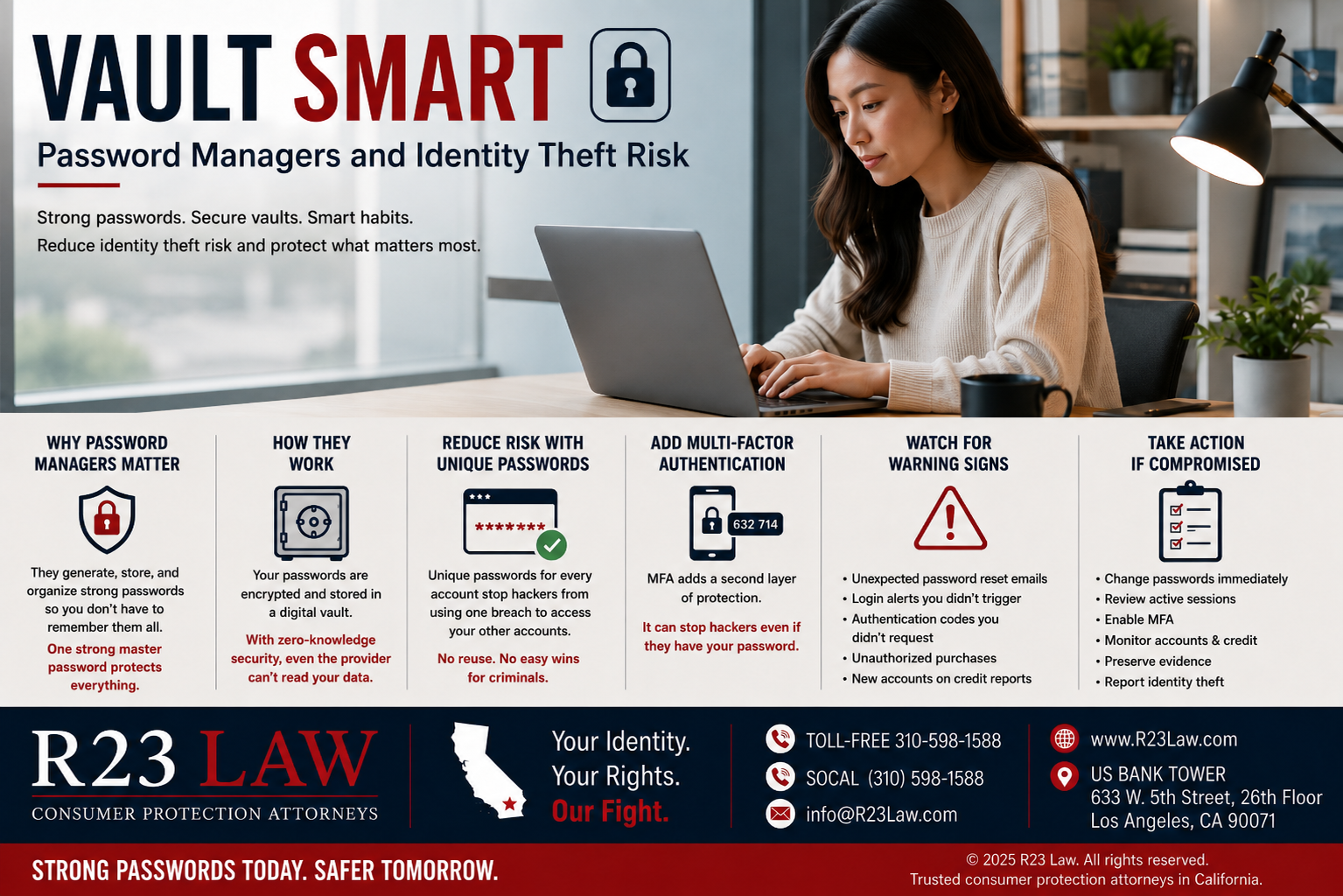
Login credentials are valuable targets for identity thieves
A stolen username and password may expose email, banking, shopping, social media, cloud storage, and other accounts containing sensitive personal information.
Because consumers often maintain dozens of online accounts, creating and remembering a different password for every service can be difficult. Password managers provide a practical way to generate, store, and organize strong credentials.
These tools can reduce identity theft risk, but they are not completely immune from cyberattacks, software vulnerabilities, or unauthorized access. Consumers should understand how password managers work, where risks may arise, and which additional safeguards can strengthen account security.
Password Managers Store Credentials in a Digital Vault
A password manager stores usernames and passwords inside an encrypted digital vault. The user generally accesses that vault through a master password, biometric authentication, or another approved security method.
Instead of memorizing every credential, the user protects one primary account. The password manager can then generate and retrieve unique passwords for individual websites and applications.
This convenience makes the master password especially important. Anyone who gains access to that credential may be able to reach every password stored in the vault.
A strong master password should be:
Long and difficult to predict
Unique to the password manager
Unrelated to names, birthdays, or addresses
Different from every other account password
Protected by multi-factor authentication when available
The master password should never be shared through email, text message, or an unsolicited telephone call.
Encryption Strengthens Password Manager Security
Reputable password managers commonly use encryption and other cybersecurity measures designed to prevent stored credentials from being exposed in readable form.
Many providers use a zero-knowledge security model. Under this structure, the provider does not have access to the user’s master password or the readable contents of the password vault.
Account information may also be encrypted before it is transmitted or stored in cloud-based systems. This can make stolen data significantly more difficult to use without the proper decryption credentials.
No digital security product can guarantee complete protection. Password management companies may still experience data breaches, cyberattacks, software defects, or unauthorized access attempts.
The security of a password manager also depends on the consumer’s master password, device protection, account settings, and response to suspicious activity.
Unique Passwords Reduce Credential Stuffing Risk
Password reuse creates a serious identity theft risk.
When the same password is used across several websites, a breach involving one account may expose every other account protected by that credential. Criminals often test stolen username and password combinations against email services, financial platforms, retailers, and social media accounts.
This automated activity is commonly known as credential stuffing.
A password manager can reduce that risk by generating a different password for every account. If one website experiences a breach, the exposed credential should not unlock the consumer’s other accounts.
Strong passwords generally contain a lengthy and unpredictable combination of letters, numbers, and symbols. Password managers can create credentials that are more difficult to guess than familiar words, personal names, or important dates.
Multi-Factor Authentication Adds Another Barrier
Multi-factor authentication requires an additional verification step before an account can be accessed.
The second factor may involve:
A code generated by an authentication application
A physical security key
A biometric identifier
A temporary code sent to a trusted device
An approval request delivered through an account application
Multi-factor authentication can prevent unauthorized access even when a criminal possesses the correct username and password.
Consumers should enable multi-factor authentication on password managers, email accounts, financial accounts, and other platforms containing sensitive information.
An unexpected authentication code or login approval request may indicate that someone has obtained the account password. Consumers should not approve an unfamiliar request and should immediately secure the affected account.
Warning Signs of Stolen Login Credentials
Identity theft involving compromised passwords may begin with small signs.
Consumers should watch for:
Password reset emails they did not request
Login alerts from unfamiliar devices or locations
Authentication codes they did not initiate
Changes to recovery email addresses or telephone numbers
Unauthorized purchases or transfers
Messages sent without the account owner’s knowledge
Accounts that suddenly become inaccessible
New accounts appearing on credit reports
Emails being opened, forwarded, or deleted unexpectedly
Unauthorized access to an email account is especially serious. An identity thief may use the inbox to reset passwords for banking, retail, social media, and financial accounts.
Prompt action can limit further damage and preserve important evidence.
Steps After Suspected Credential Theft
Consumers who believe their login information has been compromised should act quickly.
Begin by changing the affected password from a trusted device. Every account using the same or a similar password should receive a new and unique credential.
Consumers should also:
Review active login sessions and remove unfamiliar devices.
Confirm that account recovery information has not been changed.
Enable multi-factor authentication.
Review bank and credit card transactions.
Preserve login alerts, emails, screenshots, and account records.
Notify financial institutions of unauthorized activity.
Review credit reports for unfamiliar accounts or inquiries.
Consider placing fraud alerts or security freezes on credit files.
Report identity theft to the appropriate companies and agencies.
Keep a written timeline of each discovery, report, and response.
Suspicious messages should not be deleted until copies have been preserved. Security alerts, transaction records, and account correspondence may become important evidence in a dispute or legal claim.
Safer Password Manager Practices
A password manager is most effective when combined with responsible security habits.
Consumers should select a reputable provider, install updates promptly, and avoid accessing the password vault through unfamiliar or unsecured devices.
Browser extensions and mobile applications should only be downloaded from trusted sources.
Consumers should also activate available protections such as:
Automatic vault locking
Biometric authentication
Multi-factor authentication
Breach monitoring
Weak password alerts
Reused password detection
Account activity notifications
Emergency access controls
A password manager should eliminate password reuse rather than become another account protected by a weak or familiar credential.
Identity Theft Can Create Serious Financial Harm
Stolen credentials may lead to more than temporary account access.
An identity thief may use compromised login information to:
Transfer money
Make unauthorized purchases
Open fraudulent credit accounts
Access stored identification documents
Redirect payments
Change account ownership information
Impersonate the consumer
Create debts in the consumer’s name
The resulting harm may include damaged credit, denied housing, rejected loan applications, collection activity, lost access to funds, and emotional distress.
A company’s response may also cause additional injury when it refuses to investigate documented fraud, continues reporting identity theft accounts, or restricts access to legitimate funds.
Depending on the circumstances, federal and California consumer protection laws may provide rights involving unauthorized transactions, inaccurate credit reporting, improper debt collection, and identity theft records.
R23 Law’s Expert Legal Services for Identity Theft Victims Throughout California
R23 Law's California Consumer Protection Attorneys represent identity theft victims throughout California in matters involving stolen credentials, fraudulent accounts, unauthorized transactions, and inaccurate credit reporting.
The firm evaluates matters involving:
Fraudulent bank and credit card transactions
Identity theft accounts appearing on credit reports
Financial institutions that reject documented fraud claims
Credit bureaus that fail to correct inaccurate information
Debt collectors pursuing fraudulent debts
Unauthorized account openings
Mixed credit files
Identity theft connected to data breaches
Employment or housing denials caused by false information
R23 Law’s California Identity Theft Victim Lawyers review the available evidence, identify the companies involved, and evaluate remedies available under federal and California consumer protection laws.
Learn more About R23 Law, meet Our Team, or submit a confidential inquiry through the Contact Us page.
Strong Passwords Are One Part of Identity Protection
Password managers can strengthen online security by generating unique credentials, reducing password reuse, and storing account information inside an encrypted vault.
Their effectiveness still depends on the strength of the master password, the use of multi-factor authentication, device security, software updates, and the consumer’s response to suspicious activity.
No single tool can eliminate identity theft risk. A layered approach involving unique passwords, account alerts, authentication controls, regular monitoring, and prompt action provides stronger protection.
Contact R23 Law Today
Stolen login credentials can expose financial accounts, personal records, and credit information. When unauthorized access leads to fraudulent transactions, identity theft accounts, or inaccurate credit reporting, R23 Law's California Consumer Protection Attorneys can evaluate the conduct and available legal remedies.
Connect with R23 Law through the Contact Us page regarding identity theft, fraudulent accounts, unauthorized transactions, or related consumer protection violations.
Toll-Free — 310-598-1588SoCal — (310) 598-1588Email — info@R23Law.comWebsite —www.R23Law.comAddress — US Bank Tower, 633 W. 5th Street, 26th Floor, Los Angeles, CA
© 2025 R23 Law. All rights reserved. Trusted consumer credit lawyers in Los Angeles.
Legal Disclaimer — This article provides general information and does not constitute legal advice or create an attorney-client relationship. Legal rights and available remedies depend on the facts of each matter.
