
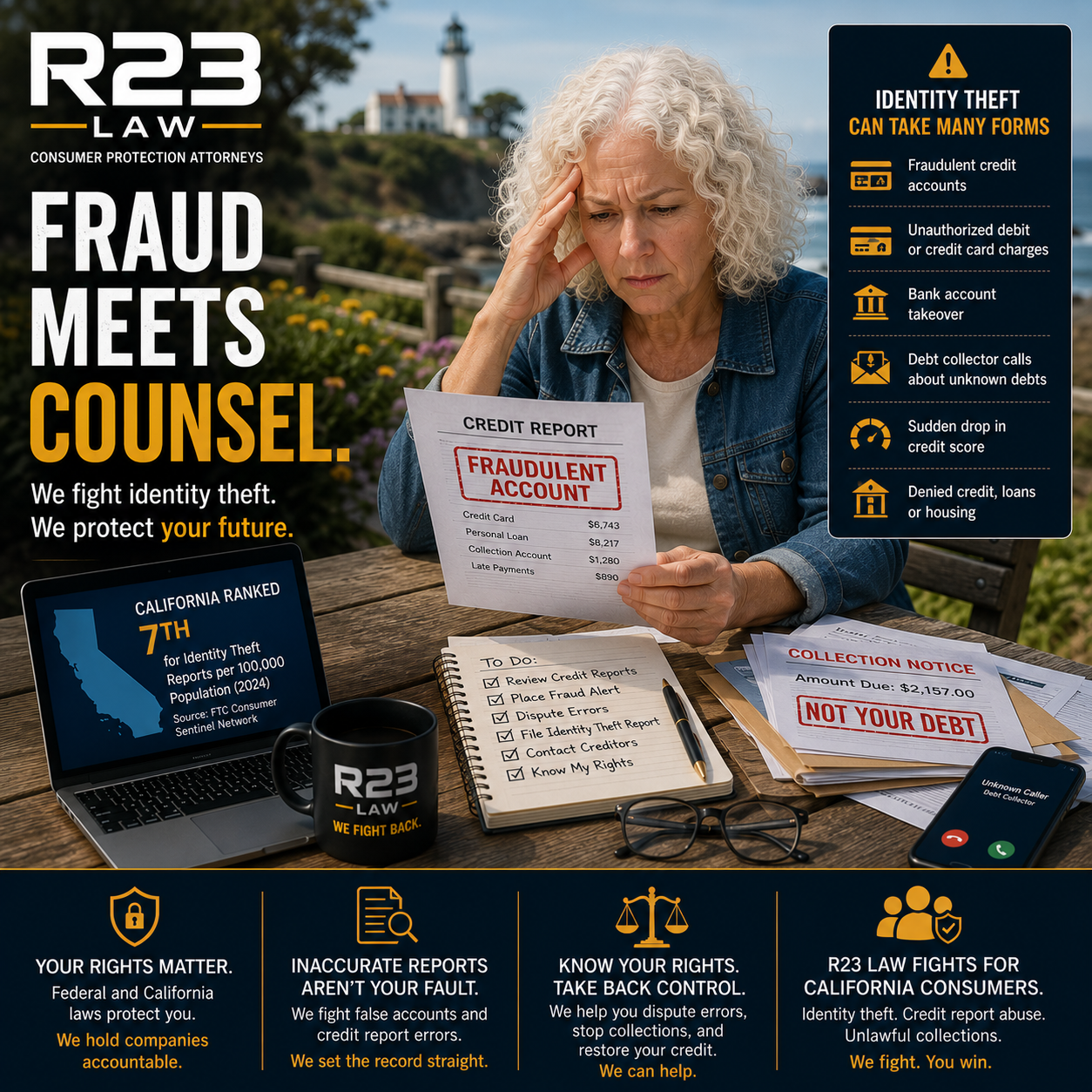
Fraudulent credit accounts and unauthorized card transactions can damage credit, drain accounts, and trigger false debts
R23 Law's California Consumer Protection Attorneys represent identity theft victims throughout California.
Fraud Meets Counsel
Identity theft can move quickly. A stolen Social Security number, hacked login, skimmed card, phishing text, breached database, or misused address can become a fraudulent credit account, unauthorized transaction, false debt, collection call, or credit report disaster.
The attached source material focuses on two of the most damaging identity theft scenarios — fraudulent credit accounts opened in a victim’s name and unauthorized debit or credit card transactions on accounts the consumer already holds. It also explains that these cases may involve the Fair Credit Reporting Act, Fair Credit Billing Act, and Electronic Fund Transfer Act when banks, creditors, credit bureaus, or furnishers fail to respond properly.
R23 Law's California Consumer Protection Attorneys represent consumers throughout California when identity theft causes financial loss, damaged credit, denied applications, collection pressure, and ignored disputes. Learn more about the firm at AboutUs, meet Our Team, or begin a confidential review through ContactUs.
Fraudulent Credit Accounts Can Wreck a Credit Profile
A fraudulent credit account is often opened with stolen personal information such as a name, Social Security number, date of birth, address, or other identifying data. The thief may use that information to open credit cards, loans, bank accounts, utility accounts, or other financial products.
Once the account is maxed out, abandoned, or reported late, the victim may see a sudden credit score drop, collection account, denial letter, or unfamiliar tradeline. The attached source material notes that victims often discover the fraud only after a denied application, missed payment alert, credit score change, or collector contact.
Unauthorized Debit and Credit Card Charges Create Immediate Financial Harm
Unauthorized charges can appear on accounts a consumer already uses. These charges may come from card skimmers, compromised apps, retailer breaches, digital wallet access, phishing links, stolen devices, or account takeover activity.
Credit card disputes and debit card disputes are not identical. The Fair Credit Billing Act applies to billing errors on credit cards and other open-end credit accounts, and the FTC states that unauthorized credit card charge responsibility is limited to $50 under federal law. The FTC also instructs consumers to send written billing disputes to the billing inquiry address within 60 days after the first bill with the error was sent.
For unauthorized electronic fund transfers, Regulation E provides tiered liability rules. The CFPB states that when a consumer reports the loss or theft of an access device within two business days after learning of it, liability cannot exceed the lesser of $50 or the amount of unauthorized transfers before notice. Liability can increase when notice is delayed.
R23 Law's Expert Legal Services for Fraud Injury Victims Throughout California
R23 Law's California Consumer Protection Attorneys represent identity theft injury victims facing fraudulent accounts, unauthorized transactions, false balances, collection calls, credit denials, background check issues, and credit report damage.
These cases may involve banks, credit card issuers, fintech platforms, lenders, debt collectors, Equifax, Experian, TransUnion, and companies that supplied inaccurate information to credit bureaus. R23 Law reviews the documents, identifies the companies with notice of the fraud, and evaluates whether they violated federal or California consumer protection laws.
FCRA Rights After a Fraudulent Account Appears
The Fair Credit Reporting Act gives identity theft victims a powerful tool. A consumer reporting agency generally must block information identified as resulting from identity theft within four business days after receiving proper proof of identity, an identity theft report, identification of the fraudulent information, and a statement that the information does not relate to any transaction by the consumer.
When credit bureaus or furnishers keep reporting a fraudulent account after receiving documentation, R23 Law's California Consumer Protection Attorneys may evaluate claims for unreasonable investigation, failure to block, inaccurate reporting, and continued publication of false credit information.
California Consumer Protection Claims for False Debts
Identity theft often becomes worse when a fraudulent account is treated like a real debt. A collector may call. A bank may demand payment. A lender may verify false information. A credit bureau may continue reporting a tradeline that should have been blocked or corrected.
R23 Law pursues cases involving the FCRA, California Consumer Credit Reporting Agencies Act, California Identity Theft Act, Fair Debt Collection Practices Act, Rosenthal Fair Debt Collection Practices Act, FCBA, EFTA, and other consumer protection laws where applicable.
Local Representation Without the Guesswork
Consumers often search for an identity theft lawyer near me after weeks or months of failed disputes. Location matters, but experience with credit reporting, debt collection, bank investigations, and federal consumer protection statutes matters even more.
R23 Law's California Consumer Protection Attorneys serve consumers across California from Los Angeles and Southern California to Northern California, the Central Valley, coastal communities, and inland regions. Identity theft cases are often built from records — credit reports, dispute letters, FTC reports, police reports, bank statements, card statements, certified mail receipts, denial notices, and collection letters.
Records That Strengthen an Identity Theft Case
Victims should preserve every document connected to the fraud. Important records may include credit reports, bank statements, card statements, fraud alerts, police reports, FTC identity theft reports, dispute letters, certified mail receipts, emails, screenshots, account closure notices, creditor responses, denial letters, and debt collection communications.
IdentityTheft.gov is the federal government’s resource for identity theft victims and provides checklists and sample letters for the recovery process.
R23 Law's California Consumer Protection Attorneys for Credit, Banking, and Collection Damage
Fraud may begin with a thief, but legal claims often arise from what companies do next. A bank may deny a valid unauthorized transfer claim. A credit card issuer may mishandle a billing dispute. A credit bureau may fail to block a fraudulent account. A debt collector may continue collection activity after receiving identity theft documentation.
R23 Law's California Consumer Protection Attorneys focus on that second wave of injury — the corporate failures that keep fraud alive on paper.
Contact R23 Law Today
When identity theft creates fraudulent accounts, unauthorized transactions, damaged credit, denied applications, or wrongful collection activity, R23 Law's California Consumer Protection Attorneys can evaluate the records and pursue accountability under consumer protection law.
SoCal — (310) 598-1588
