
JOB ON THE LINE — Background Check Errors and FCRA Rights
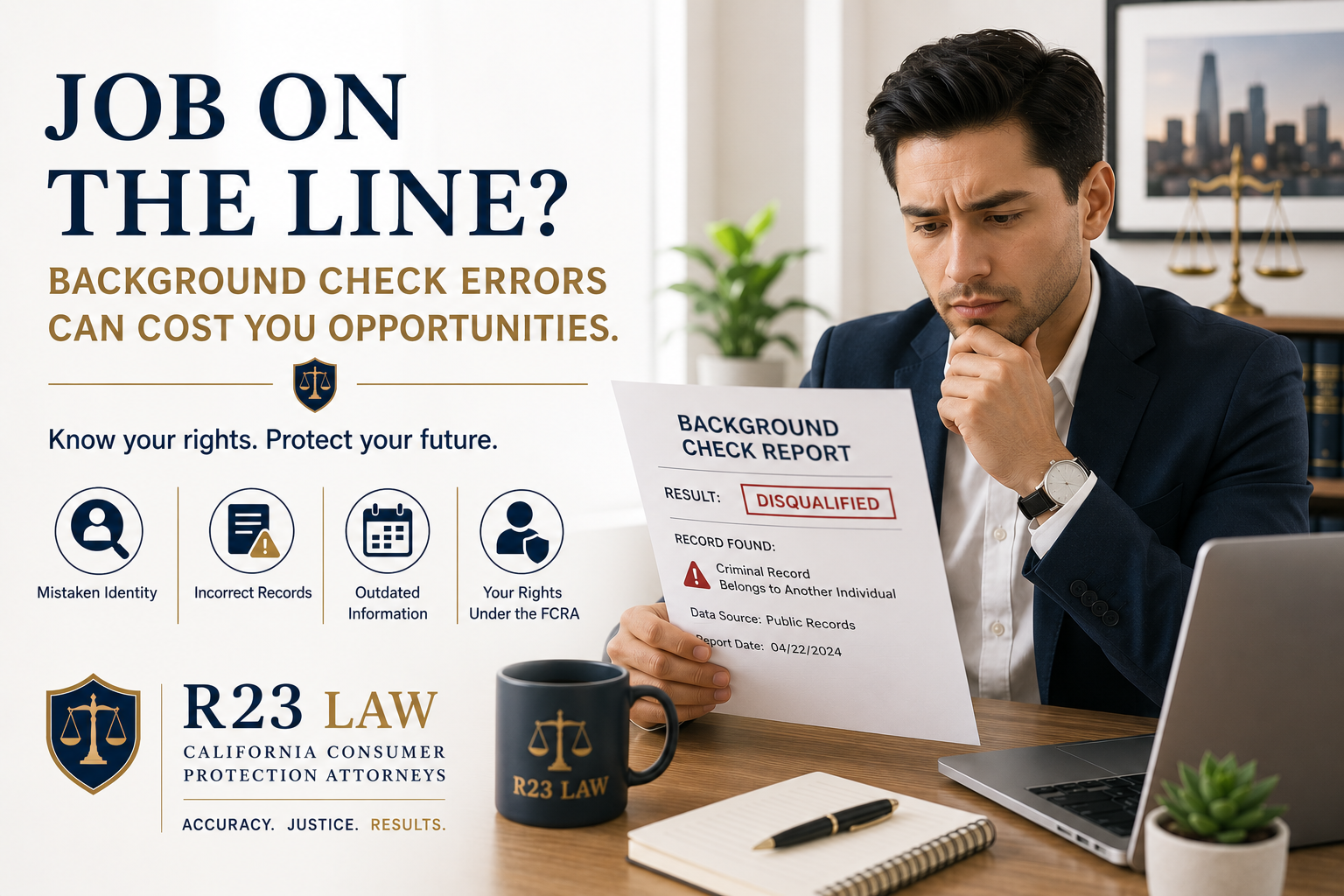
A job offer can disappear quickly when a background check contains information that does not belong to the applicant
Employers routinely use third-party background screening companies to review criminal records, employment history, public records, and other information during the hiring process. For many applicants, the screening is routine. For others, an inaccurate report can transform a promising employment opportunity into a dispute over someone else's criminal record, outdated information, or a database error.
The attached source focuses specifically on employment background check errors, including reports prepared by companies such as HireRight, and the steps consumers can take when incorrect information threatens a job opportunity.
R23 Law's California Consumer Protection Attorneys represent consumers dealing with inaccurate employment background checks, false criminal records, mistaken identities, failed disputes, and other consumer reporting violations throughout California.
Employment Background Checks Can Decide Whether a Job Offer Survives
Employers may use third-party background screening companies as part of the hiring process.
These reports can contain information about an applicant's:
Criminal history
Employment history
Public records
Personal identifying information
Other background information relevant to the employer's decision
When accurate, the report reflects the applicant's history.
When inaccurate, it can cause an employer to make a decision based on information that has nothing to do with the person applying for the job.
The source identifies mistaken identity, outdated information, incorrect criminal records, and technical or database problems as examples of errors that may appear in employment background reports.
HireRight Background Check Errors Can Put Employment at Risk
The attached source specifically discusses HireRight as an example of a company employers may use for background screening.
Like other consumer reporting agencies, a background screening company can produce a report containing inaccurate information.
Common problems may include:
Criminal records belonging to another person
Incorrect middle names or initials
Mistaken identity
Outdated criminal history
Incorrect public records
Records that were improperly matched to the applicant
Other inaccurate personal information
A small identifying difference can matter enormously.
If two people share a similar name but have different birth dates, middle initials, Social Security information, or other identifiers, a failure to distinguish between them can place someone else's history into an innocent applicant's report.
The Fair Credit Reporting Act Covers Employment Background Reports
The Fair Credit Reporting Act — FCRA does not apply only to traditional credit reports.
Employment background reports provided by companies in the business of compiling consumer information can qualify as consumer reports under the FCRA. The FTC explains that employers using such reports for hiring, retention, promotion, or reassignment must comply with the FCRA.
Background screening companies also have obligations under federal law concerning the accuracy of the information they report.
The FTC states that employment screening companies covered by the FCRA must provide consumers access to their files, conduct reasonable investigations when consumers dispute inaccurate information, and provide written notice of investigation results.
These protections become particularly important when inaccurate information threatens employment.
Consumers Have the Right to Know What Is Being Reported
The attached source identifies several important FCRA rights for consumers undergoing employment background screening.
Those include rights relating to:
Knowing when background information has been used against them
Accessing information in their consumer file
Disputing inaccurate information
Requesting reinvestigation of disputed information
Obtaining the actual report is critical.
Without seeing what the screening company reported, an applicant may know only that the employer suddenly changed its position without knowing why.
Request and Preserve a Copy of the Background Check
The source recommends reviewing the report carefully rather than assuming the information is correct.
Consumers should examine:
Name
Middle name or initial
Date of birth
Addresses
Criminal records
Court records
Employment information
Other identifying details
Keep a copy of the report showing the error.
If the screening company later issues a corrected version, the original report may provide important evidence of what the employer saw before making its decision.
Wrong Criminal Records Can Be Especially Damaging
One of the most serious employment background check errors occurs when another person's criminal history is associated with the applicant.
The source identifies errors involving outdated criminal records, incorrect criminal history, wrong middle initials, and public-record mix-ups.
A false criminal record can create an immediate and damaging impression.
An employer may believe the applicant has:
A conviction that belongs to someone else
A criminal case that was inaccurately matched
An outdated record
A criminal history inconsistent with the applicant's disclosures
The applicant can then be placed in the position of proving that information supplied by a professional screening company is wrong.
Supporting Documentation Can Establish the Correct Record
A background check dispute should identify the specific error and provide documentation supporting the consumer's position.
The source recommends gathering evidence such as court records when criminal information is inaccurate.
Depending on the error, supporting materials may include:
Court records
Records showing a case belongs to another individual
Documentation of expungement
Identification documents
Employment records
Records showing a different Social Security number
Documents establishing the correct middle name or initial
Other records contradicting the background report
Send copies rather than original documents and preserve everything submitted.
Pre-Adverse Action Rights Give Applicants an Opportunity to Review the Report
When an employer plans to take adverse employment action based on a consumer report, federal law imposes important procedural requirements.
Before rejecting an applicant or taking another adverse employment action based on the report, the FTC states that the employer must provide the applicant with a notice that includes a copy of the consumer report relied upon and a copy of the Summary of Your Rights Under the Fair Credit Reporting Act.
This pre-adverse action process gives the applicant an opportunity to review the report before the final employment decision.
That opportunity can be critical when the report contains information belonging to someone else.
Final Adverse Action Carries Additional Notice Requirements
If the employer ultimately decides not to hire the applicant based on information in the consumer report, additional FCRA notice requirements apply.
According to the FTC, the adverse action notice must provide information including the name, address, and telephone number of the consumer reporting company that supplied the report and notify the applicant of the right to dispute the accuracy or completeness of the information.
The notice also informs the consumer that the reporting company itself did not make the employer's hiring decision.
Preserve both the pre-adverse and final adverse action notices.
They can document the role the background report played in the employment decision.
Written Background Check Disputes Create a Strong Paper Trail
The attached source recommends putting disputes in writing and sending them by certified mail with return receipt requested.
A written dispute should clearly identify:
The inaccurate information
Why the information is incorrect
The correct information
Supporting documentation
The correction being requested
Consumers should retain:
The dispute letter
Every supporting attachment
Certified mail documentation
Delivery confirmation
Responses from the screening company
Updated reports
Communications with the employer
This creates a timeline showing exactly what the background screening company knew and when it received notice of the error.
Background Screening Companies Generally Have 30 Days to Reinvestigate a Dispute
The source states that background screening companies generally have 30 days to investigate a consumer dispute.
Federal law likewise generally requires a consumer reporting agency to conduct a reasonable reinvestigation within 30 days after receiving a qualifying dispute. In certain circumstances, that period may be extended by up to 15 additional days if relevant information is submitted during the initial investigation period.
The reporting agency must consider relevant information provided by the consumer during the reinvestigation.
That makes a detailed and well-documented dispute particularly important.
Informing the Potential Employer Can Preserve Context
The source also recommends notifying the potential employer that the background report contains an error and that a dispute has been initiated.
The applicant can preserve communications showing:
When the employer was notified
Which information was disputed
Whether supporting documentation was provided
Whether the employer delayed or reconsidered the decision
Whether the job was ultimately denied
These records can become important when determining the actual consequences of the inaccurate report.
A Self-Check Can Reveal Problems Before an Employer Finds Them
The source recommends that job seekers consider reviewing their own background information before beginning an employment search.
The objective is straightforward — identify incorrect information before it interferes with an employment opportunity.
Consumers may also review relevant public records to confirm that information concerning criminal matters is accurate.
This can be particularly useful for individuals who previously experienced:
Identity theft
Criminal record mix-ups
Expunged records
Name confusion
Background screening errors
Discovering an error before a job application provides more time to investigate and document the problem.
Failed Corrections Can Create a Consumer Protection Claim
Some background check errors are corrected promptly after a dispute.
Others remain.
When a screening company fails to correct inaccurate information despite receiving documentation establishing the problem, the dispute history may become an important part of evaluating the consumer's legal rights.
The FCRA requires covered consumer reporting agencies to conduct reasonable reinvestigations of disputed information, and the FTC has emphasized that screening companies cannot create unreasonable obstacles for consumers attempting to exercise their rights.
For an applicant who lost employment because of the inaccurate report, the consequences may already be significant before the reinvestigation is completed.
Background Check Errors Can Cause Real Financial Damage
An inaccurate employment report can result in more than inconvenience.
A consumer may lose:
A job offer
Salary
Benefits
Career advancement
Professional opportunities
False criminal information can also cause embarrassment and reputational harm.
Consumers should preserve documents showing what the employment opportunity was worth, including job offers, compensation information, emails, rejection notices, and other records establishing what happened after the background report was issued.
R23 Law's California Consumer Protection Attorneys Pursue Background Check Violations Throughout California
Employment background screening cases can involve inaccurate public records, mistaken identity, false criminal histories, HireRight reports, failed disputes, and adverse employment decisions.
R23 Law's California Consumer Protection Attorneys evaluate the complete reporting and dispute history to determine whether consumer protection laws may have been violated.
A legal evaluation may examine:
The original employment background report
The inaccurate information
Whether the criminal record belongs to another person
Identifying information used by the screening company
Pre-adverse action documentation
Final adverse action notices
Written disputes
Supporting evidence
The screening company's reinvestigation
Whether the inaccurate information was corrected
Whether the applicant lost employment or income
Learn more about R23 Law's attorneys through Our Team and the firm's consumer protection practice through About Us.
A Bad Background Check Should Not Decide a Career
An applicant can have the qualifications, experience, and employer interest needed for a position and still lose the opportunity because a background screening report contains incorrect information.
Consumers have rights when employment background reports are inaccurate.
Obtaining the report, documenting the error, preserving adverse action notices, submitting a detailed written dispute, and maintaining the complete record can become critical when employment is at stake.
When inaccurate information remains after a documented dispute, R23 Law's California Consumer Protection Attorneys can evaluate the reporting company's conduct and the employment consequences that followed.
Contact R23 Law Today
An inaccurate background check can derail a job opportunity at the moment an applicant expects to move forward. False criminal records, mistaken identities, outdated information, and failed disputes can create immediate financial and professional consequences.
R23 Law's California Consumer Protection Attorneys represent consumers throughout California facing inaccurate employment background checks and related consumer reporting violations.
Toll-Free — 310-598-1588 SoCal — (310) 598-1588 Email — info@R23Law.com Website — www.R23Law.com US Bank Tower, 633 W. 5th Street, 26th Floor, Los Angeles, CA
© 2025 R23 Law. All rights reserved. Trusted consumer credit lawyers in Los Angeles.
