
LOCK, REPORT, RESTORE – California Identity Theft Response After Personal Information Is Stolen
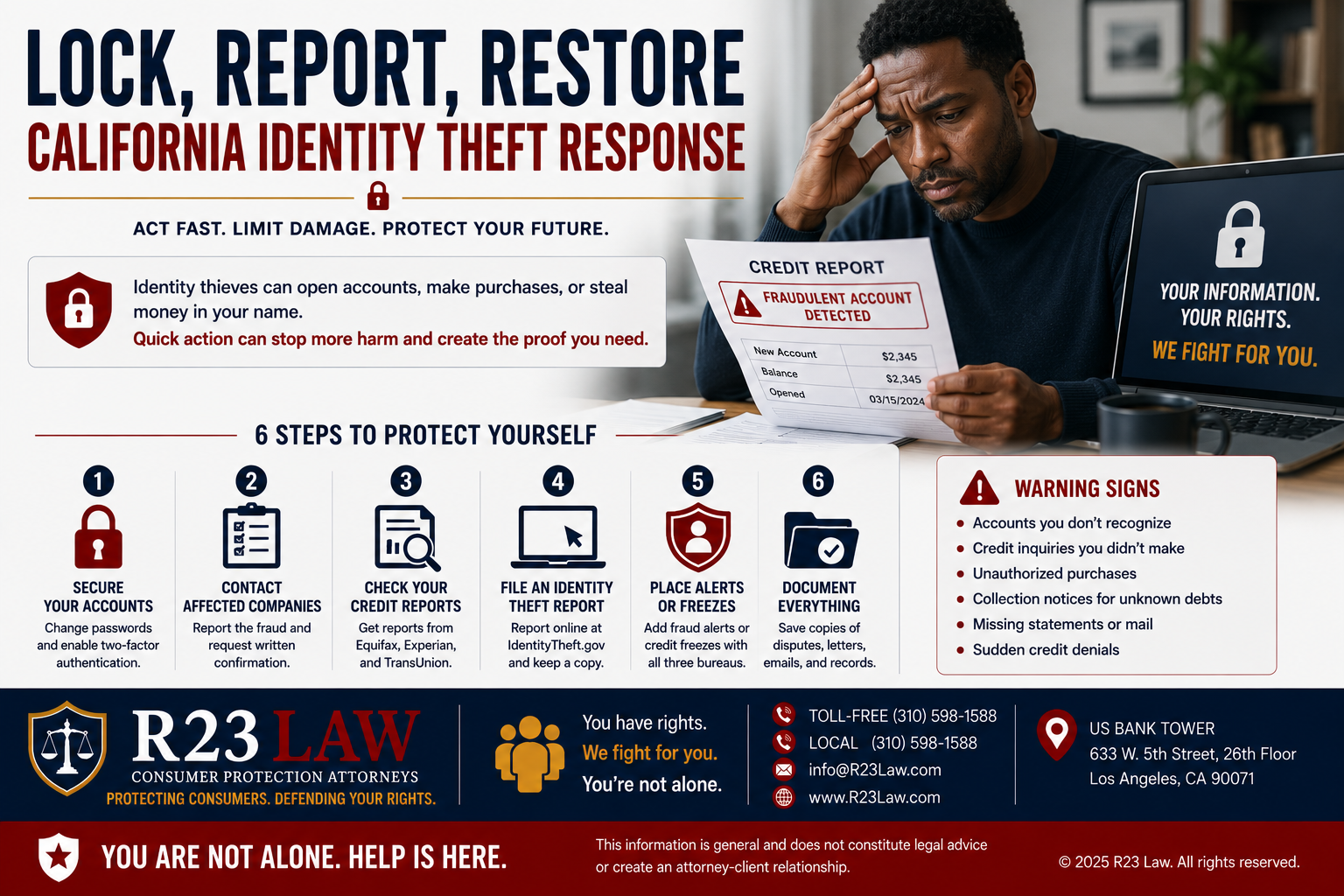
Identity theft can begin with a single unfamiliar transaction and quickly spread across a consumer’s financial life
A fraudster may use stolen personal information to apply for a credit card, obtain a loan, file a tax return, access medical services, or create accounts in someone else’s name. The victim may not discover the misuse until an unauthorized withdrawal appears, a creditor sends an unexpected bill, or a fraudulent account damages the victim’s credit report.
Acting promptly can limit additional losses, preserve valuable evidence, and create the documentation needed to challenge fraudulent accounts. Consumers should address both the immediate misuse of their information and the credit reporting damage that may continue afterward.
Warning Signs That An Identity Has Been Stolen
Identity theft is not always immediately obvious. Some victims first learn of the fraud months later, after applying for housing, financing, or another service involving a credit review.
The attached source identifies two particularly important warning signs: suspicious information appearing on a credit report and unauthorized activity on bank or credit card statements.
Consumers should investigate:
Credit accounts they do not recognize.
Credit inquiries from unfamiliar companies.
Incorrect names, addresses, or identifying information.
Collection accounts involving unknown debts.
Credit card purchases they did not make.
Bank withdrawals or transfers they did not authorize.
Unexpected account balances.
Bills for products or services they never received.
A sudden credit denial based on unfamiliar information.
Missing financial statements or account correspondence.
Current Consumer Financial Protection Bureau guidance likewise recommends reviewing credit reports and financial statements for suspicious activity.
An unfamiliar entry should not be dismissed as a harmless clerical mistake. It may indicate that someone has enough personal information to continue opening accounts or accessing existing ones.
R23 Law's Expert Legal Services For Financially Injured Identity Theft Victims
Identity theft can produce several overlapping consumer problems. A victim may face fraudulent credit accounts, damaged credit reports, collection demands, background check errors, and repeated disputes that fail to correct the underlying information.
R23 Law's California Consumer Protection Attorneysevaluate the complete chain of events, including:
The information that was stolen or misused.
The accounts opened or accessed without authorization.
The businesses that approved the fraudulent transactions.
The companies reporting the accounts to the credit bureaus.
The disputes submitted by the consumer.
The investigations performed by credit reporting agencies and furnishers.
The financial and emotional injuries caused by continued reporting.
A legal review may reveal that the original identity thief was not the only party responsible for the consumer’s ongoing losses. Credit bureaus, creditors, account furnishers, or debt collectors may create additional injury when they continue reporting or collecting a fraudulent obligation after receiving notice.
Notify The Company Connected To The Fraud
The first response should generally be directed to the company where the fraudulent activity occurred.
That may include a:
Bank.
Credit card issuer.
Lender.
Utility provider.
Wireless company.
Medical provider.
Retailer.
Online payment service.
Debt collector.
Contact the company’s fraud department and identify each unauthorized account or transaction. Request that compromised accounts be closed, restricted, or assigned new account numbers when appropriate.
The attached source emphasizes immediate notification, especially when a thief may possess highly sensitive information such as a Social Security number.
Consumers should request written confirmation stating that:
The account or transaction was fraudulent.
The consumer is not responsible for the unauthorized activity.
The company has closed or restricted the account.
Any associated credit reporting will be corrected or withdrawn.
IdentityTheft.gov similarly recommends contacting the fraud department of each affected business, closing fraudulent accounts, removing bogus charges, and retaining written confirmation.
Obtain Credit Reports And Fraudulent Account Records
A consumer should review credit reports from Equifax, Experian, and TransUnion. Fraudulent information may appear on one report but not the others.
The attached article advises obtaining copies of the reports and requesting records from creditors connected to the fraudulent activity.
AnnualCreditReport.com is the centralized site established under federal law for requesting reports from the three nationwide credit reporting agencies. Current information from the site states that consumers may request free reports weekly, which is broader access than the annual availability referenced in many older consumer guides.
Review each report for:
Accounts that were never opened by the consumer.
Incorrect balances or payment histories.
Unauthorized hard inquiries.
Unknown collection accounts.
Addresses where the consumer never lived.
Names or Social Security number variations that do not belong to the consumer.
Accounts incorrectly identifying the consumer as a borrower, co-borrower, or authorized user.
Save complete copies of the reports. Later versions may change, making the original reports important evidence of what was being published at a particular time.
R23 Law's Legal Review Of Fraudulent Account Records
R23 Law's California Consumer Protection Attorneys can examine application records, account statements, credit reports, dispute responses, and collection notices to identify inconsistencies supporting an identity theft claim.
Relevant discrepancies may include:
Signatures that do not match the consumer’s signature.
Applications submitted from unfamiliar addresses.
Phone numbers or email accounts the consumer never used.
Transactions occurring in distant locations.
Accounts opened while the consumer was elsewhere.
Conflicting dates or balances across credit reports.
Documents showing that a company ignored an identity theft report.
Transaction records may show who applied for the account, where the application originated, and which identifying information was used. The Fair Credit Reporting Act includes rights and business obligations concerning records related to identity theft.
File An Identity Theft Report
IdentityTheft.gov is the federal government’s central resource for reporting identity theft and creating a personalized recovery plan. The site also provides checklists, forms, and sample letters.
An FTC Identity Theft Report can provide formal documentation that:
The consumer reported the misuse.
Specific accounts or transactions were identified as fraudulent.
The consumer is requesting correction of identity-theft-related information.
The attached source recommends filing a report with the Federal Trade Commission and notes that the FTC may provide recovery plans and dispute forms.
Depending on the circumstances, a consumer may also file a report with local law enforcement. A police report may be especially important when:
The suspected thief is known.
The fraud involved stolen physical documents.
A creditor requests a police report.
The victim’s identity was used during contact with law enforcement.
Continued fraud or personal safety concerns exist.
Current CFPB guidance advises identity theft victims to report the theft through IdentityTheft.gov and to local police.
Place A Fraud Alert Or Credit Freeze
Fraud alerts and credit freezes are distinct protective measures.
Fraud Alerts
A fraud alert tells creditors reviewing the credit report to take additional steps to verify the applicant’s identity before approving certain new credit requests.
The attached source recommends contacting all three major credit bureaus. Current federal guidance clarifies that a consumer may place an initial fraud alert by contacting one nationwide credit reporting company; that company must notify the other two.
An initial fraud alert generally lasts one year and may be renewed. An extended alert is available to qualifying identity theft victims and lasts seven years.
Credit Freezes
A credit freeze restricts prospective creditors from accessing the consumer’s credit file. Because creditors generally will not open new credit without reviewing the file, a freeze creates a stronger barrier against new-account identity theft.
Unlike a fraud alert, a freeze must generally be placed separately with Equifax, Experian, and TransUnion.
A credit freeze does not:
Correct existing fraudulent accounts.
Stop unauthorized use of an already compromised card.
Prevent every form of identity theft.
Eliminate the need to monitor financial statements.
Consumers planning to apply for legitimate credit may need to temporarily lift the freeze.
Change Passwords And Strengthen Account Security
Identity thieves frequently gain access to several accounts because consumers reuse passwords or because a compromised email account controls password resets for financial services.
The attached source recommends changing passwords, using strong credentials, considering a password-management system, and enabling two-factor authentication on sensitive accounts.
Begin with accounts that can expose additional personal or financial information:
Primary email accounts.
Online banking.
Credit cards.
Payment applications.
Tax preparation accounts.
Health insurance portals.
Mobile phone accounts.
Social media.
Cloud storage.
Each account should have a unique password. Avoid minor variations of the same password across several platforms.
Two-factor authentication adds another verification step beyond the password. The FTC recommends prioritizing sensitive accounts such as email, banking, credit cards, tax filing, social media, and payment applications.
Consumers should also review account recovery information, including backup email addresses, telephone numbers, and security questions. An identity thief may change those settings to maintain access even after the password is replaced.
Dispute Identity-Theft-Related Credit Report Errors
Reporting identity theft does not automatically guarantee that every fraudulent account will disappear from a credit report.
Consumers should identify each inaccurate entry and submit disputes to the credit reporting agency and, when appropriate, the company that furnished the information.
The CFPB states that correcting a credit report error generally involves contacting both the credit reporting company and the information furnisher. Consumers should preserve copies of the dispute and all supporting documentation.
A dispute package may include:
A copy of the credit report with the error clearly marked.
Proof of identity.
The FTC Identity Theft Report.
A police report, when available.
Account statements.
Correspondence from the creditor.
Proof that the consumer lived elsewhere.
Signature comparisons.
Prior dispute results.
A concise explanation of why the account is fraudulent.
Federal law contains a specific process for blocking qualifying information resulting from identity theft. Section 605B of the FCRA generally requires a consumer reporting agency to block identified identity-theft information within four business days after receiving the required proof of identity, identity theft report, identification of the disputed information, and a statement that the information does not relate to a transaction by the consumer.
Whether a particular submission satisfies those legal requirements depends on the facts and documentation provided.
R23 Law's Expert Legal Services For Failed Credit Disputes
Credit reporting agencies and furnishers do not always correct fraudulent information after the first dispute.
Some consumers receive form responses stating that an account was “verified,” even though they supplied an identity theft report and documents showing that the account did not belong to them.
R23 Law's California Consumer Protection Attorneys examine whether the companies involved:
Reviewed all relevant documents.
Forwarded dispute information to the appropriate furnisher.
Conducted a reasonable investigation.
Corrected inaccurate account ownership.
Removed unverifiable information.
Blocked qualifying identity-theft entries.
Continued reporting information known to be disputed.
Reinserted previously removed information.
Sent accurate dispute results.
The FCRA gives consumers the right to dispute incomplete or inaccurate information. Credit reporting companies generally must take steps to investigate a properly submitted dispute, subject to rules concerning frivolous or irrelevant submissions.
Regulation V also provides that furnishers must conduct reasonable investigations of qualifying direct disputes involving identity theft, fraud, account liability, balances, payment status, and other reportable account information.
Preserve Evidence Of Financial And Emotional Injury
Identity theft cases are often strengthened by detailed records showing both the reporting violation and its consequences.
Consumers should preserve:
Every version of each credit report.
IdentityTheft.gov records.
Police reports.
Account applications and transaction histories.
Bank and credit card statements.
Dispute letters and supporting documents.
Certified-mail receipts.
Online submission confirmations.
Credit bureau investigation results.
Creditor correspondence.
Collection letters and call records.
Credit, loan, housing, or employment denial notices.
Documents showing increased interest rates.
Out-of-pocket expenses.
Time spent addressing the fraud.
Records reflecting significant stress or emotional distress.
Create a timeline identifying when the fraud was discovered, when each company was notified, what documents were submitted, and how each business responded.
That timeline may establish that a company continued publishing or collecting fraudulent information despite repeated notice.
Identity Theft Can Trigger Debt Collection And Background Check Injuries
Identity theft may produce consequences beyond a traditional credit report.
A fraudulent account may be sold or transferred to a debt collector. Incorrect identity information may also appear in tenant, employment, or other consumer reports.
The attached source recognizes that identity theft may lead to credit report errors, background check errors, debt collection disputes, and related consumer problems.
Consumers should not assume that paying a fraudulent debt is the simplest solution. Payment may not remove the account from a credit report, and it may complicate later efforts to establish that the obligation was never authorized.
Collection communications should be saved, and consumers should avoid making unsupported admissions about ownership of the debt.
R23 Law's California Consumer Protection Attorneys Pursue Accountability
R23 Law's California Consumer Protection Attorneys represent consumers facing identity theft, inaccurate credit reporting, fraudulent debts, and unlawful collection activity.
Depending on the circumstances, the firm’s legal services may include:
Investigating the origin and reporting of fraudulent accounts.
Reviewing prior credit disputes.
Obtaining and analyzing account records.
Identifying responsible credit bureaus, furnishers, creditors, and collectors.
Challenging continued publication of fraudulent information.
Documenting financial, reputational, and emotional injury.
Pursuing actual damages and other remedies available under applicable law.
Seeking recovery of qualifying out-of-pocket losses.
The attached source notes that identity theft victims whose rights have been violated may be able to pursue damages, including compensation for out-of-pocket costs. The claims and recoverable remedies in any particular case depend on the evidence, the parties involved, and the nature of the legal violations.
Take Control Before The Damage Spreads
Identity theft recovery is rarely completed through a single phone call. It may require closing accounts, securing passwords, reviewing all three credit reports, filing an identity theft report, placing credit protections, and disputing every fraudulent entry.
When credit bureaus, furnishers, or debt collectors refuse to correct documented identity theft, legal action may be necessary to protect the consumer’s credit and financial future.
Contact R23 Law for a free consultation with R23 Law's California Consumer Protection Attorneys.
This article is provided for general informational purposes and does not constitute legal advice.
