
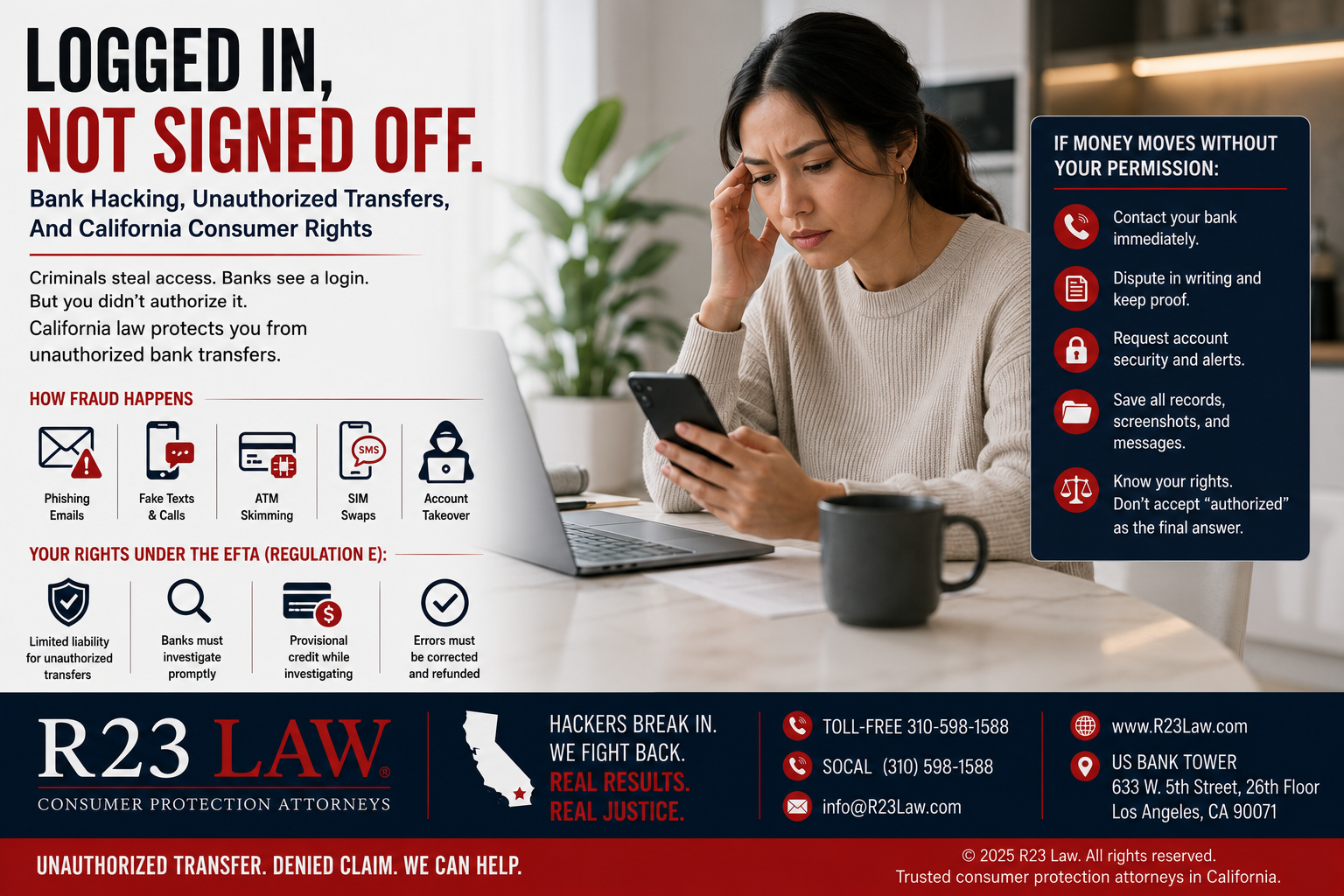
A bank login is not the same thing as permission
A correct PIN is not the same thing as consent.
A “chip verified” label is not the same thing as proof that the customer authorized the transaction.
Victims of bank hacking and unauthorized transfers often hear the same response from their financial institution: “Our system shows the transaction was authorized.” But that phrase can hide the real question. Did the consumer actually authorize the transfer, or did a criminal use stolen credentials, compromised devices, intercepted cards, phishing tactics, or account takeover methods to move money without permission?
The attached source explains the core problem: banks often confuse credential use with authorization, rely on oversimplified explanations, and overlook how fraud mechanically occurs. It also emphasizes a key point for victims: banks authenticate systems, but they do not authenticate intent.
R23 Law's California Consumer Protection Attorneys represent consumers dealing with hacked bank accounts, unauthorized bank transfers, denied fraud claims, debit card fraud, ACH fraud, payment-app transfers, and claims under the Electronic Fund Transfer Act, commonly called the EFTA, and Regulation E.
“The System Says Authorized” Is Not The End Of The Story
Banks often treat electronic evidence as conclusive. A password was used. A PIN was entered. A device was recognized. A chip transaction processed. A one-time code was submitted.
But fraud can happen even when a system successfully authenticates credentials.
The attached guide explains that criminals use real-world methods to move money without authorization, including ATM skimming, card trapping, fake mobile banking apps, phishing, smishing, vishing, SIM swaps, replacement debit card interception, chip-reader compromise, and other account takeover techniques.
That matters because the EFTA defines an unauthorized electronic fund transfer as a transfer from a consumer account initiated by someone other than the consumer, without actual authority, and from which the consumer receives no benefit.
The legal issue is not simply whether the bank’s system recognized a credential. The issue is whether the consumer actually authorized the transfer.
How Bank Hacking And Unauthorized Transfers Happen
Unauthorized transfer cases often involve layered fraud. The criminal may first obtain access, then bypass security, then move money quickly.
Common mechanisms include:
Phishing: fake emails that look like bank messages
Smishing: fraudulent text messages impersonating banks or fraud departments
Vishing: phone calls where scammers pose as bank representatives
Fake mobile banking apps: apps that steal credentials or hijack sessions
SIM swaps: phone-number takeover used to intercept one-time passcodes
ATM skimming: hidden devices that capture card data and PINs
Card trapping: sabotaged ATMs that retain cards for later theft
Replacement card interception: newly issued cards stolen from the mail and activated
Credential stuffing: use of leaked usernames and passwords after data breaches
Account takeover: unauthorized access to online banking followed by transfers
The attached source stresses that understanding fraud mechanics changes the story because the real activity may happen somewhere else, even while the consumer is blamed for “doing something.”
Authentication Is Not Authorization
This distinction is central.
Authentication asks whether a system accepted a credential, card, code, device, or transaction channel.
Authorization asks whether the consumer actually gave permission.
The attached guide separates those concepts directly, noting that credential use is often confused with authorization and that objective evidence matters more than assumptions.
A criminal may have the correct password because of phishing. A criminal may have a one-time code because of SIM swapping. A criminal may have a debit card because it was intercepted in the mail. A criminal may know a PIN because of skimming. A transaction may be “card present” because the card was stolen, trapped, cloned, or misused.
Those facts can undermine a bank’s claim that the consumer must have authorized the transaction.
Regulation E Protects Consumers From Unauthorized Electronic Transfers
Regulation E protects consumers using electronic fund transfers. The CFPB identifies Regulation E as the rule implementing the electronic fund transfer provisions that govern consumer protections for covered transactions.
Covered electronic fund transfers may include ATM withdrawals, debit card transactions, ACH transfers, direct deposits, and certain electronic payments from consumer accounts. Regulation E also sets procedures for error resolution, including unauthorized transfer disputes.
The attached unauthorized-bank-transfer source explains that consumers should notify their bank immediately after discovering an unauthorized bank transfer, duplicate charge, hacked online account, or other unauthorized transaction. It also notes that when a bank refuses reimbursement despite a valid claim, EFTA remedies may be available.
Report Unauthorized Transfers Quickly And In Writing
When money moves without authorization, timing matters.
Consumers should notify the bank immediately and identify each disputed transfer. A phone call may start the process, but a written dispute helps create proof.
A strong written dispute should include:
Consumer name and account number
Date of each unauthorized transaction
Amount of each unauthorized transaction
Merchant, recipient, ATM, or transfer description
Statement that the consumer did not authorize the transfer
Statement that the consumer received no benefit from the transfer
Description of suspected fraud, such as phishing, account takeover, lost card, SIM swap, or hacked device
Request for investigation under the EFTA and Regulation E
Request for provisional credit, when applicable
Request for documents relied on if the bank denies the claim
Regulation E limits consumer liability for unauthorized transfers based on timing and other requirements. The CFPB’s Regulation E liability rule addresses when a consumer may be liable for unauthorized electronic fund transfers and makes timely notice important.
Banks Must Investigate, Not Guess
When a consumer reports an unauthorized transfer or other covered error, Regulation E requires the financial institution to investigate and follow error-resolution procedures.
A bank investigation should not simply ask whether the password was correct or whether the transaction matched a familiar device. That may show system access. It does not necessarily prove customer authorization.
Relevant evidence may include:
Login locations
IP addresses
Device history
SIM swap indicators
Failed login attempts
Password reset history
New payee creation
Unusual transfer pattern
ATM video
Card activation records
Merchant records
Prior account behavior
Fraud alerts
Consumer travel/location evidence
Phishing messages or scam call logs
The attached source explains that victims are often blamed for actions they never took because real evidence is ignored or reduced to bank system labels.
Common Bank Denial Language That Deserves Scrutiny
Bank denial letters often use phrases that sound final but may not answer the legal question.
Watch for language such as:
“Valid credentials were used.”
“The transaction was chip verified.”
“The correct PIN was entered.”
“The transfer came from a recognized device.”
“A one-time passcode was used.”
“The transaction was card present.”
“No bank error occurred.”
“You participated in a scam.”
“The transaction appears consistent with your account history.”
“We found no unauthorized activity.”
The attached guide specifically flags issues involving “chip verified,” “correct PIN entered,” “card present,” and authentication versus authorization, explaining that those labels may describe a process or channel rather than prove the consumer’s intent.
A denial letter is not a verdict. It is evidence to review.
Evidence To Preserve After Bank Hacking
A strong unauthorized-transfer claim depends on preserving the trail before it disappears.
Save:
Bank statements
Screenshots of unauthorized transfers
Fraud claim confirmation numbers
Bank denial letters
Provisional credit notices
Secure messages with the bank
Emails or texts from scammers
Phone call logs
Voicemails
Password reset notifications
Device login alerts
SIM swap or carrier records
Police reports
FTC identity theft reports
ATM receipts
Travel records showing where you were
Proof you did not receive any benefit from the transfer
Notes of every bank call, including date, time, representative name, and what was said
R23 Law’s archive emphasizes that consumer protection cases often turn on documentation, including dispute records, financial records, notices, and proof of harm.
Identity Theft, Account Takeover, And Unauthorized Transfers Often Overlap
Bank hacking rarely exists in isolation.
A criminal may use identity theft to reset credentials, redirect mail, intercept a replacement debit card, open new accounts, or gain enough information to pass security questions. The attached guide identifies SIM swaps, replacement debit card interception, fake mobile banking apps, and credential theft as mechanisms that can allow criminals to move money without the consumer’s authorization.
If identity theft is involved, consumers should consider:
Filing an FTC IdentityTheft.gov report
Filing a police report
Freezing credit reports
Placing fraud alerts
Changing bank, email, and mobile carrier passwords
Reviewing all accounts for additional fraud
Disputing fraudulent credit report entries
Preserving breach notices or scam communications
The stronger the identity-theft record, the harder it may be for a bank to dismiss the dispute as ordinary authorized activity.
EFTA Remedies After A Bank Denies A Valid Fraud Claim
When a financial institution violates the EFTA, consumers may have legal remedies. The EFTA establishes the rights, liabilities, and responsibilities of participants in electronic fund transfer systems.
Civil remedies may include actual damages, statutory damages in individual cases, and attorney’s fees and costs in successful actions, depending on the facts and statutory requirements. The attached unauthorized-bank-transfer source similarly notes that statutory damages, actual damages, and attorney’s fees may be available when a financial institution violates the EFTA.
Potential damages may include:
Stolen funds
Overdraft fees
Returned payment fees
Late fees caused by missing funds
Account closure consequences
Credit damage from unpaid bills
Time spent disputing
Emotional distress where recoverable
Other financial losses tied to the violation
The key is connecting the bank’s conduct to the consumer’s harm.
R23 Law's California Consumer Protection Attorneys For Bank Hacking And Unauthorized Transfers
Banks may authenticate systems. Consumers authorize transactions.
That difference matters.
R23 Law's California Consumer Protection Attorneys represent consumers harmed by hacked bank accounts, unauthorized electronic fund transfers, denied Regulation E claims, debit card fraud, ACH fraud, ATM withdrawal disputes, payment-app transfers, SIM-swap account takeover, identity theft, and financial institution misconduct.
If your bank denied a fraud claim because “the system shows authorized,” contact R23 Law today for a free consultation with R23 Law's California Consumer Protection Attorneys.
Credentials can be stolen. Intent cannot be assumed.
Disclaimer: This article provides general information and is not legal advice. Rights and deadlines depend on the transaction type, timing of notice, bank disclosures, account documents, investigation records, and applicable law.
