
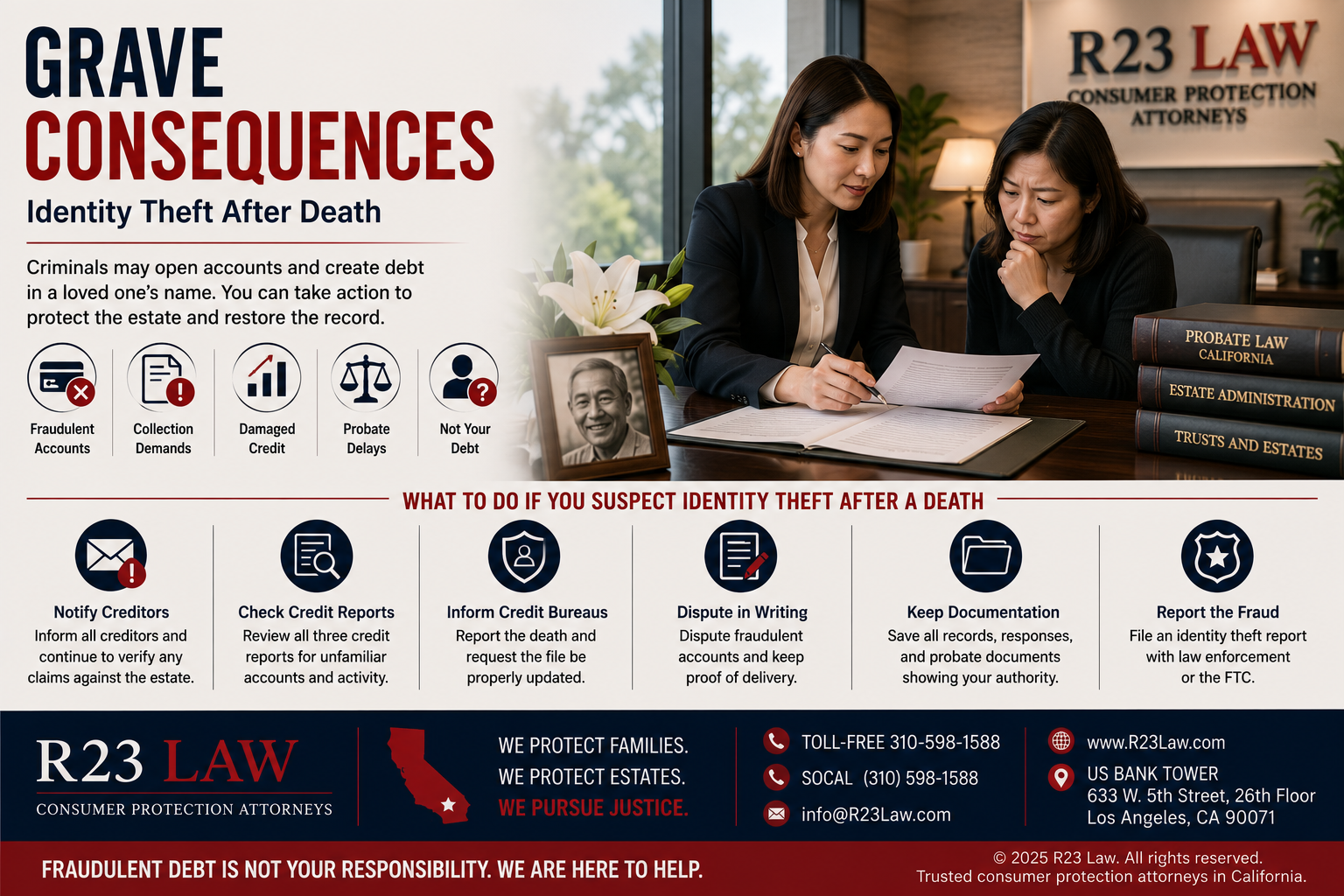
Losing a family member is already emotionally and financially difficult
Discovering that someone has stolen the deceased person’s identity can add fraudulent accounts, collection demands, credit reporting problems, and probate delays to an already painful situation.
Criminals may use a deceased person’s name, Social Security number, date of birth, former address, or other identifying information to open credit accounts, obtain services, file fraudulent claims, or make unauthorized purchases. Because the victim is no longer available to monitor account activity, identity theft after death may continue unnoticed for months.
Surviving family members are generally not personally responsible for fraudulent debts created in a deceased relative’s name. However, those debts may still create problems for the estate unless the personal representative acts quickly to dispute them.
Deceased Individuals Remain Attractive Identity Theft Targets
Identity thieves often search public sources for information about recently deceased individuals. Online obituaries, memorial notices, public records, and social media posts may reveal valuable personal information, including:
Full legal name
Date of birth
Previous city or address
Family member names
Employment history
Schools attended
Date of death
Families may also be less likely to monitor a deceased relative’s credit activity while managing funeral arrangements, grief, estate administration, and probate. Criminals may take advantage of that delay by opening accounts before creditors, government agencies, and consumer reporting agencies are notified of the death.
The result may be a trail of unauthorized credit cards, personal loans, utility accounts, collection notices, or inaccurate credit reporting associated with the deceased person.
Family Members Are Generally Not Personally Liable
A family relationship alone does not ordinarily make someone responsible for another person’s debt.
When a person dies with a legitimate financial obligation, a creditor may be permitted to submit a claim against the estate. Any valid debt is generally addressed through the probate or estate administration process rather than transferred automatically to children, siblings, or other relatives.
Different rules may apply when a surviving person:
Co-signed the account
Was a joint account holder
Personally guaranteed the obligation
Assumed responsibility under a separate agreement
Is affected by applicable California community-property rules
Fraudulent debt should not be treated as a valid estate obligation. When an account was opened after the person died, or when evidence shows that the deceased person never authorized the transaction, the estate representative may dispute the account and challenge any related creditor claim.
Fraudulent Debt Can Disrupt Probate
Even when family members are not personally liable, identity theft can interfere with the administration of the estate.
A creditor or debt collector may submit a claim based on an account that appears valid in its records. Until the account is investigated and corrected, the fraudulent claim may delay distributions to beneficiaries, increase administrative expenses, and complicate the work of the executor or personal representative.
Prompt action can reduce the risk that a fraudulent account will be accepted as a legitimate estate debt. The personal representative should preserve documents showing the date of death, the date the account was opened, the transactions involved, and all communications with the creditor or debt collector.
Evidence Can Expose Post-Death Fraud
Clear documentation is often central to proving that a debt resulted from identity theft. Useful records may include:
A certified copy of the death certificate
Account statements and collection notices
The date the disputed account was opened
Credit applications or transaction records
Proof that charges occurred after the date of death
Police reports or identity theft reports
Probate documents confirming the representative’s authority
Written disputes sent to creditors, collectors, and credit reporting agencies
Delivery confirmations and responses
The estate representative should keep copies of every document sent or received. Written correspondence sent through a trackable delivery method may create an important record if the creditor, collector, or reporting agency fails to conduct a reasonable investigation.
Immediate Measures Can Protect the Estate
Once suspected identity theft is discovered, the executor, administrator, or authorized family representative should consider taking the following measures.
Notify Creditors and Financial Institutions
Contact each creditor, bank, lender, or service provider associated with the fraudulent activity. Inform the company that the account holder is deceased and that the account is disputed as identity theft.
Provide copies rather than originals of supporting documents unless an original is specifically required.
Review Available Credit Information
Request the deceased person’s credit reports through the appropriate process and review them for unfamiliar accounts, addresses, inquiries, and balances.
A newly opened account, unfamiliar creditor, or post-death credit inquiry may indicate additional fraudulent activity.
Notify Consumer Reporting Agencies
The major consumer reporting agencies should be notified of the death. The authorized representative may request that the file be marked as belonging to a deceased consumer and that inaccurate accounts be investigated.
Each agency may require proof of death and documentation showing that the requesting person has authority to act for the estate.
Dispute Fraudulent Accounts in Writing
A written dispute should clearly identify the account, explain why it is fraudulent, and include supporting documentation. The dispute should also request correction or deletion of any inaccurate information associated with the deceased person.
Preserve a Complete Paper Trail
Maintain a timeline of calls, letters, emails, reports, and responses. Record the names of company representatives and the dates of all communications.
This documentation may become important if a creditor continues collection activity, a debt collector pursues the estate, or a consumer reporting agency fails to correct inaccurate information.
Consumer Protection Laws May Apply
Identity theft involving a deceased relative may implicate several areas of consumer protection law.
The Fair Credit Reporting Act regulates the accuracy and handling of information maintained by consumer reporting agencies. California law may provide additional protections involving identity theft, consumer records, debt collection, and unfair business practices.
The available legal claims depend on the facts, including:
When the fraudulent account was opened
Whether the account was reported to a credit bureau
Whether a written dispute was submitted
How the creditor or reporting agency investigated
Whether collection activity continued after notice of the fraud
Whether the estate suffered financial loss or probate delays
A consumer protection attorney can evaluate the conduct of creditors, debt collectors, financial institutions, and consumer reporting agencies to determine whether legal violations occurred.
R23 Law's California Consumer Protection Attorneys Address Identity Theft Claims
R23 Law's California Consumer Protection Attorneys represent consumers and families affected by identity theft, inaccurate credit reporting, unauthorized accounts, and improper collection activity.
Depending on the circumstances, the firm may:
Investigate the origin of fraudulent accounts
Review credit reports and collection records
Prepare or evaluate written disputes
Communicate with creditors and consumer reporting agencies
Challenge fraudulent claims asserted against an estate
Assess violations of federal and California consumer protection laws
Pursue available compensation when unlawful conduct causes financial harm
Learn more about the attorneys handling consumer protection matters through Our Team and review the firm’s mission and approach through About R23 Law.
R23 Law's Expert Legal Services for Consumers Facing Financial Injury Throughout California
Identity theft after death can produce more than administrative inconvenience. It may delay probate, reduce estate assets, expose private family information, and force relatives to spend significant time responding to debts that were never authorized.
R23 Law represents consumers facing financial injury throughout California. The firm understands the relationship between identity theft, credit reporting, debt collection, and estate-related disputes.
Early legal review may clarify which accounts are fraudulent, which companies received notice, and whether a creditor, collector, or reporting agency failed to comply with consumer protection law.
Protecting a Loved One’s Legacy
A deceased person’s identity should not become an opportunity for fraud.
Family members are generally not personally responsible for debts created through post-death identity theft. Still, the estate representative must take fraudulent accounts seriously. A prompt, documented dispute may prevent an invalid claim from delaying probate or reducing the assets intended for beneficiaries.
Contact R23 Law Today
Identity theft involving a deceased relative can place an unfair burden on a grieving family. R23 Law's California Consumer Protection Attorneys evaluate fraudulent accounts, credit reporting errors, and improper collection activity affecting consumers and estates throughout California.
Toll-Free — 310-598-1588
SoCal — (310) 598-1588
Email —info@R23Law.com
Website —www.R23Law.com
Address — US Bank Tower, 633 W. 5th Street, 26th Floor, Los Angeles, CA
© 2025 R23 Law. All rights reserved. Trusted consumer credit lawyers in Los Angeles.
