
MAILBOX MAXED OUT — Why Credit Card Fraud From Stolen Mail Isn’t Your Responsibility
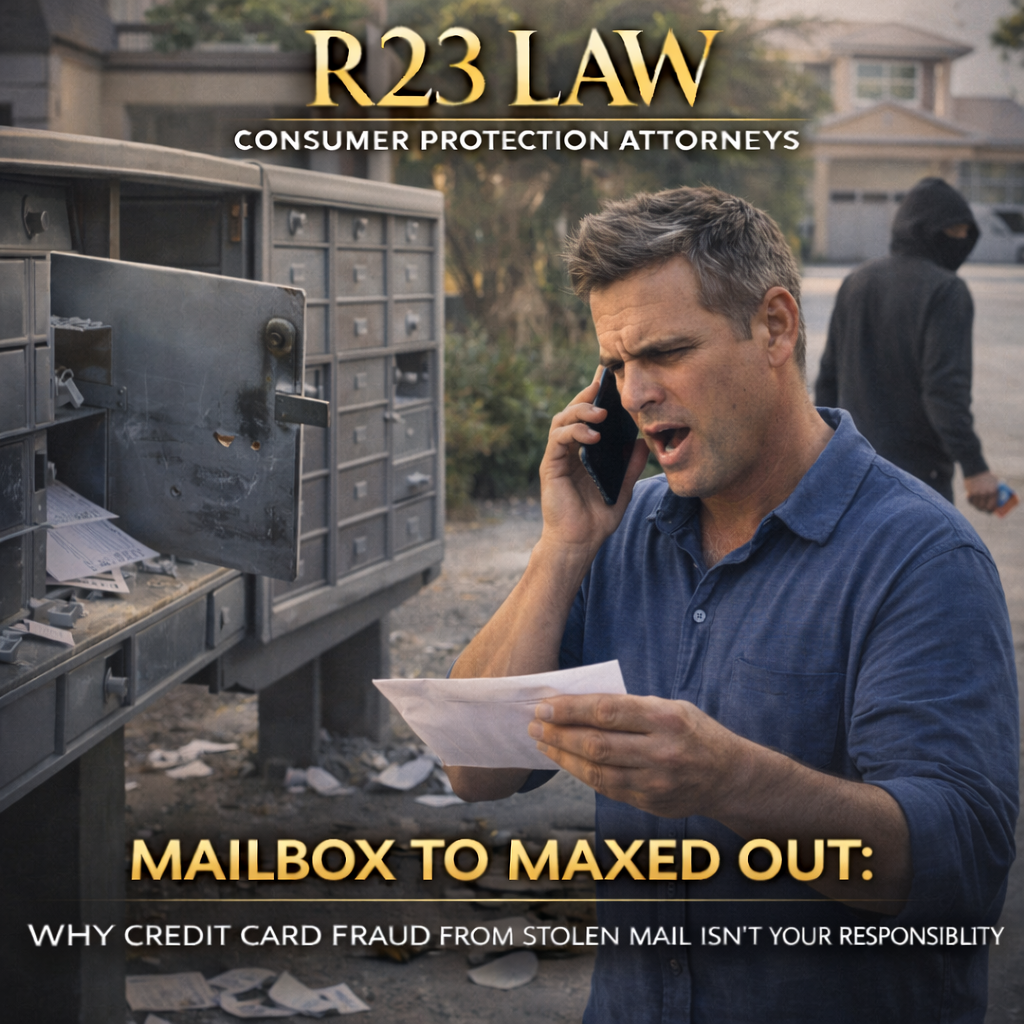
A notification from your bank appears out of nowhere
Charges you didn’t make. Transactions you don’t recognize. You do what most people would do—you call the bank, report the fraud, and expect it to be corrected.
Then the letter arrives.
The bank claims the card was used, the chip was present, and the charges are therefore your responsibility. That conclusion is wrong—and California law is clear on the issue.
When credit card fraud begins with stolen mail, the liability does not fall on the consumer. R23 Law’s California Consumer Protection Attorneys regularly confront banks that rely on technical excuses to shift blame where it does not belong.
How This Fraud Actually Happens
Mail theft has become a common gateway to credit card fraud, particularly in neighborhoods with communal or unsecured mailboxes.
A typical sequence looks like this:
A bank mails a replacement or new credit card
A thief intercepts the mail
The card is activated, often with minimal verification
Fraudulent charges accumulate quickly
The bank later claims the card was “used properly”
The presence of a chip or activation record does not prove the consumer authorized anything.
Why the Bank’s Explanation Falls Apart
Banks often argue that because the card was chipped, activated, or technically “yours,” the charges must be valid. That argument ignores how identity theft actually works.
Criminals do not need your consent to activate a stolen card. They only need possession—and banks know this.
Technical jargon does not override consumer protection law.
California Law Is Explicit
Under the California Identity Theft Act (Cal. Civ. Code § 1798.92), consumers are not responsible for debts resulting from identity theft.
If a card was stolen from the mail and used fraudulently:
The debt does not belong to the consumer
Payment is not required
Credit reporting must be corrected
The law does not carve out exceptions for stolen mail, chipped cards, or bank form letters.
The Costly Mistake Consumers Are Pressured to Make
After a denial, many consumers panic and begin making payments—sometimes just the minimum—to protect their credit.
That move can backfire.
Banks may later argue that payment equals responsibility. Even a small payment can be twisted into an admission that the debt was legitimate.
Credit can be repaired. Fraudulent debt can be erased. But payments create leverage for the wrong side.
What Should Happen Instead
When stolen mail leads to credit card fraud, the focus should be on documentation and enforcement—not appeasement.
Important steps often include:
Preserving all bank correspondence
Reviewing credit reports for additional fraud
Disputing the debt as identity theft
Avoiding voluntary payments on fraudulent charges
Consumer protection laws exist to stop this conduct, not normalize it.
About R23 Law
R23 Law is a California consumer protection law firm focused on enforcing laws that protect individuals from identity theft, fraudulent credit card charges, and unlawful debt collection practices. Our attorneys handle cases involving stolen mail fraud, improper bank denials, and credit reporting violations.
Contact R23 Law Today
If a bank blamed you for credit card fraud that began with stolen mail, experienced consumer protection counsel matters.
Toll-Free: 310-598-1588
Email: info@R23Law.com
