
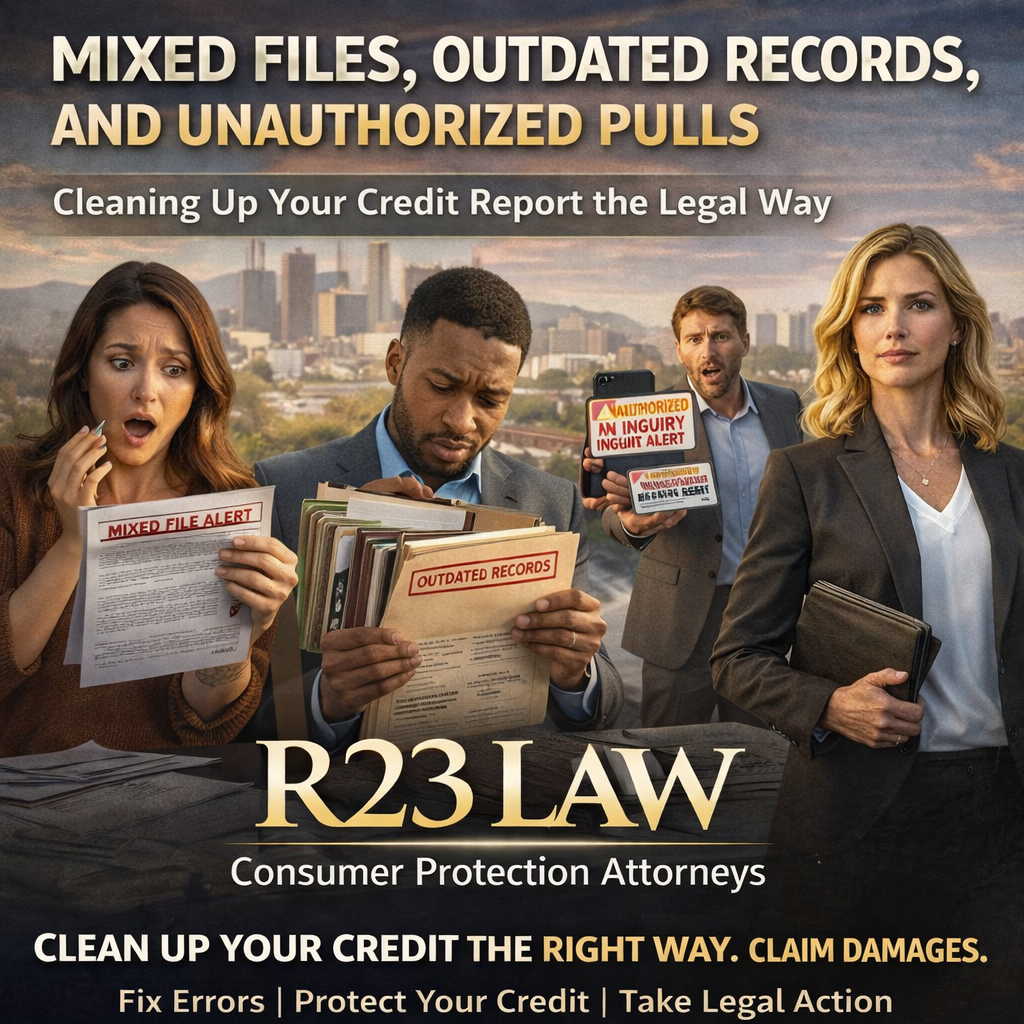
Credit report mistakes can cost you more than just points—they can cost you opportunities
Learn how R23 Law’s California Consumer Protection Attorneys help clean up errors and enforce your rights under the Fair Credit Reporting Act (FCRA).
Credit Errors Aren’t Just Annoying—They’re Actionable
In Los Angeles, credit report mistakes happen all too often. From mixed file errors (someone else’s information showing up on your report) to unauthorized hard pulls, even a small error can snowball into a big financial setback—denied loans, lost jobs, or unfair interest rates.
Fortunately, the Fair Credit Reporting Act (FCRA) gives you the right to demand accuracy—and to seek compensation when those rights are ignored.
R23 Law’s California Consumer Protection Attorneys specialize in identifying violations, correcting credit reports, and holding reporting agencies accountable for the harm they cause.
The Most Common Credit Reporting Violations We See
Based on cases across Los Angeles, these are the most frequent (and fixable) violations under the FCRA:
Mismatched Personal Data – Reports listing another person’s accounts under your name or SSN
Unverified Accounts – Lenders failing to verify disputed accounts
Unauthorized Hard Inquiries – Creditors accessing your report without written consent
Outdated Public Records – Bankruptcies, liens, or judgments that remain past the FCRA’s limits
Incomplete Dispute Investigations – Bureaus failing to complete an investigation within 30 days
Each of these errors can significantly lower your score and block access to financial opportunities.
The Right Way to Fix It: Enforcing Your FCRA Rights
Here’s how R23 Law recommends approaching a credit correction:
1. Pull Your Reports
Visit AnnualCreditReport.com to access your reports from all three bureaus: Equifax, Experian, and TransUnion.
2. Document Everything
Highlight every error and gather supporting evidence—statements, court records, identity documentation.
3. File Disputes in Writing
Send certified letters to each bureau citing specific errors. Include all supporting materials.
4. Track the Bureaus’ Responses
Credit bureaus must respond in writing within 30 days. Document all timelines and correspondence.
5. Contact a Consumer Protection Attorney
If the investigation stalls or fails to resolve your issues, you may be eligible for statutory damages, attorney’s fees, and actual losses.
How R23 Law’s California Consumer Protection Attorneys Advocate for You
At R23 Law, we start with a free credit report review. From there:
We send formal legal demands to credit bureaus and furnishers
If errors aren’t corrected, we pursue litigation in state or federal court
We leverage California’s strong consumer protection laws for maximum impact
You pay nothing unless we win compensation on your behalf
Why Local Legal Representation Matters
California has its own consumer protection law—the Consumer Credit Reporting Agencies Act (CCCRAA)—which provides even more safeguards than the FCRA. Local attorneys like R23 Law understand how to use these state-level protections to your advantage.
Our team knows the procedures of Southern California courts and how to navigate them efficiently. That gives you an edge when it comes to timelines, filings, and holding violators accountable.
Reclaim Your Financial Future
Bad credit reporting doesn’t have to define your financial life. With the right legal support, you can:
Clear inaccurate data
Improve your credit profile
Unlock better loan terms, housing access, and job opportunities
Recover damages when credit agencies break the law
Contact R23 Law’s California Consumer Protection Attorneys today for a free consultation. We’ll guide you through the process of restoring your record and defending your rights—because your financial future deserves accuracy and accountability.
