
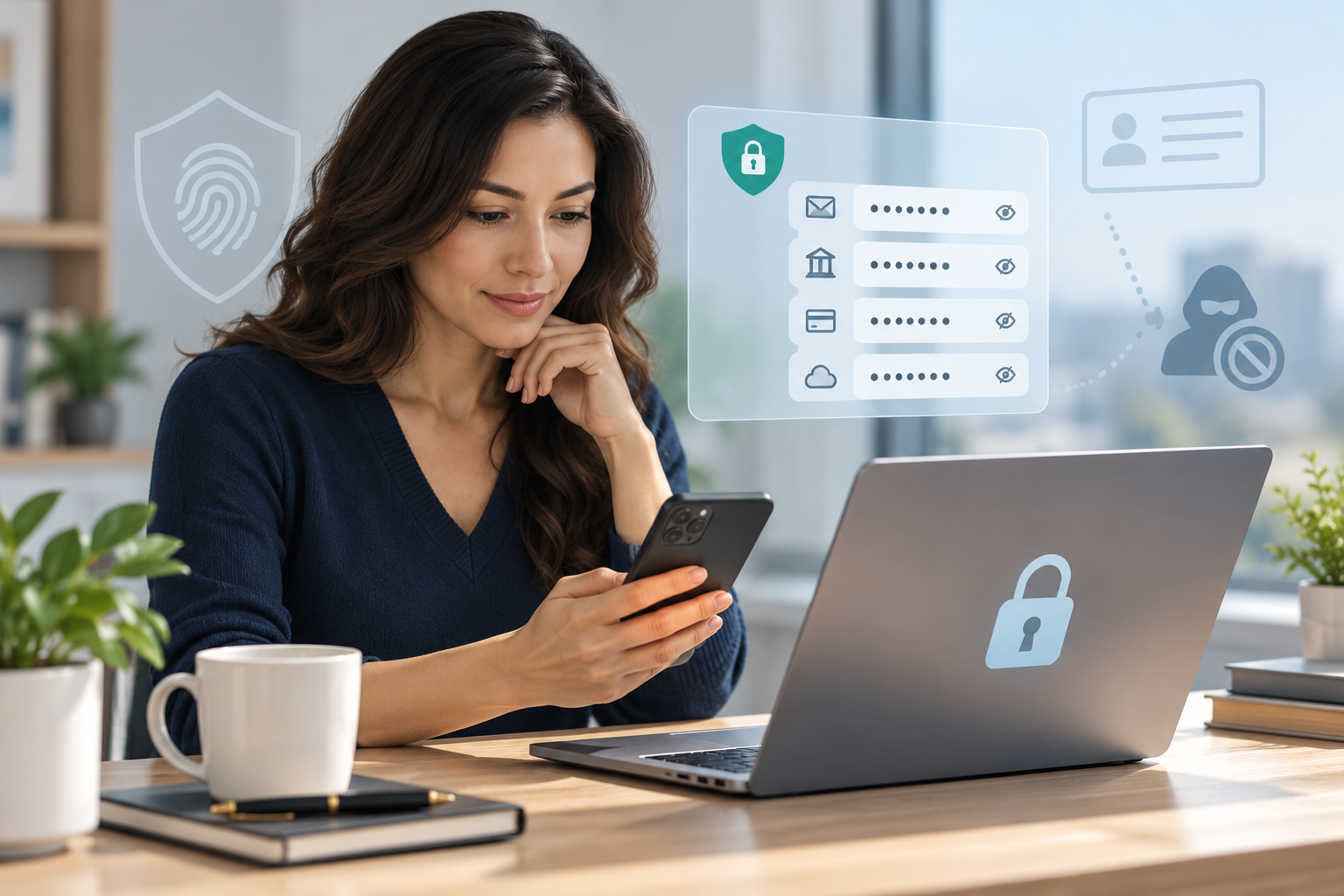
Passwords protect some of a consumer’s most sensitive information
Email accounts, online banking, credit cards, shopping accounts, and other digital services can contain financial and personal information that identity thieves may attempt to access. But remembering a different strong password for every account can be difficult.
That is where password managers enter the picture.
Password managers can generate and store strong, unique passwords, reducing the need to reuse credentials or write passwords somewhere insecure. But no security tool eliminates identity theft risk completely.
Understanding both the benefits and limitations of password managers can give consumers another layer of protection against account takeovers and identity theft.
ONE MASTER PASSWORD — MANY UNIQUE CREDENTIALS
A password manager is designed to securely store login credentials for multiple accounts.
As the attached source explains, passwords stored within the system are generally protected by a single master password. Many password managers can also generate passwords and automatically enter login credentials for users.
This can address a common security problem — password reuse.
Instead of remembering dozens of different credentials, a consumer can rely on the password manager while maintaining different passwords across individual accounts.
PASSWORD REUSE CAN TURN ONE COMPROMISED ACCOUNT INTO MANY
Using the same password across multiple accounts can create broader exposure.
If a reused password is compromised, the security problem may no longer be limited to one account.
A password manager can reduce that risk by generating strong, unique passwords for individual accounts. The source also notes that these tools can reduce reliance on weak or easily guessed passwords and eliminate the need to write credentials in insecure locations.
In other words, consumers do not need to choose between remembering one simple password everywhere and maintaining a notebook filled with login credentials.
THE MASTER PASSWORD DESERVES MASTER-LEVEL SECURITY
Centralizing passwords creates convenience, but it also makes protecting the password manager itself especially important.
The source cautions that if someone successfully obtains or guesses the password protecting the manager, the accounts stored within the system may become accessible.
That makes the master password particularly important.
Consumers using a password manager should avoid choosing a weak or easily guessed master password, particularly one based on personal information that may be publicly available.
TWO-FACTOR AUTHENTICATION ADDS ANOTHER LOCK
The source recommends two-factor authentication as an additional layer of protection for password manager accounts.
With two-factor authentication enabled, possession of the password alone may not be enough to access the account. An additional one-time verification code is required. That added step can become valuable when a password has been compromised.
Strong credentials and two-factor authentication serve different purposes, and using them together can make unauthorized account access more difficult.
PASSWORD MANAGERS ARE NOT INVINCIBLE
No digital security system is completely risk-free.
The source acknowledges that password managers themselves can potentially become targets of data breaches, although it characterizes such incidents as rare. This is an important distinction.
Using a password manager can improve password practices, but consumers should not interpret that protection as a guarantee that their personal information can never be compromised.
Security is about reducing risk rather than pretending risk no longer exists.
ZERO-KNOWLEDGE ENCRYPTION ADDS AN IMPORTANT SAFEGUARD
The source identifies zero-knowledge encryption as a security measure used by many password managers.
Under the model described in the source, the password manager company itself cannot see the user’s stored passwords. Passwords are also encrypted before being synchronized with cloud storage.
These security measures are designed to protect stored credentials.
Even so, the source emphasizes that no tool is entirely without risk.
Consumers should continue practicing good account security even when using password management software.
A PASSWORD MANAGER DOES NOT REPLACE IDENTITY THEFT AWARENESS
Strong passwords can address one avenue of unauthorized account access.
They cannot eliminate every form of identity theft.
Consumers may still encounter compromised information through other circumstances, and a password manager cannot prevent every possible misuse of personal data.
That means consumers should continue paying attention to suspicious account activity even when their passwords are strong and unique.
Account security should be treated as one component of broader identity theft protection.
COMPROMISED ACCOUNT — CHANGE THE PASSWORD QUICKLY
If personal information is compromised despite using a password manager, the source recommends immediately changing passwords associated with affected accounts.
Changing compromised credentials can reduce the opportunity for someone who obtained an existing password to regain access using the same information.
Consumers should also consider whether other accounts could be affected, particularly if passwords were reused before the password manager was implemented.
FRAUD ALERTS CAN ADD PROTECTION AFTER IDENTITY THEFT
The source also recommends placing fraud alerts with the credit reporting agencies after identity theft. Are Password Managers Effective…
A fraud alert can signal that the consumer may be an identity theft victim and that additional identity verification should occur in connection with new credit activity.
This can become particularly important when stolen information extends beyond a compromised password.
An identity thief who possesses sufficient personal information may attempt to create entirely new accounts rather than simply access an existing one.
KEEP RECORDS WHEN IDENTITY THEFT OCCURS
Once identity theft has occurred, documentation becomes important.
Consumers may want to preserve records such as:
Security alerts concerning compromised accounts
Password reset notifications
Unrecognized login notices
Records of unauthorized transactions
Credit reports showing fraudulent accounts
Fraud alert documentation
Communications with affected companies
Information concerning a relevant data breach
These records can provide a timeline showing when suspicious activity occurred and what the consumer did after discovering it.
PASSWORD MANAGER BREACHES CAN RAISE ADDITIONAL CONCERNS
The attached source also raises the possibility that a password manager may fail to adequately protect consumer data and discusses potential legal action when negligence contributes to a compromise.
Whether a company has legal responsibility for a particular data compromise depends on the specific circumstances and applicable law.
A breach alone does not establish liability.
Consumers who believe a company's security failure contributed to identity theft should preserve breach notices, company communications, evidence of resulting fraudulent activity, and records of financial losses.
R23 LAW'S EXPERT LEGAL SERVICES FOR IDENTITY THEFT VICTIMS THROUGHOUT CALIFORNIA
R23 Law's California Consumer Protection Attorneys represent consumers dealing with identity theft and the financial consequences that can follow compromised personal information.
A stolen password can become the beginning of a larger problem involving unauthorized account access, fraudulent financial activity, or misuse of other personal information.
R23 Law represents consumers dealing with identity theft-related consumer protection matters and the consequences that may remain after their information has been compromised.
ONE PASSWORD TO GUARD THEM ALL
Password managers can solve an important security problem by making strong, unique passwords practical across multiple accounts.
But concentrating credentials in one system makes protecting that system especially important.
Choose a strong master password. Enable two-factor authentication. Avoid reusing passwords. Remain alert for suspicious account activity.
And remember that even strong cybersecurity practices cannot guarantee that identity theft will never occur.
The objective is to make unauthorized access more difficult — and to recognize and respond to a compromise when it happens.
Contact R23 Law Today
Strong passwords can reduce identity theft risk, but even careful consumers can have personal information compromised.
When stolen login credentials or other personal information lead to identity theft and resulting consumer protection problems, R23 Law's California Consumer Protection Attorneys can evaluate the circumstances and applicable consumer rights.
Visit [ContactUs](/ContactUs) to contact R23 Law regarding an identity theft or consumer protection matter.
Toll-Free: 310-598-1588
SoCal: (310) 598-1588
Email: info@R23Law.com
Website: www.R23Law.com
Address: US Bank Tower, 633 W. 5th Street, 26th Floor, Los Angeles, CA
© 2025 R23 Law. All rights reserved. Trusted consumer credit lawyers in Los Angeles.
