
SCORE SETTLING — Credit Report Errors That Can Cost California Consumers
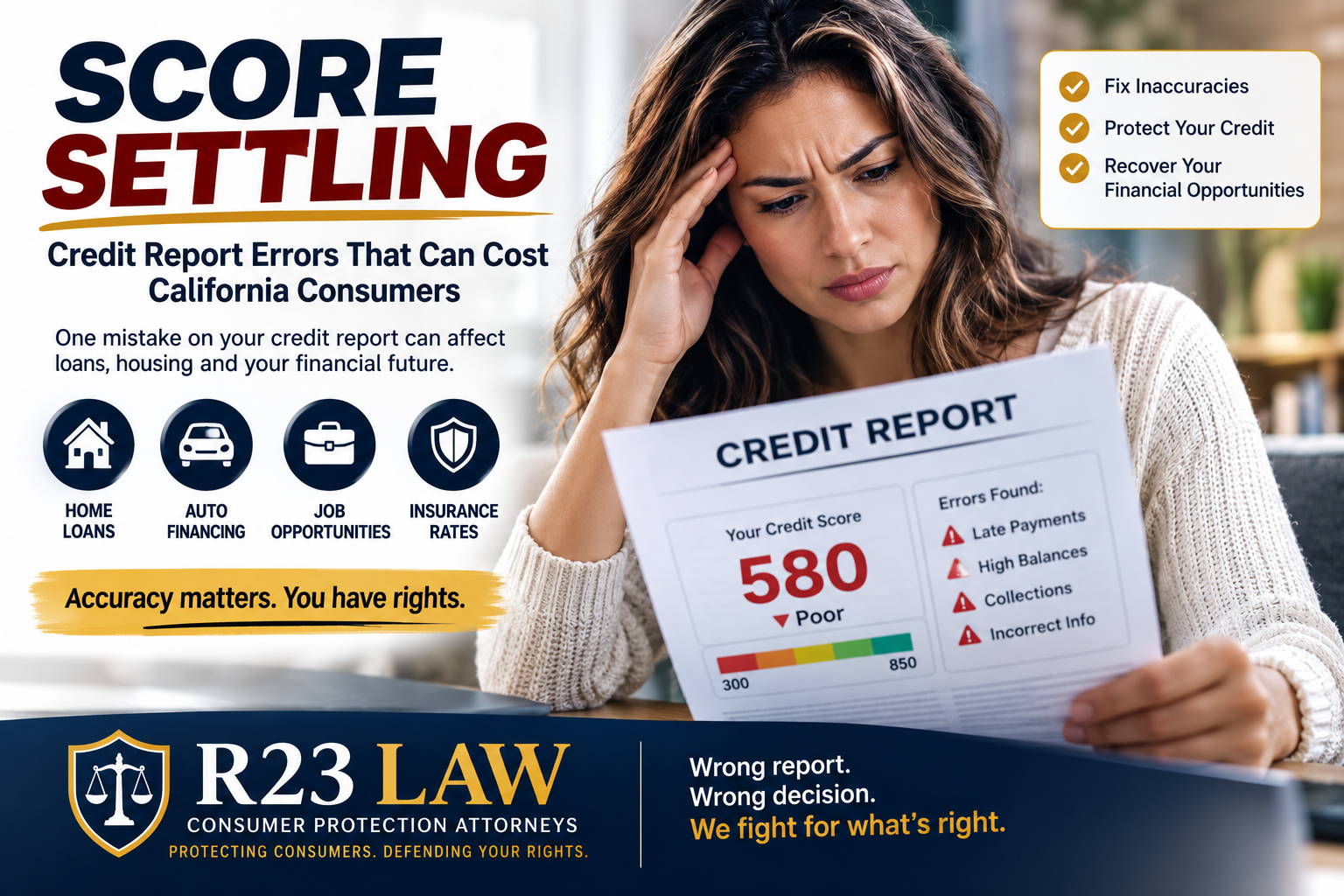
Credit report errors can affect loans, housing, and financial opportunities
R23 Law's California Consumer Protection Attorneys represent consumers facing inaccurate credit reporting. Credit reports can stretch across many pages and contain dense account histories, unfamiliar abbreviations, payment codes, personal identifiers, and creditor information.
That complexity makes errors easy to miss.
A wrong balance, unfamiliar account, incorrect payment date, or account that should have been closed can affect far more than a number on a screen. Credit report errors may influence lending decisions, interest rates, housing applications, insurance costs, and other financial opportunities.
R23 Law's California Consumer Protection Attorneys represent credit injury victims throughout California when inaccurate account information damages their financial standing.
Credit Report Errors Can Hide In Plain Sight
Consumers often review a credit report by looking only at the score.
The report itself may contain the information responsible for lowering that score.
Common areas requiring close review include:
Personal identifying information
Open and closed accounts
Account balances
Payment histories
Collection accounts
Credit inquiries
Public-record information
Accounts belonging to another person
An error may appear minor while producing significant consequences.
For example, an account listed as open after it was closed may distort the consumer’s credit profile. An incorrect late payment may make a reliable borrower appear delinquent. A fraudulent account may increase debt and signal identity theft.
Accounts That Do Not Belong To The Consumer
One of the most serious credit report errors is an account the consumer never opened.
An unfamiliar account may result from:
Identity theft
A mixed credit file
Similar names
Incorrect Social Security number matching
Data-entry mistakes
Reporting errors by a creditor or collector
Consumers should not assume every unfamiliar account is automatically identity theft. The source may instead be a reporting or matching error.
The account should still be investigated promptly.
Important details include:
Creditor name
Account number
Date opened
Reported balance
Payment history
Address connected to the account
Recent inquiries
Collection activity
R23 Law's Expert Legal Services For Identity-Related Credit Injury Victims
R23 Law's California Consumer Protection Attorneys examine whether an unfamiliar account resulted from fraud, a mixed file, or inaccurate reporting.
Relevant evidence may include:
Complete credit reports
Identity theft reports
Account applications
Billing statements
Collection letters
Creditor communications
Dispute results
Proof of the consumer’s identity and address history
The distinction matters because identity theft and ordinary reporting errors may require different evidence and corrective measures.
Incorrect Personal Information Can Create Larger Problems
Credit reports may contain errors involving:
Misspelled names
Incorrect birth dates
Wrong Social Security numbers
Addresses where the consumer never lived
Employers the consumer never worked for
Information belonging to another person
Incorrect identifying information may cause accounts from another file to become associated with the consumer.
A wrong address or name variation may also be an early sign that someone used the consumer’s information to apply for credit.
Consumers should review every personal-information section rather than focusing exclusively on balances and payment history.
False Criminal Information Requires Immediate Attention
The attached source also identifies false criminal information as a potentially serious error.
A credit report and an employment background report are not always the same document, but incorrect criminal information may still appear in consumer reports used for employment, housing, or other decisions.
False criminal records can result from:
Similar names
Incorrect dates of birth
Incomplete court records
Expunged or outdated information
Records belonging to another person
A consumer who discovers criminal information that does not belong to them should preserve the report and identify the company that supplied it.
Incorrect Balances Can Distort A Credit Profile
A creditor may report a balance that is:
Higher than the amount owed
Already paid
Duplicated
Assigned to the wrong account
Missing a payment
Missing an insurance or settlement credit
Still accruing after closure
An inflated balance may increase reported debt and affect how lenders evaluate the consumer.
A balance dispute should be supported with records such as:
Monthly statements
Payment confirmations
Settlement agreements
Account ledgers
Bank records
Creditor emails
Payoff letters
R23 Law's Expert Legal Services For Balance And Payment Reporting Injuries
R23 Law's California Consumer Protection Attorneys review whether creditors, debt collectors, or other reporting companies accurately reflected payments and account balances.
The firm’s review may compare:
The consumer’s records
The creditor’s statements
The amount shown on each credit report
The date each payment was made
The account’s reported status
The results of prior disputes
A balance that appears incorrect should be traced transaction by transaction.
Wrong Payment Dates Can Create False Delinquencies
Payment history can be one of the most damaging areas of a credit report when reported inaccurately.
Potential errors include:
A timely payment marked late
A payment assigned to the wrong month
A missed payment that never occurred
An account reported delinquent after payoff
A payment plan reported incorrectly
A closed account continuing to show new late payments
Consumers should compare the report with bank statements, receipts, automatic-payment confirmations, and creditor records.
Even one incorrect late-payment entry may affect future lending decisions.
Closed Accounts Should Be Reported Accurately
An account that was closed may continue appearing on a credit report as open.
That error may make it appear that the consumer has additional active credit or unresolved debt.
Consumers should review:
The account status
The closure date
The current balance
The payment history
Whether new activity appears after closure
A closure confirmation or final statement may support the dispute.
Credit Report Errors Can Affect More Than A Score
Inaccurate reporting may contribute to:
Credit denials
Higher interest rates
Reduced credit limits
Housing denials
Collection activity
Loan delays
Lost financial opportunities
Emotional distress
Time spent pursuing corrections
Consumers should preserve adverse-action notices from lenders, landlords, or other companies.
Those notices may identify the credit reporting agency involved and provide evidence connecting the inaccurate report to a specific financial injury.
R23 Law's Expert Legal Services For Financial Injury Victims Throughout California
R23 Law's California Consumer Protection Attorneysevaluate both the reporting error and the resulting harm.
Relevant damages evidence may include:
Loan denial notices
Higher-rate offers
Housing rejection letters
Increased deposits
Lost refinancing opportunities
Collection notices
Credit monitoring costs
Correspondence showing repeated disputes
Records of emotional or financial distress
The existence of an error and the harm caused by that error are related but separate parts of the case.
Written Disputes Create A Stronger Record
The attached source recommends sending a written dispute with evidence supporting the correction.
A dispute should clearly identify:
The consumer
The account or information being challenged
The specific error
Why the information is inaccurate
The requested correction
The documents supporting the dispute
Consumers should send copies rather than original records and retain proof of delivery.
Useful supporting documents may include:
Account statements
Payment receipts
Identity documents
Closure letters
Police reports
Identity theft reports
Settlement records
Court documents
Creditor correspondence
A precise dispute is often stronger than a general statement that the report is wrong.
Keep A Complete Dispute File
Consumers should preserve:
Every version of the credit report
Dispute letters
Supporting documents
Certified-mail receipts
Online confirmation pages
Investigation results
Creditor responses
Updated reports
Denial notices
A timeline of telephone calls and correspondence
Credit reporting disputes may involve multiple companies, and each company may respond differently.
The records can show whether the information was corrected, verified without explanation, removed temporarily, or reported again later.
Reporting Companies May Refuse To Correct Errors
The attached source recognizes that correction is not always simple.
A reporting company may:
Reject the dispute
Verify the information without a meaningful explanation
Request additional documents
Correct only part of the error
Remove the item and later report it again
Continue reporting conflicting information
Consumers should not assume that an automated dispute result proves the information is accurate.
The underlying documents remain important.
R23 Law's California Consumer Protection Attorneys Challenge Unresolved Credit Errors
R23 Law's California Consumer Protection Attorneys represent consumers when inaccurate information remains after disputes or when companies fail to meaningfully address the evidence.
The firm may review conduct involving:
Equifax
Experian
TransUnion
Banks
Credit card issuers
Auto lenders
Mortgage companies
Debt collectors
Medical providers
Other information furnishers
The legal analysis may address the original error, the dispute process, the investigation, continued reporting, and resulting damages.
Credit Accuracy Protects Financial Opportunity
A credit report can influence major financial decisions.
Consumers should review every section carefully, identify unfamiliar information, compare account data with their own records, and create a written dispute file when inaccuracies appear.
A reporting mistake should not be allowed to define a consumer’s financial reputation.
R23 Law's California Consumer Protection Attorneys represent credit reporting injury victims throughout California when inaccurate accounts, balances, payment histories, or personal information interfere with financial opportunities.
Contact R23 Law's California Consumer Protection Attorneys
Consumers facing unresolved credit report errors should preserve complete reports, dispute records, supporting documents, and evidence of any credit denial or financial loss.
Contact R23 Law's California Consumer Protection Attorneys for a free consultation regarding inaccurate credit reports, mixed files, identity theft accounts, incorrect balances, false payment histories, and related consumer-protection claims.
Toll-Free: 310-598-1588 Email: info@R23Law.com Website:www.R23Law.comOffice: US Bank Tower, 633 W. 5th Street, 26th Floor, Los Angeles, California
Disclaimer: This article provides general information and does not constitute legal advice or create an attorney-client relationship. The availability of any claim or remedy depends on the report, dispute history, responsible companies, resulting injury, evidence, and applicable law.
