
STOLEN NAME, REAL WARRANT — Criminal Identity Theft And California Victim Rights
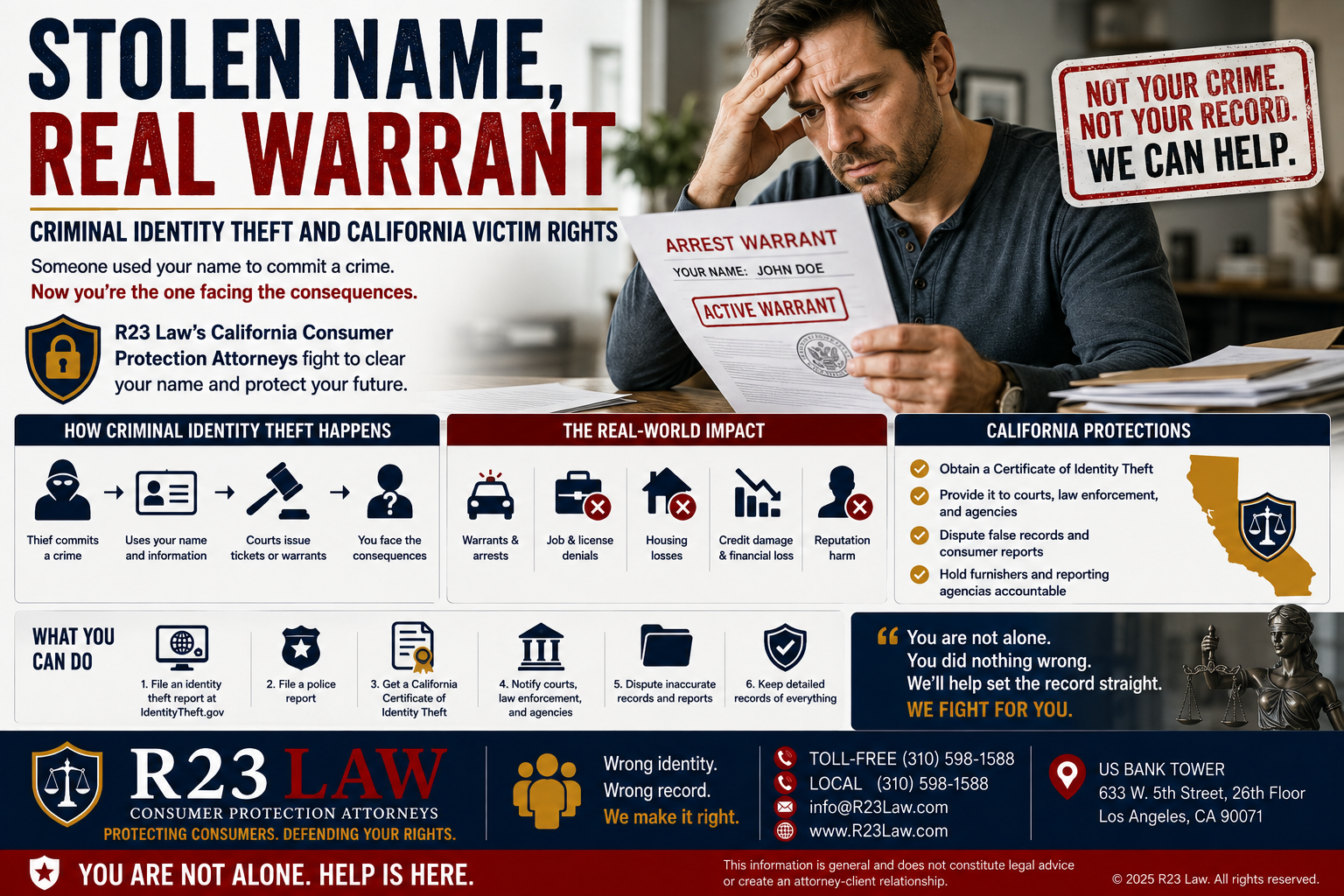
Criminal identity theft can lead to warrants, false records, job denials, and housing losses
A person can steal more than money or credit.
An identity thief may provide another person’s name, address, birth date, or other identifying information after committing a crime. The real offender walks away under a false identity. The victim may later face unpaid tickets, court notices, criminal records, or even an arrest warrant.
For a law-abiding consumer, discovering that another person committed a crime under their name can be devastating.
R23 Law's California Consumer Protection Attorneys represent criminal identity theft victims throughout California when stolen personal information creates false records, financial injury, or damage to employment and housing opportunities.
Criminal Identity Theft Puts Another Person’s Crime In The Victim’s Name
Criminal identity theft occurs when someone commits an offense and gives law enforcement another person’s identifying information to avoid responsibility.
This may occur after:
A traffic violation
A parking offense
A misdemeanor arrest
A failure to appear
A more serious criminal offense
The identity thief may use the victim’s name, address, date of birth, driver’s license information, or other identifying details.
The victim may know nothing about the incident until a notice arrives, a background check reveals a record, or law enforcement appears with a warrant.
R23 Law's Expert Legal Services For Criminal Identity Theft Victims Throughout California
Criminal identity theft can produce several overlapping problems.
R23 Law's California Consumer Protection Attorneys evaluate the consumer consequences surrounding:
False identifying information
Criminal records linked to the wrong person
Arrest warrants issued under the victim’s name
Employment background check errors
Housing screening denials
Fraudulent accounts and loans
Credit reporting damage
Lost financial opportunities
Correcting one record may not resolve every consequence.
A victim may need to address criminal records, consumer reports, fraudulent financial accounts, and inaccurate background checks separately.
Minor Offenses Can Create Major Consequences
The original offense does not need to be a serious felony to create serious problems for the victim.
An identity thief may receive a traffic ticket or misdemeanor citation under the victim’s name. If the offender fails to pay the ticket or appear in court, the court may issue a warrant using the false identity.
The victim may then face:
Unexpected police contact
Detention or arrest
Court appearances
Legal expenses
Missed work
Emotional distress
Damage to personal reputation
The victim must then establish that someone else committed the offense.
Serious Crimes Can Create Long-Term Record Damage
In other cases, an identity thief may use stolen information while committing a more serious crime.
A false criminal record may interfere with:
Employment
Professional licensing
Housing
Volunteer positions
Education
Insurance
Financial services
Even when the victim is innocent, an inaccurate record can continue appearing in databases and consumer reports until it is formally corrected.
R23 Law's California Consumer Protection Attorneys Address Background Check Injury
A criminal identity theft record may later appear in an employment or tenant background check.
The report may incorrectly state that the victim:
Was arrested
Failed to appear in court
Was convicted
Has an active warrant
Used an alias
Committed an offense in another location
These errors can cost a consumer a job or housing opportunity before the victim understands what caused the problem.
R23 Law's California Consumer Protection Attorneys review background reports, denial notices, court records, identity documents, and dispute histories to identify how the false information became associated with the consumer.
Criminal Identity Theft May Also Damage Credit
A person using another individual’s identity for criminal activity may also use the same information to open financial accounts.
The identity thief may obtain:
Credit cards
Personal loans
Auto loans
Utility accounts
Mobile telephone accounts
Other forms of credit
Fraudulent balances and missed payments may then appear on the victim’s credit reports.
The consumer may experience:
Lower credit scores
Collection activity
Loan denials
Higher interest rates
Difficulty obtaining housing
Additional identity theft
A criminal identity theft matter may therefore develop into both a criminal-record problem and a credit-reporting dispute.
R23 Law's Expert Legal Services For Credit Injury Victims Throughout California
R23 Law's California Consumer Protection Attorneys examine whether the person who used the victim’s identity also created fraudulent financial accounts.
The review may include:
Equifax credit reports
Experian credit reports
TransUnion credit reports
Collection letters
Account applications
Loan records
Identity theft reports
Credit denial notices
Dispute correspondence
The goal is to identify every account, inquiry, balance, or personal-information entry connected to the stolen identity.
File An Identity Theft Report With The Federal Trade Commission
The attached source identifies an FTC identity theft report as an important early step.
Consumers can report identity theft to the Federal Trade Commission and create documentation describing the fraud.
The report may include:
The victim’s identifying information
The type of identity theft
The records or accounts affected
The known circumstances
A recovery plan
The consumer should retain a complete copy of the FTC report and all confirmation information.
File A Police Report
After completing the FTC report, the source recommends filing a police report.
The consumer should bring documentation showing that another person used the victim’s identity.
Relevant records may include:
The FTC identity theft report
Court notices
Warrant information
Background reports
Credit reports
Identification documents
Proof of the victim’s location
Employment or travel records
Communications from creditors or collectors
The police report creates an additional official record of the identity theft allegation.
R23 Law's California Consumer Protection Attorneys Build The Evidence Record
Criminal identity theft cases depend heavily on documentation.
R23 Law's California Consumer Protection Attorneys review and organize evidence such as:
FTC reports
Police reports
Court records
Arrest information
Citation records
Driver’s license records
Employment records
Housing denial notices
Background reports
Credit reports
Fraudulent account statements
Dispute letters
Identity documents
A detailed timeline can show where the victim was when the offense occurred and when the false record was discovered.
California’s Certificate Of Identity Theft Process
The attached source also describes an application for a Certificate of Identity Theft.
According to the source, the certificate process involves six steps and is intended to establish that the consumer was the victim of identity theft when another person used the consumer’s identity.
The certificate may assist the victim in demonstrating factual innocence and separating the victim from the offender’s conduct.
Because the process can involve multiple records and agencies, consumers should preserve every document connected to the false criminal history.
Factual Innocence Matters
A criminal identity theft victim did not commit the offense merely because the offender used the victim’s name.
The victim may need to establish:
The identity information was used without permission
Another person committed the offense
The victim was not present
The victim did not receive the citation
The victim did not make the court appearance
The victim did not open related accounts
The criminal record belongs to someone else
Records proving the victim’s location, employment, travel, or physical appearance may become important.
R23 Law's Expert Legal Services For False Record Injury Victims
False criminal information can spread across several systems.
The incorrect record may appear in:
Court databases
Law enforcement files
Employment screening reports
Tenant screening reports
Consumer reporting databases
Credit files
R23 Law's California Consumer Protection Attorneys evaluate which companies reported or used the false information and whether correction procedures were followed.
A court correction may not automatically update every private background screening company.
Employment And Housing Losses Should Be Documented
Criminal identity theft may cause measurable financial damage when a false record leads to a denial.
Consumers should preserve:
Job rejection emails
Rescinded employment offers
Background check notices
Tenant screening reports
Housing denial letters
Lost wage records
Increased housing costs
Application fees
Communications identifying the criminal record
These documents may connect the false identity theft record to a specific injury.
Credit And Background Reports Require Separate Review
A consumer should not assume that correcting the criminal case will automatically remove every inaccurate consumer report entry.
The victim should review:
All three major credit reports
Employment background reports
Tenant screening reports
Court records
Public-record databases
Each reporting company may have its own dispute process.
The consumer should retain copies of all disputes, supporting documents, delivery confirmations, and investigation results.
R23 Law's California Consumer Protection Attorneys Pursue Consumer Accountability
Criminal identity theft begins with the person who misused the victim’s identity.
Additional injury may occur when a background screening company, credit bureau, creditor, collector, or other business continues reporting false information after receiving notice.
R23 Law's California Consumer Protection Attorneys evaluate:
How the identity was used
Which criminal records were affected
Whether financial accounts were opened
Which companies reported the information
Whether disputes were submitted
Whether the information was corrected
Whether the victim lost employment, housing, or credit
The appropriate legal response depends on the source of the record and the evidence available.
Someone Else’s Crime Should Not Become The Victim’s Record
Criminal identity theft can place an innocent person’s name on a citation, warrant, arrest record, or background report.
The consequences may include police contact, job loss, housing denial, credit damage, and lasting emotional distress.
Victims should create official identity theft reports, preserve all records, document every denial, and address each false report directly.
R23 Law's California Consumer Protection Attorneys represent criminal identity theft victims throughout California when false records and stolen personal information interfere with financial stability and future opportunities.
Contact R23 Law's California Consumer Protection Attorneys
Consumers facing false criminal records, arrest warrants, background check errors, or fraudulent accounts connected to identity theft should preserve every related document.
Contact R23 Law's California Consumer Protection Attorneys for a free consultation concerning criminal identity theft, false background reports, fraudulent credit accounts, employment denials, housing losses, and related consumer-protection claims.
Toll-Free: 310-598-1588 Email: info@R23Law.com Website:www.R23Law.comOffice: US Bank Tower, 633 W. 5th Street, 26th Floor, Los Angeles, California
Disclaimer: This article provides general information and does not constitute legal advice or create an attorney-client relationship. Criminal record correction, identity theft certificates, consumer reporting claims, and available remedies depend on the facts, records, responsible entities, and applicable law.
