
SEND BUTTON, SPEND FOREVER — EFTA Rights After Peer-to-Peer Payment Fraud
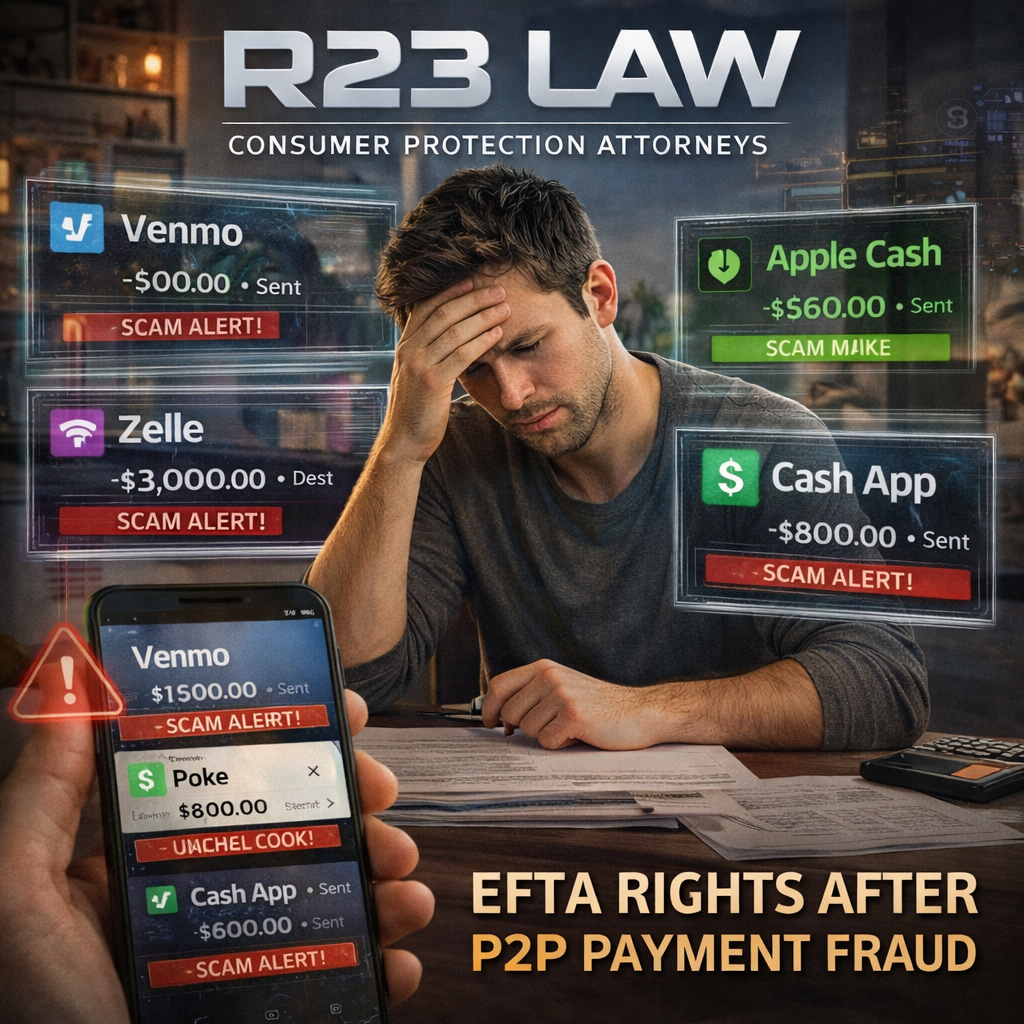
Venmo, Zelle, Apple Cash, and Cash App fraud can trigger Electronic Fund Transfer Act (EFTA) and Regulation E protections
Learn deadlines, dispute rules, and documentation steps from R23 Law’s California Consumer Protection Attorneys.
Peer-to-peer (P2P) payment apps are built for convenience: split dinner, pay rent, reimburse a friend—done. The problem is that scammers love “done.” Once money moves instantly, the tug-of-war shifts to whether the bank or payment provider treats the transaction as a reversible error or a final loss.
Federal law may still be on the consumer’s side in many situations. The Electronic Fund Transfer Act (EFTA) (15 U.S.C. § 1693 et seq.) and its implementing regulation, Regulation E (12 C.F.R. Part 1005), create rules for electronic transfers and require specific dispute and investigation procedures.
This is a recurring focus for R23 Law’s California Consumer Protection Attorneys: when institutions move fast to process payments, but slow (or dismissive) when fraud hits.
P2P Payments Often Fall Under the EFTA and Regulation E
The EFTA covers “electronic fund transfers” and provides a baseline framework for rights and responsibilities in electronic payment systems.
Many P2P transactions can be covered when the app is linked to a bank account or debit card. That matters because coverage can drive what the bank must do when you report a problem—and how your liability is limited for unauthorized transfers.
s the EFTA Is Designed to Provide
In plain language, the EFTA/Regulation E framework is built to require things like:
limits on consumer liability for unauthorized transfers
prompt error resolution by financial institutions (including structured investigation steps)
disclosures about account terms and certain fees
procedures to investigate and correct errors when consumers report problems
Your bank doesn’t get to freestyle the process if Regulation E applies—there’s a rulebook.
“Unauthorized” vs. “Scammed” Transactions: The Category Fight
One of the messiest parts of P2P fraud is classification—because different fact patterns can trigger different legal obligations.
The attached material breaks down common buckets in a way consumers actually recognize:
Unauthorized access to your account (for example, a hacked login that initiates transfers) is typically the clearest path to EFTA protections.
Mistaken or coerced transfers may qualify depending on circumstances—especially when reported quickly.
Payments you made voluntarily to a scammer can be harder to recover, but some fact patterns may still fit within EFTA/Regulation E protections.
That last category is where banks often default to “you pressed send,” while consumers rightly respond, “I pressed send because the transaction was engineered by deception.”
R23 Law’s California Consumer Protection Attorneys look closely at the real mechanics: account takeovers, spoofed commudentifiers, and whether the institution followed the dispute procedures Regulation E requires.
Deadlineraud Disputes
Speed is leverage. Under the EFTA/Regulation E ecosystem, timing can affect liability and remedies.
The attached material highlights a keport the unauthorized transaction promptly—generally within 60 days of receiving the statement that shows the transfer**.
The statute and regulations also address liability limits and notice concepts for unauthorized transfers.
If you wait, the bank may argue your notice was late and push responsibility back onto you.
What Regulation E Requires After You Report Fraud
When you notify a financial institution of an error, Regulation E sets out procedures for resolving errors—including required steps to investigate and respond within defined timeframes, and rules that may require provisional credit in certain situations.
If an institution issues blanket denl investigation, that’s not just frustrating—it can be legally significant.
A Documentation Stack That Moves the Needle
P2P fraud disputes are won and lost on documentation. Build a clean record that makes it difficult to dismiss your claim as “unverified”:
Screenshots of the transaction(s), recipient details, and confirmation screens
Chat logs, texts, emails, DMs that show the scam setup and pressure tactics
Bank/app timestamps (date/time, amount, reference numbers)
Proof of account security events (password reset emails, device logins, carrier changes)
Written communications with the bank/payment provider, including claim numbers and denials
This isn’t busywork. It’s the difference between a fast denial and a record that forces accountability.
Where R23 Law’s California Consumer Protection Attorneys Fit In
When P2P fraud results in a bank refusing reimbursement—or when the investigation looks like a form letter instead of a real process—consumer protection laws may provide options. R23 Law’s California Consumer Protection Attorneys evaluate:
whether the transfers qualify as “unauthorized” (or otherwise covered errors)
whether Regulation E procedures were followed
whether the institution’s communications and timelines match legal requirements
what damages flowed from the denial, delay, or mishandling
Disclaimer: This article is for informational purposes only, not a legal advice.
