
WHEN A PHONE TICKET GETS A DUI COSTUME — Checkr Background Check Mix-Ups in California
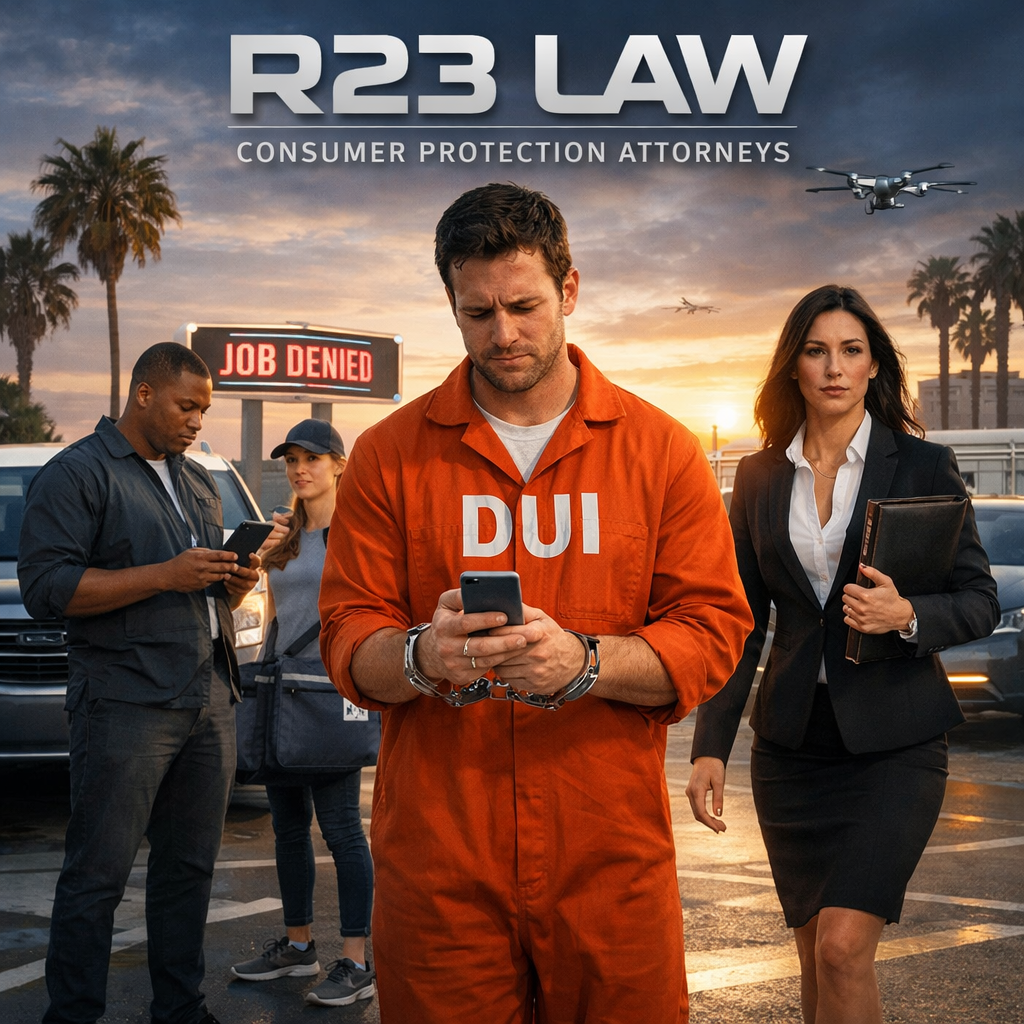
Some background checks mislabel cell phone tickets as alcohol-related driving offenses, sidelining drivers and job seekers
Learn FCRA rights with R23 Law’s California Consumer Protection Attorneys
A background check is supposed to reflect facts—not remix them into something worse.
Yet one of the most alarming patterns flagged in the attached material is this: cell phone violations being misreported as alcohol-related driving offenses on background checks, including cases noted in Santa Clara County, California. That kind of “category swap” can be career-ending for rideshare and delivery drivers, and it can derail any job where a clean driving record matters.
This is exactly the lane where R23 Law’s California Consumer Protection Attorneys step in: consumer reporting errors that create real-world consequences, fast.
Why “Phone Ticket → Alcohol Offense” Errors Hit So Hard
For gig drivers, driving is the job. For many employers, driving is the dealbreaker.
When a background check mistakenly turns a non-alcohol ticket into an alcohol-related offense, the fallout can include:
Immediate deactivation or stalled onboarding for rideshare/delivery apps
Job offer delays or withdrawals for roles involving driving, field work, or company vehicles
Higher insurance flags (or employer concerns about liability)
Reputational harm that follows you from application to application
Even if the mistake is later “corrected,” the denial window can still cost you income, opportunities, and stability.
How These Background Check Coding Errors Happen
This kind of reporting failure often comes from a familiar mix of shortcuts and bad data handling:
Misclassification of violation codes
Some reports translate DMV or court entries into standardized “offense categories.” If that translation is wrong, the label becomes the problem—especially when it falsely implies impairment.
Incomplete record context
A database may store only partial text or a shorthand code, and the background check vendor fills in the blanks incorrectly.
Over-reliance on vendors and automated logic
Large screening operations run at scale. If a flawed rule is baked into the system, it can repeat across many consumers.
The attached material describes this pattern as showing up in multiple cases—exactly the type of repetition consumer protection laws are meant to curb.
The FCRA: Accuracy Rules Still Apply to Driving History Reporting
Many background check companies are “consumer reporting agencies” under the Fair Credit Reporting Act (FCRA) when their reports are used for employment-related decisions (including gig platform eligibility in many real-world scenarios).
Under the FCRA framework, two principles matter most in these “wrong label” cases:
Reasonable procedures for accuracy
Background check companies are expected to use reasonable procedures aimed at accuracy—especially when reporting something as serious as an alcohol-related offense.
A real dispute and reinvestigation process
When you dispute an item, the company must conduct a reinvestigation and correct or delete information that can’t be verified or is being reported inaccurately.
R23 Law’s California Consumer Protection Attorneys focus on whether the company’s systems and reinvestigation practices were lawful—and whether the misreporting triggered a denial, deactivation, or lost income.
What to Do When a Background Check Mislabels a Ticket
If a background check turned a phone ticket into an alcohol offense, build a clean paper trail quickly:
1) Get the underlying report—not just the platform summary
Download the full background check report (and any supporting pages showing the alleged offense).
2) Pull proof of the actual citation/record
Gather court or DMV documentation showing what the violation really was (and what it wasn’t).
3) Dispute in writing
Dispute the inaccurate classification in writing and attach your proof. Keep confirmation of delivery and screenshots of any portal status changes.
4) Track the real costs
Document:
days/weeks locked out
missed earnings (screenshots, statements, logs)
job communications (offer emails, deactivation notices)
This evidence matters because damages aren’t theoretical when the error blocks you from working.
Why These Cases Often Aren’t “One-Off Glitches”
When a background check vendor repeatedly mislabels the same type of violation, that points to process-level failure—not a single bad entry. The attached material flags this as a developing pattern, which is a major reason these claims can carry weight when the facts line up.
That’s also why consumers shouldn’t accept “we updated it” as the end of the story if the damage has already occurred.
Where R23 Law’s California Consumer Protection Attorneys Fit In
When an inaccurate background check report causes a denial, deactivation, or lost wages, the legal analysis often centers on:
whether the report was prepared with reasonable accuracy procedures
whether the dispute/reinvestigation was handled properly
whether the consumer received required notices (where applicable)
what harm flowed from the error
R23 Law’s California Consumer Protection Attorneys handle consumer reporting and background check matters with a focus on accountability and recovery where the facts support it—especially when a mislabeling error turns routine driving history into something far more damaging.
Disclaimer: This article is for informational purposes only and does not constitute legal advice
