
SOUND THE ALERT – California Consumer Guide To Fraud Alerts And Credit Protection
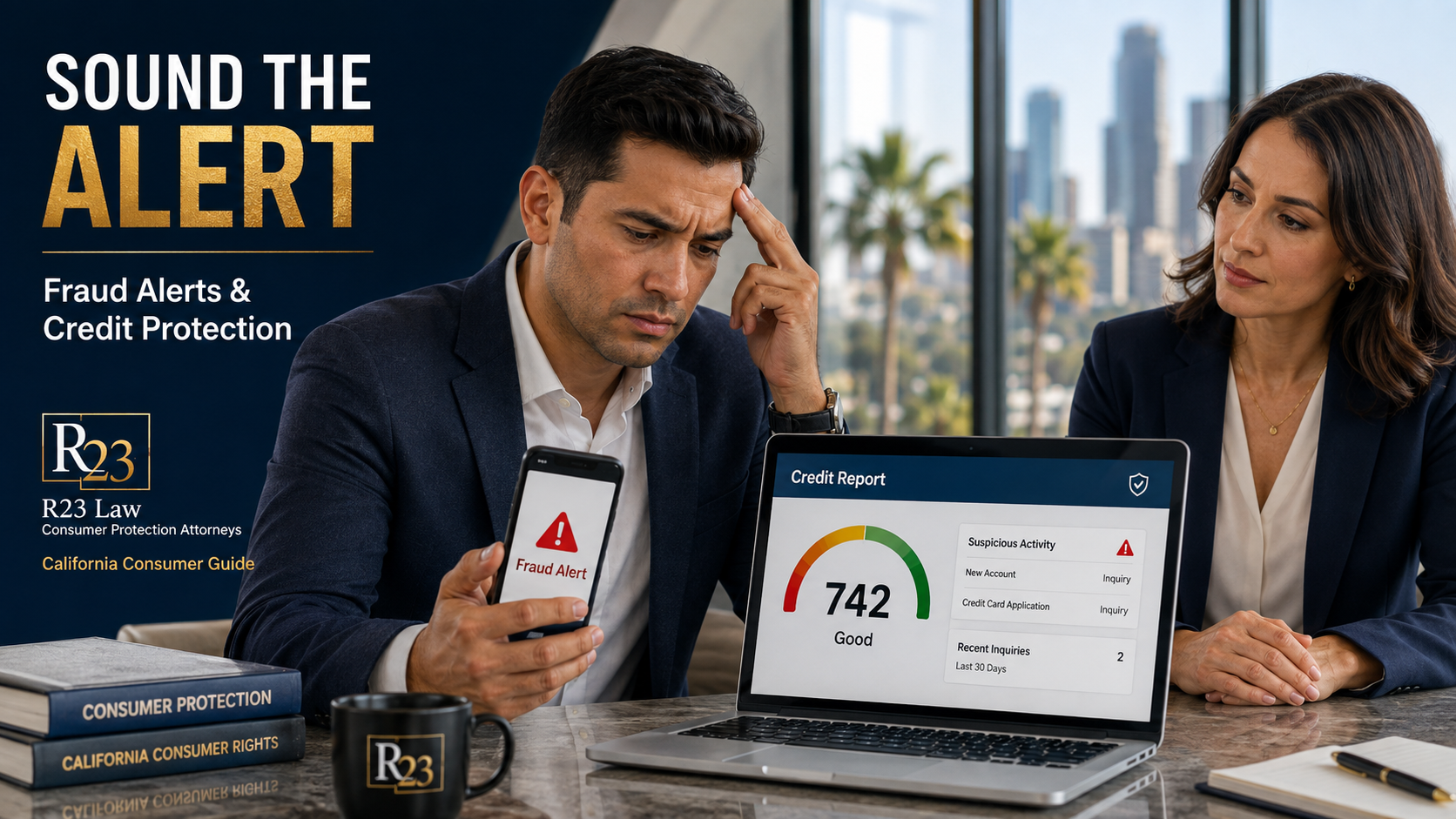
A suspicious credit inquiry, unfamiliar account, or major data breach can leave a consumer wondering whether someone is preparing to use their identity
A fraud alert on a credit report creates an added identity-verification requirement before a creditor approves certain new credit requests.
Fraud alerts are free and available to consumers who believe they are—or may soon become—victims of fraud or identity theft. By placing an alert with one nationwide credit reporting company, the consumer triggers a process requiring that company to notify the other two major credit bureaus.
A fraud alert can be an important early response, but it does not correct fraudulent accounts already appearing on a credit report. When inaccurate information remains after an identity theft dispute, R23 Law’s California Consumer Protection Attorneys represent consumers financially injured by unlawful credit reporting practices.
A Fraud Alert Places A Warning On Your Credit File
A fraud alert is a notice attached to a consumer’s credit file. It tells creditors reviewing the report that the applicant may be an identity theft victim and that the creditor must take reasonable steps to verify the applicant’s identity before approving covered credit requests.
The added verification requirement can make it more difficult for an identity thief to:
Open a new credit account in the victim’s name.
Obtain an additional card on an existing account.
Request an increase to an existing credit limit.
Use stolen identifying information to impersonate the consumer.
A fraud alert does not prevent every form of identity theft. It is primarily directed at new credit activity and generally does not stop someone from misusing an existing account that has already been compromised.
Placing A Fraud Alert With The Credit Bureaus
Consumers may place a fraud alert by contacting one of the three nationwide credit reporting companies:
Equifax
Experian
TransUnion
Unlike a credit freeze, a fraud alert generally requires contact with only one bureau. Once the selected bureau processes the request, it must notify the other two bureaus so that corresponding alerts can be added to their files.
Because telephone numbers, mailing addresses, and online procedures may change, consumers should use the current fraud-alert page maintained by the selected credit reporting company.
After placing the alert, review credit reports from all three bureaus. Look for unfamiliar accounts, incorrect balances, unknown addresses, unauthorized inquiries, or identifying information belonging to another person.
R23 Law’s Expert Legal Services For Consumers Injured By Credit Reporting Errors
A fraud alert is a preventive measure. It does not automatically erase fraudulent accounts or compel a credit bureau to correct identity-theft-related information.
R23 Law’s California Consumer Protection Attorneys evaluate whether a credit reporting agency, creditor, account furnisher, or debt collector failed to respond properly after receiving notice of identity theft.
The firm’s legal services may include:
Reviewing credit reports and identity theft documentation.
Identifying fraudulent accounts and reporting inconsistencies.
Evaluating disputes sent to credit bureaus and account furnishers.
Examining whether a reasonable investigation occurred.
Challenging inaccurate or unverifiable credit information.
Documenting financial loss, reputational injury, and emotional distress.
Pursuing available damages under federal and California consumer protection laws.
A consumer’s legal options depend on the underlying facts, the dispute history, and the conduct of the businesses reporting or collecting the fraudulent accounts.
The Three Types Of Fraud Alerts
Federal consumer protection law recognizes different fraud alerts for different circumstances.
Initial Fraud Alert
An initial fraud alert is available to a consumer who believes they are—or may soon become—a victim of identity theft or fraud.
The alert lasts for one year. It may be renewed after it expires. When an initial fraud alert is active, creditors reviewing the credit report must take reasonable steps to verify the consumer’s identity before approving covered requests for new credit.
An initial alert may be appropriate after:
A wallet or Social Security card is stolen.
Personal information is exposed in a data breach.
An unfamiliar credit inquiry appears.
Mail containing financial information goes missing.
A consumer suspects that a relative, former partner, or other person obtained private information.
Login credentials for a financial or email account are compromised.
The consumer may place another initial fraud alert when the one-year period ends if the risk remains.
Extended Fraud Alert
An extended fraud alert is intended for consumers whose identities have already been stolen.
It lasts for seven years. Current CFPB guidance states that an identity theft victim may place an extended alert after filing an identity theft report through IdentityTheft.gov. An extended alert also provides additional access to free credit reports and removes the consumer’s name from certain prescreened credit and insurance marketing lists for five years.
An extended fraud alert may be appropriate when fraudulent accounts have already been opened, unauthorized debts are appearing on credit reports, or stolen personal information continues to be used.
Active-Duty Fraud Alert
An active-duty fraud alert is available to qualifying members of the armed forces who are assigned away from their usual duty station.
The alert lasts for 12 months, although the servicemember may request earlier removal or place another alert if the deployment continues. A personal representative may place or remove the alert when direct contact with the servicemember is difficult.
An active-duty alert also removes the servicemember’s name from certain prescreened credit and insurance marketing lists for two years.
Fraud Alerts Do Not Lower Credit Scores
The attached source explains that placing a fraud alert does not reduce a consumer’s credit score or change the scoring formula. The alert may slow a credit application because the creditor must complete additional identity-verification steps, but the alert itself is not a negative credit entry.
Consumers applying for a mortgage, automobile loan, rental property, or another form of credit should be prepared for the creditor to request additional information.
Removing Or Renewing A Fraud Alert
An initial fraud alert expires after one year unless the consumer places another alert. A consumer may also request removal before the expiration date.
The removal process generally requires contacting a nationwide credit reporting company and completing its identity-verification procedure. The bureau may request documentation establishing that the person requesting removal is the consumer whose file contains the alert.
Extended and active-duty alerts may also be removed before their scheduled expiration at the consumer’s request.
Before removing an alert, consider whether:
The source of the identity theft has been contained.
Compromised passwords and account numbers have been replaced.
Fraudulent credit information has been corrected.
Mail and electronic accounts are secure.
There have been additional suspicious inquiries or applications.
The person who obtained the information may still have access to it.
Fraud Alert Versus Credit Freeze
Fraud alerts and credit freezes are both free, but they operate differently.
A fraud alert allows creditors to access the credit report while requiring additional identity verification before certain credit is approved.
A credit freeze restricts prospective creditors from accessing the credit file. Because lenders generally will not issue new credit without reviewing the report, a freeze creates a stronger barrier against new-account identity theft.
There is also an important procedural difference:
A fraud alert may be initiated through one nationwide credit bureau, which must notify the other two.
A credit freeze must generally be placed separately with Equifax, Experian, and TransUnion.
A freeze remains in place until the consumer lifts or removes it. A fraud alert expires after its applicable one-year or seven-year period unless renewed.
Neither measure eliminates the need to monitor existing bank accounts, credit cards, and financial statements. A fraudster who already controls an account may continue attempting transactions even when an alert or freeze is active.
R23 Law’s California Consumer Protection Attorneys Address Unresolved Identity Theft Damage
Identity theft may continue causing damage even after a fraud alert is placed. Fraudulent accounts may remain on credit reports, debt collectors may demand payment, or creditors may repeatedly verify accounts the consumer never opened.
R23 Law’s California Consumer Protection Attorneys investigate whether companies complied with their obligations after receiving a consumer’s identity theft report or credit dispute.
Potential violations may involve:
Failure to conduct a reasonable investigation.
Continued reporting of fraudulent or unverifiable accounts.
Failure to consider identity theft records and supporting documents.
Repeated verification of information that does not belong to the consumer.
Collection attempts involving debts created through identity theft.
Failure to correct inaccurate balances, account ownership, or payment history.
The Fair Credit Reporting Act gives consumers the right to dispute inaccurate information and requires credit reporting agencies and account furnishers to satisfy specific investigation duties. A consumer financially injured by noncompliance may have claims for actual damages and, depending on the conduct, other available remedies.
Preserve Evidence Of Credit And Financial Injury
Consumers should maintain an organized file containing all identity theft and credit reporting records.
Important evidence may include:
Copies of all three credit reports.
Fraud alert and credit freeze confirmations.
IdentityTheft.gov documentation.
Police reports.
Dispute letters and supporting exhibits.
Certified-mail receipts and delivery records.
Credit bureau investigation results.
Creditor and debt collector correspondence.
Loan, housing, or employment denial notices.
Records of increased interest rates or unfavorable credit terms.
Bank and credit card statements reflecting unauthorized activity.
Notes describing significant stress, lost time, and out-of-pocket expenses.
These records may establish what the consumer reported, when each company received notice, and whether the resulting investigation complied with the law.
R23 Law’s Legal Representation For Financially Injured Identity Theft Victims
A fraud alert can reduce the risk of additional new-account fraud, but it is not a substitute for correcting an already damaged credit file.
R23 Law’s California Consumer Protection Attorneys represent identity theft victims facing inaccurate credit reports, fraudulent debts, and unlawful collection activity. The firm evaluates the entire reporting chain—from the company furnishing the account to the credit bureau publishing the information—and pursues accountability when consumer rights are violated.
Consumers should act promptly when fraud-related information interferes with credit, housing, employment, transportation, or financial security.
Contact R23 Law for a free consultation with R23 Law’s California Consumer Protection Attorneys.
This article is provided for general informational purposes and does not constitute legal advice
