
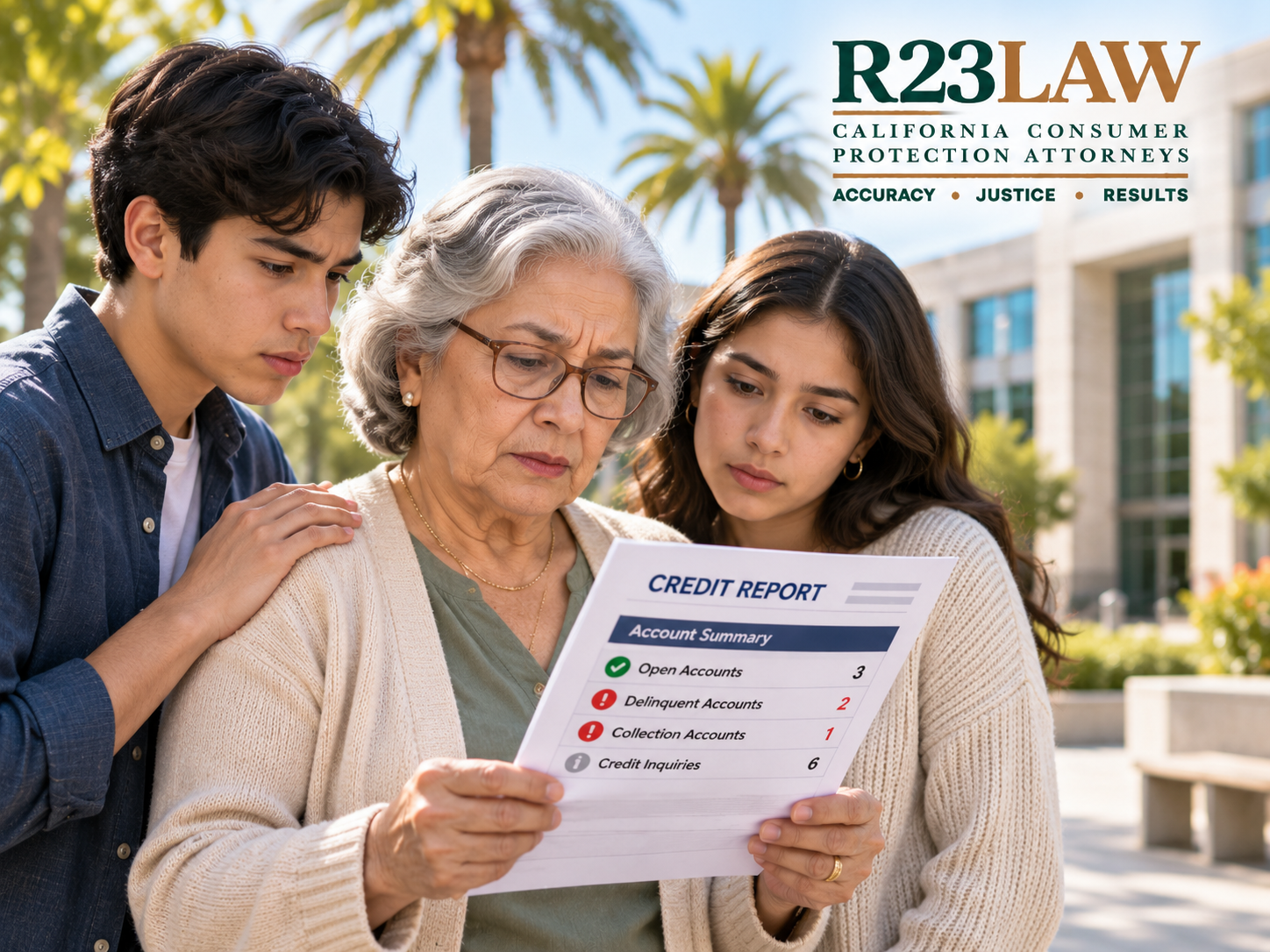
Your credit report should reflect your financial history, not someone else's fraudulent activity
Unfortunately, identity theft can leave California consumers facing unfamiliar credit accounts, unpaid debts, and damaged credit scores for financial obligations they never authorized.
For many victims, the first warning sign appears when reviewing a credit report or receiving an unexpected collection notice. By then, fraudulent accounts may already be affecting their ability to secure loans, obtain favorable interest rates, or qualify for housing.
Identity theft can damage your financial reputation, but federal and California consumer protection laws provide important rights to challenge fraudulent credit information.
At R23 Law, our experienced California Consumer Protection Attorneys advocate for identity theft victims facing inaccurate credit reports, unauthorized accounts, and potential violations of consumer protection laws.
FRAUD IN YOUR NAME — Understanding Financial Identity Theft
Financial identity theft occurs when someone unlawfully uses another person's identifying information to obtain credit, access financial accounts, or conduct unauthorized transactions.
Criminals may steal personal information through phishing scams, data breaches, stolen documents, or other fraudulent methods.
Using a victim's name, address, Social Security number, or financial information, identity thieves may:
Open unauthorized credit card accounts
Apply for personal loans
Make fraudulent purchases
Accumulate debts in another person's name
Create collection accounts linked to the victim's identity
Unlike ordinary clerical credit reporting errors, identity theft involves unauthorized use of personal information.
Consumers may discover the fraud through unexpected account statements, unfamiliar credit inquiries, or collection notices involving debts they never incurred.
An account does not become a legitimate financial obligation simply because an identity thief opened it using your personal information.
CREDIT REPORT RED FLAGS — Spotting Identity Theft Before The Damage Spreads
Regularly reviewing your credit reports is one of the most effective ways to identify potential financial identity theft.
Fraudulent accounts may remain unnoticed until payments become delinquent or creditors begin collection efforts.
Warning signs include:
Unfamiliar Credit Accounts — Credit cards or loans you never opened.
Suspicious Credit Inquiries — Applications submitted without your authorization.
Unexpected Collection Accounts — Debts associated with creditors you do not recognize.
Incorrect Account Balances — Charges or obligations resulting from fraudulent activity.
Unfamiliar Personal Information — Addresses or identifying details that may indicate misuse of your identity.
Consumers can request free credit reports from Equifax, Experian, and TransUnion through AnnualCreditReport.com.
Because different creditors may report information to different agencies, checking all three reports is essential.
Identifying fraudulent accounts early can reduce the risk of additional credit damage and support efforts to correct inaccurate information.
CLEAR YOUR NAME — Steps To Remove Identity Theft Errors From Credit Reports
Discovering fraudulent activity on your credit report requires prompt action.
Identity theft recovery can involve multiple creditors, credit bureaus, and collection agencies. Preserving evidence and documenting your disputes are important throughout the process.
1. Report The Identity Theft
File an identity theft report through the Federal Trade Commission at IdentityTheft.gov.
Depending on the circumstances, filing a police report may also be appropriate.
These reports can provide important documentation supporting your claim that the accounts were opened without authorization.
2. Dispute Fraudulent Credit Accounts
Notify each credit reporting agency displaying fraudulent information.
Clearly identify the unauthorized accounts and provide relevant supporting documentation, including available identity theft reports.
Under the Fair Credit Reporting Act (FCRA), credit reporting agencies generally must conduct reasonable reinvestigations of qualifying disputes within 30 days, subject to certain exceptions and extensions.
Qualifying identity theft victims may also request that fraudulent information be blocked from their credit reports under FCRA Section 605B.
When the statutory requirements are satisfied, the credit reporting agency generally must block qualifying information within four business days after receiving the required documentation.
3. Contact Creditors And Debt Collectors
Notify creditors associated with fraudulent accounts that you did not authorize the activity.
If collection agencies are pursuing debts resulting from identity theft, dispute the obligations and preserve all correspondence.
4. Protect Your Financial Information
Consider placing fraud alerts or credit freezes with the major credit reporting agencies to reduce the risk of additional unauthorized accounts.
Preserve copies of credit reports, dispute letters, identity theft reports, and investigation results.
A documented paper trail can be important when fraudulent information remains unresolved or consumer protection violations are suspected.
YOUR IDENTITY, YOUR RIGHTS — FCRA And California Consumer Protections
The Fair Credit Reporting Act (FCRA) provides important protections against inaccurate credit reporting, including rights related to identity theft disputes and fraudulent account information.
California consumers may also receive protections under the California Consumer Credit Reporting Agencies Act (CCRAA) and the California Identity Theft Act.
These laws establish legal protections concerning credit reporting practices and certain unauthorized uses of personal identifying information.
When reporting agencies or information furnishers fail to comply with applicable legal requirements, consumers may have grounds to pursue legal remedies.
Depending on the circumstances, potential remedies may include compensation for financial losses, qualifying emotional distress, statutory damages in certain cases, and attorney's fees where authorized by law.
However, identity theft alone does not automatically establish liability against a credit reporting agency or creditor. A viable claim depends on the specific statutory requirements and facts involved.
RESTORING YOUR FINANCIAL REPUTATION — R23 Law's California Consumer Protection Attorneys
Identity theft can create lasting credit reporting problems, particularly when fraudulent accounts remain unresolved after disputes.
At R23 Law, our California Identity Theft Victim Lawyers and California Consumer Protection Attorneys advocate for individuals affected by unauthorized accounts, inaccurate credit reports, and potentially unlawful dispute investigations.
Our attorneys evaluate identity theft-related credit reporting errors, potential FCRA and CCRAA violations, and available legal remedies when appropriate.
Our experienced legal team is committed to protecting consumers whose financial identities have been compromised.
Learn more about R23 Law and our consumer finance law practice.
YOUR CREDIT, YOUR FUTURE — Don't Let Identity Theft Define Either
Identity theft can damage your creditworthiness and create financial obligations you never authorized.
However, reviewing your credit reports, documenting fraudulent activity, and disputing unauthorized accounts are important steps toward protecting your financial reputation.
When credit reporting agencies fail to comply with applicable consumer protection laws, additional legal remedies may be available.
R23 Law's California Consumer Protection Attorneys are committed to protecting identity theft victims throughout California from unlawful credit reporting practices and related financial harm.
Contact R23 Law Today
If an identity thief has opened credit accounts in your name, fraudulent debts are damaging your credit history, or reporting agencies have failed to properly address your disputes, your consumer protection rights may have been violated.
Contact R23 Law's California Identity Theft Victim Lawyers and California Consumer Protection Attorneys to discuss your circumstances and explore available legal options.
Our legal team is dedicated to protecting California consumers from identity theft-related credit reporting errors and unlawful financial practices.
Toll-Free: 310-598-1588
SoCal: (310) 598-1588
Email: info@R23Law.com
Website: www.R23Law.com
Office: US Bank Tower, 633 W. 5th Street, 26th Floor, Los Angeles, CA
© 2025 R23 Law. All rights reserved. Trusted consumer credit lawyers in Los Angeles.
