
STUCK IN NEUTRAL — When Checkr’s License Verification Freezes Gig Driving
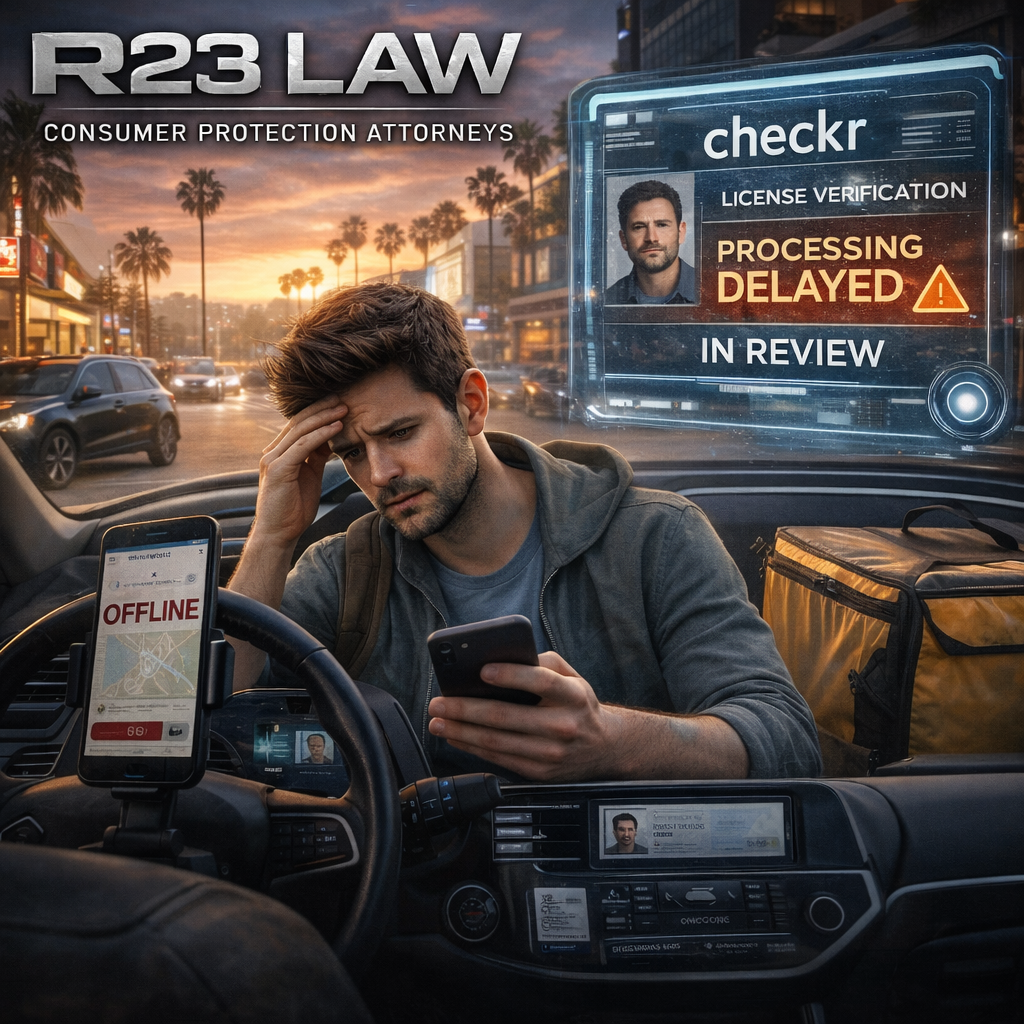
Checkr license verification delays can sideline rideshare and delivery drivers
Know your FCRA rights with R23 Law’s California Consumer Protection Attorneys.
The gig economy runs on speed: sign up, upload documents, pass screening, start earning. But when a background check vendor’s driver’s license verification doesn’t update—or updates too slowly—drivers can be blocked from the platform even while holding a valid license.
The attached piece spotlights this exact bottleneck with Checkr, describing how delays or failures in license verification can keep qualified workers from driving for rideshare or delivery apps, and how the financial and emotional fallout hits fast.
For Californians, this problem lives at the intersection of consumer reporting rules, platform onboarding practices, and real-life economics. That’s where R23 Law’s California Consumer Protection Attorneys focus: when a screening system’s errors or lag produce unfair lockouts.
Why License Verification Is a Big Deal in Gig Work
Rideshare and delivery companies typically rely on background check services to verify:
a driver’s license status
driving record information
other eligibility factors tied to safety and compliance
License verification is a core gatekeeper step—meant to reduce safety risks and confirm a driver is legally cleared to drive on-platform.
When that gatekeeper step goes wrong, it doesn’t just delay onboarding. It can cut off income entirely.
The License Verification Bottleneck: Where Checkr Systems Can Break Down
According to the attached piece, a frequent issue is delay or failure in updating driver’s license information within Checkr’s database, potentially linked to DMV database issues, technical glitches, or processing delays.
In practical terms, that can look like:
a renewed license still showing as expired
a corrected DMV record not reflected in the screening file
an “in review” status that drags on with no clear timeline
conflicting status updates across the platform, the DMV, and the screening vendor
For a driver, the result is the same: you’re ready to work, but the system says “not yet.”
The Real Consequences: Income Loss First, Explanations Later
The attached article emphasizes what this lockout does to people who rely on gig income: missed bills, increased debt, and difficulty covering essentials like housing and healthcare—plus the stress of uncertainty and job insecurity.
And it doesn’t stop at the driver. When verification failures reduce the active driver pool, communities can feel it too—longer wait times, fewer available drivers, and reduced access to services.
Consumer Reporting Rules Still Apply to Gig Screening
Many gig platforms rely on third-party screening reports. When a company assembles and provides information used to determine eligibility for work, federal and California consumer reporting rules may be in play.
A key federal law is the Fair Credit Reporting Act (FCRA), which regulates consumer reporting agencies and includes duties tied to accuracy and dispute handling for consumer report information used in employment-type decisions.
R23 Law’s California Consumer Protection Attorneys often examine whether a lockout is tied to:
inaccurate status reporting (e.g., the file doesn’t reflect current license reality)
unreasonable matching or updating procedures
a dispute process that doesn’t meaningfully resolve the issue
platform actions based on flawed reporting
California Adds Another Layer of Protection
California consumer protection laws can provide additional requirements and remedies in background-screening contexts. Depending on how the screening is structured and used, state law may impose extra duties around disclosures, reporting practices, and consumer rights.
That’s why it matters where you live and where you’re trying to work: the compliance landscape for gig economy background checks isn’t one-size-fits-all.
Documentation That Strengthens Your Position
If a Checkr license verification delay or error blocks you from driving, create a clean record trail:
Save screenshots of the platform status (date-stamped if possible)
Download the Checkr report/file available to you (not just a summary page)
Pull DMV confirmation of your current license status (as available)
Keep written communications with the platform and screening vendor
Track earnings impact (time off-platform, missed shifts, cancelled plans)
This isn’t busywork—it’s the difference between “something went wrong” and “here’s exactly what happened, when, and what it cost.”
What Better Systems Look Like
The attached piece outlines straightforward fixes: tighter coordination between gig companies and screening vendors, continuous monitoring of verification pipelines, faster resolution of technical issues, clearer communication channels, and more transparency—like clear explanations, estimated timelines, and regular updates.
In other words: fewer black boxes, fewer silent delays, fewer drivers stuck in limbo.
Where R23 Law’s California Consumer Protection Attorneys Come In
A gig driver’s livelihood shouldn’t hinge on a stale database entry. When a background check process causes a lockout despite valid credentials, the legal question often becomes whether the reporting and dispute processes complied with consumer protection requirements—and whether the driver suffered compensable harm.
R23 (Law)’s California Consumer Protection Attorneys handle consumer reporting disputes and related screening failures with a focus on accountability and financial recovery when the facts support it.
Disclaimer: This article is for general informational purposes and is not legal advice.
