
THE ROBOT SAID “Denied” — When Automated Background Checks Blow Up Rental Applications
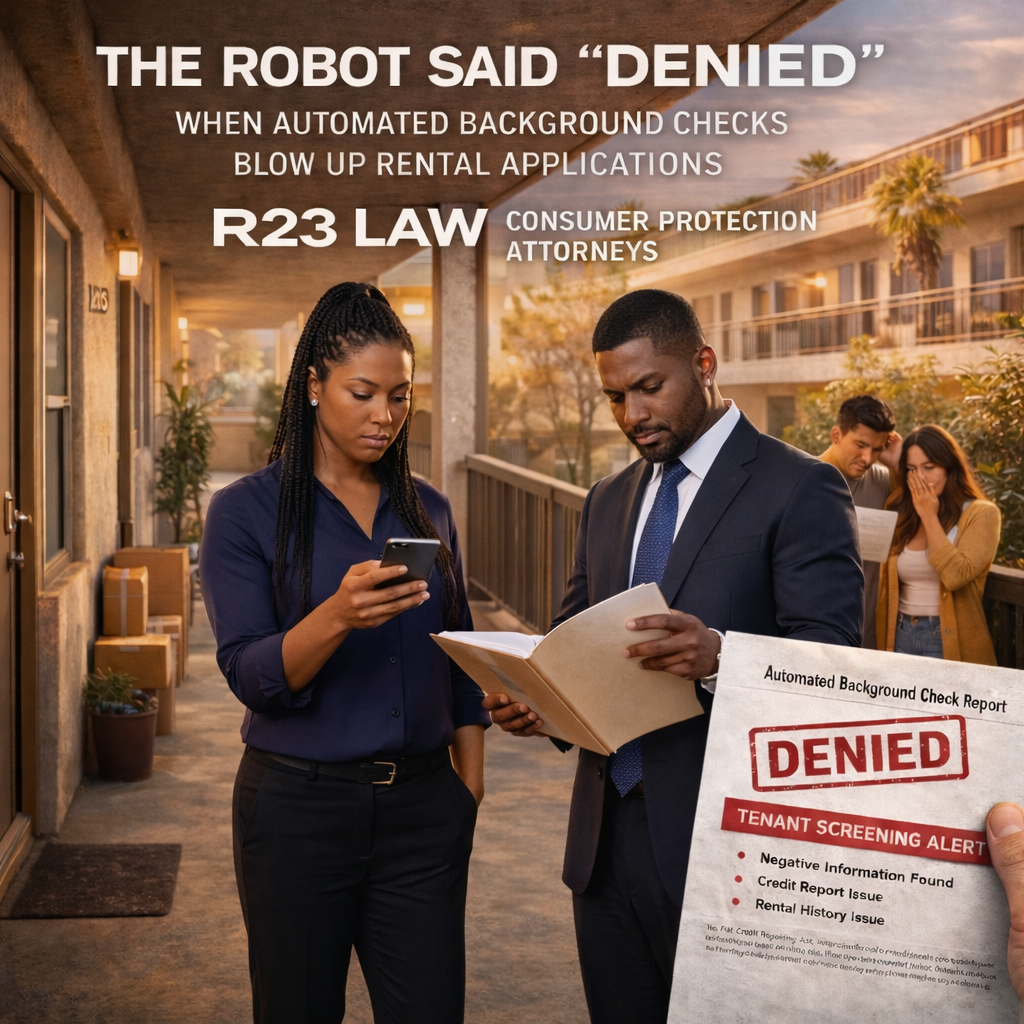
Automated tenant screening can trigger rental denials based on credit, evictions, or mistaken identity
Rights and next steps from R23 Law’s California Consumer Protection Attorneys.
Automated background checks have quietly become the bouncer at the door of California housing. Instead of a person weighing context, many property managers lean on screening software that flags “risk” and spits out a decision—often fast, often final, and sometimes flat-out wrong.
R23 Law’s California Consumer Protection Attorneys see a common pattern: the denial feels personal, but the problem is mechanical—a rigid system, questionable data sources, and little room to explain what really happened.
Why automated screening causes more rental denials
Automated tenant screening tools typically reduce an application to a checklist. If the program detects certain “deny triggers,” it may generate an immediate rejection—sometimes without meaningful human review.
Common denial triggers in automated background checks
Screening criteria vary, but automated systems frequently focus on:
Income-to-rent ratios (for example, requirements like 2–3x monthly rent)
Credit score thresholds (some landlords screen out applicants below a certain score)
Criminal history flags (often based on broad categories, without nuance)
Evictions and negative rental history (including late payments, property damage claims, or prior unlawful detainers)
When software is doing the deciding, it often treats these items as binary—present or absent—rather than evaluating the details.
The “missing human” problem: context gets ignored
Automation is efficient, but efficiency is not accuracy.
Screening software generally does not account for real-life explanations—identity mix-ups, reporting errors, resolved issues, or outdated information. As the attached material notes, the system looks for red flags and doesn’t reliably adjust its risk assessment for circumstances that would matter to a reasonable person reviewing the file.
Mistaken identity: when the background check isn’t even yours
One of the most frustrating scenarios is also one of the most common: the system matches you to someone else. That risk increases with common names and incomplete cross-checking of identifiers.
The result can be devastating: a denial based on another person’s credit history, eviction record, or criminal history—while you’re left trying to prove a negative.
Tenant screening reports are often governed by consumer reporting laws
Many rental background checks are “consumer reports” used for housing decisions. When a denial is based on that type of report, federal consumer protection law (including the Fair Credit Reporting Act) may require:
access to the report used in the decision, and
a process to dispute inaccurate or incomplete information.
The attached material emphasizes that applicants have the right to review the results and start clearing inaccurate information that drove the denial.
Cleaning up incorrect information after a denial
If the issue is inaccurate information, the dispute process matters—and speed matters.
Practical steps that strengthen a dispute record
Request the screening report that was used for the decision (not a generic credit snapshot).
Identify the exact item(s) that triggered the denial (eviction entry, criminal record match, address history, etc.).
Dispute inaccuracies in writing and keep copies of everything submitted.
Attach supporting documents (court dispositions, proof of identity, payment records, address history, letters from prior landlords).
The attached material also notes that once disputed, reporting agencies are generally required to verify the information using additional sources and then correct or remove inaccurate items within the permitted timeframe—though consumers often experience resistance in practice.
Where R23 Law’s California Consumer Protection Attorneys fit in
Automated screening denials often look “final” because the system presents them that way. But the legal analysis isn’t determined by software labels—it’s determined by data accuracy obligations, notice requirements, dispute handling, and whether the screening ecosystem followed consumer protection rules.
R23 Law’s California Consumer Protection Attorneys evaluate tenant screening disputes with a focus on:
inaccurate or mixed-file reporting,
failure to reasonably investigate disputes,
improper reliance on outdated or unverified records, and
paper-trail strategy that positions the case for resolution.
Bottom line: don’t argue with the robot—audit the data
Automated background checks can be efficient, but they can also be sloppy, overbroad, and wrong. When housing decisions are based on erroneous or misattributed information, the strongest approach is evidence-driven: get the report, pinpoint the error, dispute it properly, and preserve documentation.
Disclaimer: This content is for informational purposes only and does not constitute legal advice. Outcomes depend on specific facts and applicable law.
