
CHECKED WRONG — Background Check Errors and Consumer Rights
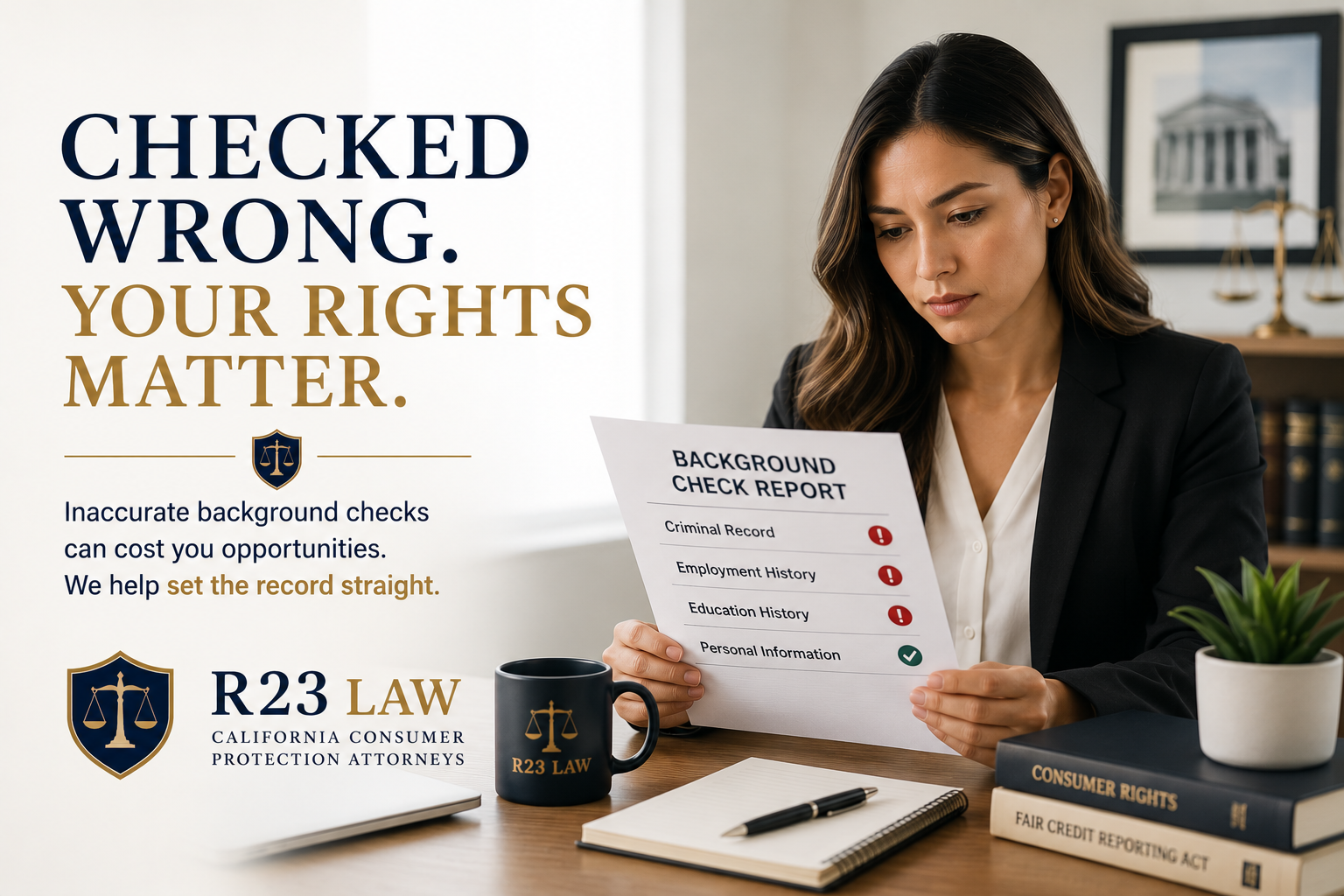
Background checks can influence some of the most important opportunities in a consumer's life
Employers may rely on them when making hiring decisions, while landlords and other businesses may use screening reports to evaluate applicants.
But background checks are not always accurate.
Incorrect criminal records, outdated information, employment history errors, or information belonging to another person can turn a routine screening into a serious financial and reputational problem. The source material explains that inaccurate background reports may result in denied employment, lost housing opportunities, reputational damage, and significant emotional and financial consequences.
R23 Law's California Consumer Protection Attorneys represent consumers facing inaccurate background checks, consumer reporting errors, failed disputes, and other violations that interfere with employment, housing, and financial opportunities.
Background Checks Can Shape Employment and Housing Decisions
A background check is generally used to gather information about an individual's history so that an employer, landlord, or other decision-maker can evaluate an application.
According to the source, background reports may include information concerning:
Criminal records
Employment history
Educational history
Other information relevant to an application
A third-party background screening company may collect the information, compile it into a report, and provide that report to the employer or other requesting organization.
When the information is accurate, a background report can serve its intended screening purpose.
When it is wrong, the consumer may suffer consequences for conduct or information that does not belong to them.
Background Checks and Reference Checks Serve Different Purposes
A background check and a reference check are not the same thing.
As the source explains, a background check generally investigates records and historical information such as criminal history, employment, and education. A reference check instead involves contacting people who previously worked with the applicant to obtain information about qualifications, character, or past performance.
The distinction matters because errors in a background report may originate from databases, public records, screening systems, or information gathered by a consumer reporting company rather than from a former employer or personal reference.
Background Check Errors Can Carry Serious Consequences
A single mistake can alter an employment or housing decision.
Background check errors may include:
Criminal records belonging to another person
Outdated criminal information
Incorrect employment history
Incorrect educational records
Expunged or otherwise outdated information
Duplicate records
Inaccurate personal information
Records incorrectly matched to the consumer
The source emphasizes that inaccurate background reports can result in employment denials, housing losses, reputational harm, financial distress, and emotional consequences.
For a consumer who has already completed interviews, received preliminary approval for housing, or otherwise advanced through an application process, an incorrect report can abruptly change the outcome.
The Fair Credit Reporting Act Protects Consumers
The Fair Credit Reporting Act — FCRA is one of the primary federal laws regulating consumer reports, including many background checks used for employment and other qualifying purposes.
The source identifies the FCRA as an important consumer protection law designed to regulate consumer reporting and establish procedures background check companies must follow.
Accuracy matters because screening companies are dealing with information that can directly affect consumers' livelihoods and opportunities.
When inaccurate information appears in a report, the FCRA may provide rights relating to disclosure, disputes, investigation, and correction depending on the circumstances.
The source also references other laws and agencies that may be relevant to particular types of information or screening practices, including the Equal Employment Opportunity Commission, the Fair and Accurate Credit Transactions Act, the Family Educational Rights and Privacy Act, and the Health Insurance Portability and Accountability Act.
The laws that apply in any particular case depend on the type of report, the information involved, and how the report was used.
Obtaining the Background Report Is an Important First Step
Consumers cannot effectively dispute an error they cannot identify.
The source recommends obtaining a copy of the background report and reviewing exactly what the screening company provided.
The report may reveal:
A criminal record that belongs to someone else
Incorrect dates
Outdated information
Incorrect employment history
Wrong educational information
A record that should not have been attributed to the consumer
Other inaccuracies that affected the decision
Keep the original report.
A later corrected version may not show what the employer or landlord originally received, so preserving the inaccurate report can be important when documenting the harm caused by the error.
Review Every Detail for Inaccurate Information
Do not assume that only major criminal records matter.
Even smaller discrepancies can create problems.
Consumers should carefully review:
Full name and name variations
Date of birth
Addresses
Criminal history
Court information
Employment history
Education history
Dates associated with reported records
Any other information used to identify the subject of the report
An incorrect identifier may provide an important clue that the screening company matched the consumer with another person.
Supporting Documents Can Strengthen a Background Check Dispute
The source recommends collecting documents that establish why the reported information is inaccurate or outdated.
Depending on the error, useful records may include:
Court documents
Expungement records
Employment records
Educational records
Identification documents
Records showing the reported criminal case belongs to another person
Correspondence from the employer or landlord
Prior background reports
Other documentation contradicting the inaccurate entry
Consumers should retain copies of everything submitted to a background screening company.
A dispute supported by documentation creates a clearer record of what the company was told and what evidence it received.
Contact the Background Screening Company About the Error
Once an error has been identified, the source recommends contacting the company responsible for the report, explaining the inaccuracy, and providing supporting documentation.
The dispute should clearly identify:
The information being challenged
Why the information is inaccurate
What the correct information should be
The supporting evidence
The correction being requested
Written documentation can become especially important if the background check company later refuses to correct the error or continues distributing inaccurate information.
Acting Quickly Can Protect Important Opportunities
Background check disputes can be time-sensitive.
An employer may be preparing to fill a position. A landlord may have other applicants waiting. A delayed correction can therefore have consequences even when the consumer is ultimately proven right.
The source stresses that prompt action can reduce the risk of additional harm from inaccurate information.
Consumers should preserve relevant communications with the employer, landlord, or other decision-maker, including:
Offer letters
Rejection notices
Emails
Adverse decision notices
Application documents
Interview correspondence
Housing communications
Pay or compensation information connected to a lost opportunity
These materials may later be important when evaluating damages.
A Failed Background Check Dispute May Signal a Larger Legal Problem
Some errors are corrected after the consumer provides the proper documentation.
Others are not.
A background screening company may continue reporting inaccurate information even after receiving evidence showing that the report is wrong.
That can substantially increase the impact on the consumer.
The source explains that consumers may seek legal representation when a background check company refuses to correct or remove inaccurate information after a dispute.
At that point, the issue may no longer be simply correcting a database entry. The dispute history itself can become important in determining whether consumer protection rights were violated.
Background Check Errors Can Cause Financial Damages
A lost job can translate directly into lost income.
A housing denial can create additional moving expenses, higher rent elsewhere, application costs, or other financial consequences.
Consumers should preserve evidence showing the economic effect of the inaccurate report.
Depending on the case, relevant records may include:
Salary information for a lost position
Offer letters
Employment rejection notices
Housing denial notices
Application fees
Additional expenses caused by the denial
Records showing other measurable losses
The source explains that legal action may be available when a background screening company reports inaccurate information and fails to properly correct it.
Emotional Distress and Reputational Harm May Also Matter
Not every consequence can be measured with a receipt.
Being falsely associated with criminal conduct or other damaging information can cause embarrassment, anxiety, frustration, and reputational harm.
The source identifies emotional distress as one category of potential damages arising from serious background check errors.
This can be particularly significant when inaccurate information is distributed to an employer, housing provider, or another organization making an important decision about the consumer.
Statutory and Punitive Damages May Be Available in Certain Cases
The source also identifies statutory damages and punitive damages among the remedies that may potentially arise from background check violations.
It states that statutory awards may range from $100 to as much as $30,000 in certain circumstances, depending on the applicable claim and law.
Punitive damages may also become relevant where conduct is sufficiently serious or intentional.
The availability of any particular damages depends on the specific facts, legal claims, and statutory requirements. An inaccurate background check does not automatically entitle every consumer to the same recovery.
Attorney's Fees and Litigation Costs May Be Recoverable
Consumer protection laws may also allow successful consumers to recover attorney's fees and litigation costs in qualifying cases.
The source emphasizes that fee-shifting provisions can make legal representation more accessible to consumers who otherwise might not have the resources to challenge a large background screening company.
Whether fees are recoverable depends on the law and the outcome of the claim.
R23 Law's California Consumer Protection Attorneys Represent Background Check Victims Throughout California
Background check cases can involve employers, landlords, screening companies, consumer reporting agencies, public records, inaccurate criminal histories, and disputes that remain unresolved.
R23 Law's California Consumer Protection Attorneys evaluate background check errors and their consequences to determine whether consumer protection laws may provide a remedy.
A legal evaluation may include:
The inaccurate background report
The source of the reported information
Whether the information belongs to another person
Whether records were outdated or incorrectly reported
Whether the consumer disputed the error
Supporting evidence provided with the dispute
The screening company's response
Whether the inaccurate information continued to be reported
Employment or housing opportunities lost because of the report
Financial, emotional, or reputational damages
Learn more about the attorneys behind the firm through Our Team and R23 Law's consumer protection practice through About Us.
Accurate Background Checks Matter Because Opportunities Matter
A background screening company may view an incorrect record as one entry in a database.
For the consumer, that entry may represent a lost job, denied apartment, damaged reputation, or months spent trying to prove that someone else's information does not belong to them.
Consumers should obtain the report, identify inaccuracies, gather supporting documents, dispute the information, and preserve the complete paper trail.
When inaccurate information remains after a documented dispute, R23 Law's California Consumer Protection Attorneys can evaluate whether the screening company's conduct violated applicable consumer protection laws.
Contact R23 Law Today
An inaccurate background check can affect employment, housing, financial stability, and reputation. Consumers should not have to carry the consequences of criminal records, employment information, or other damaging data that does not belong to them.
R23 Law's California Consumer Protection Attorneys represent consumers throughout California facing inaccurate background reports and related consumer reporting violations.
Connect with R23 Law through Contact Us to discuss the background check error, the dispute history, and the legal remedies that may apply.
Toll-Free — 310-598-1588 SoCal — (310) 598-1588 Email — info@R23Law.com Website — www.R23Law.com US Bank Tower, 633 W. 5th Street, 26th Floor, Los Angeles, CA
© 2025 R23 Law. All rights reserved. Trusted consumer credit lawyers in Los Angeles.
