
CLICK-TO-DISPUTE, CLICK-TO-REGRET — The Online Credit Dispute Trap
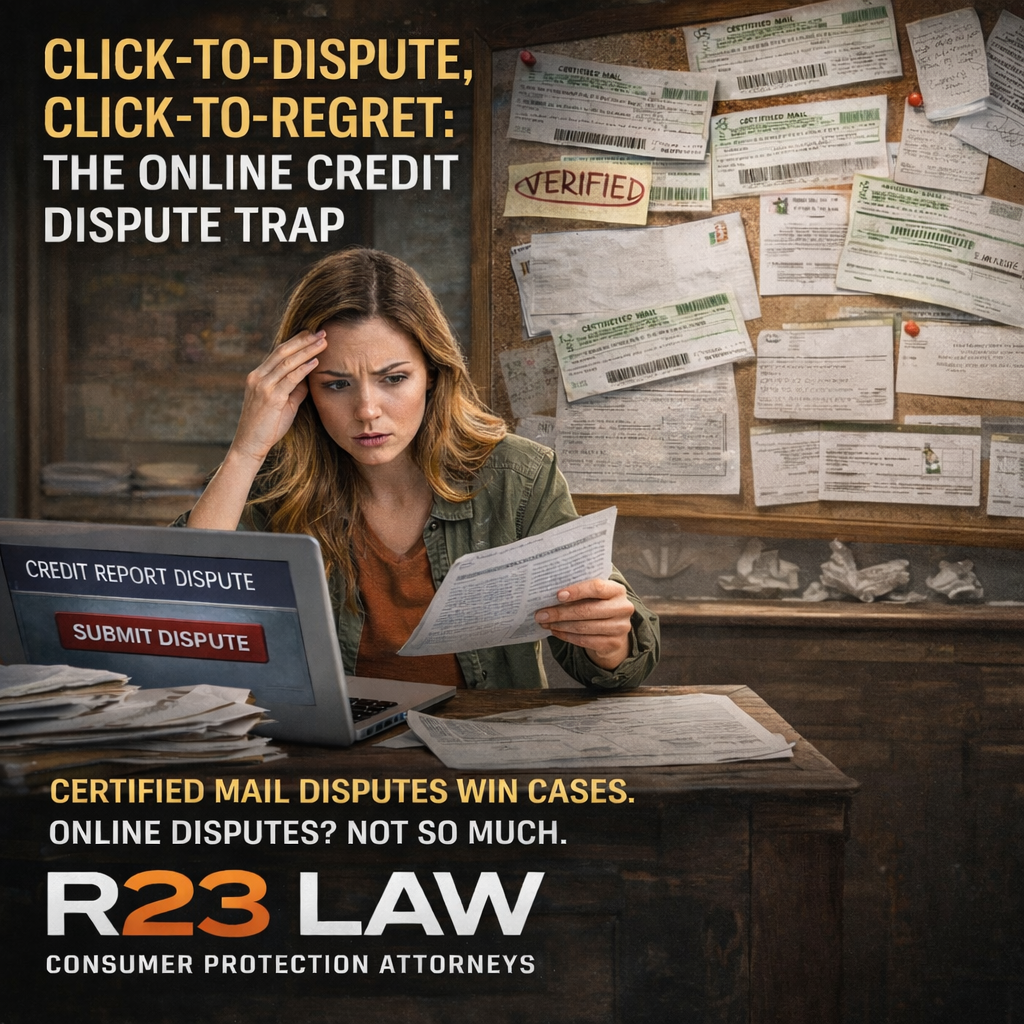
Disputing a credit report online can weaken your paper trail. Learn why certified mail disputes matter under the FCRA, and when legal claims follow “verified” errors
When you spot a credit report error, the online dispute button can feel irresistible. Fast. Convenient. A few clicks and you’re done—at least that’s the promise.
But convenience has a cost. If the credit bureaus don’t correct the mistake, an online dispute can leave you with thin proof of what you submitted, what documents were attached, and what the bureau actually received—all details that matter when your consumer rights need enforcement, not just “processing.”
Below is the core issue: credit bureaus investigate disputes at scale. If your dispute is reduced to a checkbox and routed through automation, that can be a problem—especially when the damage is serious (identity theft accounts, mixed files, collections, charge-offs, or repeat “verified” inaccuracies).
Online Credit Disputes Aren’t Built for Nuance
Online dispute portals are designed for speed and volume. That doesn’t always match what consumers actually need: a clear narrative, clean supporting documentation, and a reliable record of what was sent.
The attached article captures the practical concern: online disputes often provide no solid proof of what you submitted—and when a bureau “verifies” an error, you may be left without the evidence needed to push back effectively.
That matters because credit reporting disputes aren’t just customer service interactions. They are part of a legal framework governed primarily by the Fair Credit Reporting Act (FCRA).
The Certified Mail Advantage: Paper Trail = Leverage
If your goal is to protect your position (not just submit a complaint), disputing by mail—especially certified mail with return receipt—creates a dispute record you can point to later.
The attached article highlights what a mailed dispute can prove, including:
The date your dispute was submitted
Exactly what you disputed
That the bureaus received your dispute
And that paper trail tends to come with other advantages: you keep a complete copy, you can include key documents, and you can present the facts with more flexibility than a portal that forces your dispute into pre-set categories.
The FTC similarly emphasizes disputing in writing, including copies of documents supporting your dispute and keeping records of what you sent.
What the FCRA Requires Credit Bureaus to Do After You Dispute
Under the FCRA, when you dispute information with a consumer reporting agency, the bureau generally must conduct a reasonable reinvestigation to determine whether the disputed information is inaccurate.
The timeline
The FCRA’s reinvestigation timeline is commonly described as 30 days, with a potential extension (up to 15 additional days) in certain circumstances (such as when the bureau receives relevant information from the consumer during the initial period).
The workflow
The credit reporting company must investigate, forward the dispute and relevant information to the furnisher of the information, and report results back to you.
This is one reason the dispute record matters: if your dispute was thorough and documented, it becomes easier to assess whether the investigation was actually “reasonable” or whether it looked more like rubber-stamping.
“Verified” Isn’t the End of the Story
One of the most frustrating outcomes is the form-letter conclusion: verified.
The attached article notes a hard truth: credit bureaus often fail to fix mistakes on the first attempt, and consumers should be prepared for legal action when disputes stall or errors persist.
If you’re dealing with repeated verification of inaccurate information—especially after strong documentation—this can move from a credit cleanup issue into an FCRA compliance issue.
When Credit Reporting Errors Cross Into Legal Liability
The FCRA includes civil liability provisions that can fails to comply with FCRA requirements:
Willful noncompliance can trigger statutory damages and potentially punitive damages (depending on the facts).
Negligent noncompliance can support recovery of actual damages and attorney’s fees in a successful action.
The attached article also describes consumer options after failed disputes, including litigation to force correction, compensation for wrongful credit damage, and damages tied to delays in correcting errors.
A Practical Dispute Checklist That Preserves Your Rights
If you’re disputing by mail, the goal is simple: make your dispute easy to understand, hard to ignore, and easy to prove later.
Consider including:
A clear, item-by-item list of what’s wrong (account, balance, dates, payment status, ownership, inquiry)
Copies of supporting documents (ID theft report, police report if applicable, account statements, letters, court recordsA copy of your credit report with the inaccurate items clearly marked
A request for the specific correction (delete, update, reinvestigate with attached documents)
Certified mail tracking + return receipt, plus a full copy of everything you sent
(And yes—keep a timeline. Dates matter in consumer protection cases.)
Where R23 Law Fits In
Credit reporting problems can feel like a maze of portals, call centers, and auto-generated responses. But the law is not automated—and your dispute shouldn’t be treated like it is.
R23 Law's California Consumer Protection Attorneys focus on credit reporting accountability, dispute compliance, and the real-world damages caused by inaccurate ry or furnisher repeatedly “verifies” incorrect information—or the investigation looks more like a checkbox than a reinvestigation—those facts can matter under the FCRA.
If your dispute record is thin, online-only, or missing key documentation, rebuilding that foundation early can change the trajectory of your case.
Disclaimer: This article is for informational purposes only and does not constitute legal advice. Reading this article does not create an attorney-client relationship.
