
CREDIT REPORT CHAOS – Inaccurate Account Information, Failed Disputes, And California Credit Reporting Claims
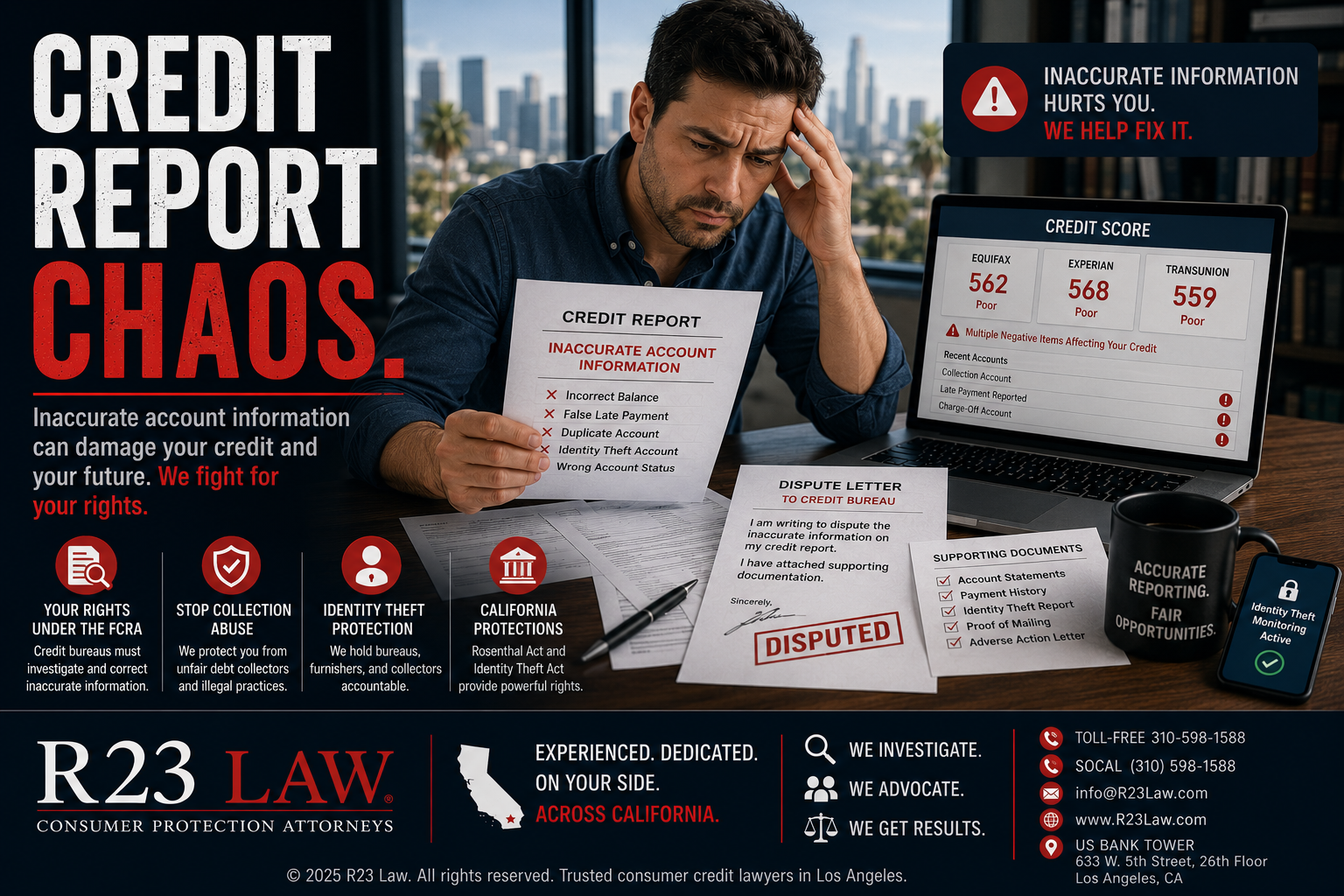
Inaccurate account information can damage credit, trigger denials, and disrupt financial opportunities
R23 Law's California Consumer Protection Attorneys represent consumers facing credit reporting errors throughout California.
Inaccurate account information on a credit report can stop financial progress cold. A wrong balance, false late payment, duplicate account, identity theft account, or outdated delinquency can affect loans, housing, insurance, employment-related screenings, and everyday financial stability.
Credit reports are not supposed to be guesswork. Credit bureaus and furnishers must follow laws designed to promote accuracy, privacy, and fair investigations when consumers dispute errors.
R23 Law's California Consumer Protection Attorneys represent consumers throughout California in credit report error, inaccurate account information, identity theft, debt collection, and financial injury matters.
Inaccurate Account Information — Small Errors, Serious Consequences
A credit report error can seem minor until it causes a denial, higher interest rate, account closure, collection notice, or adverse action letter.
The attached source explains that common credit report errors may involve personal information, account status, balances, credit limits, duplicate reporting, identity theft accounts, reinsertion of corrected information, and accounts belonging to someone with a similar name.
Common inaccurate account information includes:
Wrong current balance
Incorrect credit limit
False late payment
Closed account reported as open
Open account reported as closed
Authorized user reported as account owner
Wrong date opened
Wrong date of first delinquency
Duplicate reporting of the same debt
Identity theft account
Mixed file account from another consumer
Previously deleted information reinserted
These mistakes can damage credit scores and create long-term financial consequences.
Credit Bureaus And Furnishers Both Matter
Inaccurate account information often involves two major players — the credit reporting agency and the furnisher.
Credit reporting agencies include the major bureaus such as Equifax, Experian, and TransUnion. The attached source also notes that specialty reporting companies may collect and report consumer information, including companies that track checking account history, rental history, or background screening information.
Furnishers are the companies that provide information to the bureaus. They may include banks, credit card companies, lenders, debt collectors, auto finance companies, mortgage servicers, or other entities connected to the account.
When a consumer disputes inaccurate reporting, both the credit bureau and the furnisher may have legal duties.
The Fair Credit Reporting Act — The Dispute Process Matters
The Fair Credit Reporting Act gives consumers the right to dispute inaccurate credit report information. A dispute should explain what is wrong, why it is wrong, and how the information should be corrected.
The attached source emphasizes that disputes should be sent to both the credit bureau and the furnisher connected to the inaccurate tradeline, and that mailed disputes can be especially useful for preserving a clear record.
A strong dispute may include:
A copy of the credit report with the error identified
A clear written explanation of the inaccurate information
Account statements showing correct payment history
Bank records showing payments were made on time
Identity theft reports, when fraud is involved
Police reports, when applicable
FTC identity theft materials, when applicable
Letters from creditors
Court records showing correct case outcomes
Proof of mailing through certified mail
A vague dispute may invite a quick verification. A detailed dispute with supporting records creates a stronger foundation for correction and legal review.
Reinvestigation Results — Review The Response Quickly
After a dispute, the consumer may receive reinvestigation results from the credit bureau. The attached source explains that the disputed information may be verified, modified, updated, or deleted.
If the inaccurate account information is deleted, the immediate credit reporting harm may be reduced. If it is verified or only partially corrected, further action may be necessary.
Consumers should carefully review whether:
The account was fully removed
The payment history was corrected
The balance was updated
The account status was fixed
Duplicate reporting was removed
Fraudulent information remains
The same error appears with another bureau
The furnisher continued reporting the same inaccurate information
R23 Law's California Consumer Protection Attorneys evaluate whether credit bureaus and furnishers conducted reasonable investigations after receiving consumer disputes.
California Credit Reporting Protections
California consumers may also have rights under the California Consumer Credit Reporting Agencies Act. The attached source explains that California law may apply where a defendant reported inaccurate information, the consumer was harmed, and the defendant knew or should have known the information was inaccurate.
California’s consumer protection framework can be powerful when credit reporting errors cause real financial injury. These claims often require careful review of disputes, reporting history, credit reports, furnisher responses, and damages.
Time Limits Can Affect Credit Reporting Claims
Credit reporting disputes should not be delayed. The attached source explains that the FCRA generally requires a lawsuit to be filed within the earlier of two years after discovery of the violation or five years after the violation occurs.
That makes early action important. Consumers may need time to gather credit reports, prepare disputes, receive reinvestigation results, preserve damages evidence, and evaluate legal claims.
R23 Law's Expert Legal Services For Financial Injury Victims Throughout California
R23 Law represents financial injury victims throughout California whose credit reports contain inaccurate, damaging, or unlawful account information.
R23 Law's California Consumer Protection Attorneys may review credit reports, dispute letters, certified mail receipts, reinvestigation results, account statements, creditor records, collection notices, adverse action letters, and identity theft documentation.
The firm’s consumer protection work includes matters involving:
Inaccurate account information
Credit report errors
False late payments
Wrong balances
Duplicate accounts
Identity theft accounts
Mixed credit files
Reinserted deleted information
Furnisher investigation failures
Credit bureau investigation failures
Adverse action after inaccurate reporting
R23 Law works to pursue correction, accountability, and compensation where the law allows.
Strong Documentation Builds A Stronger Credit Report Claim
Credit reporting cases often rise or fall on documentation. Consumers should preserve every record connected to the dispute and the harm caused by the inaccurate reporting.
Important records may include:
Credit reports from Equifax, Experian, and TransUnion
Dispute letters
Certified mail receipts
Reinvestigation results
Account statements
Payment confirmations
Bank records
Collection letters
Loan denial letters
Adverse action notices
Credit monitoring alerts
Emails from creditors or bureaus
Identity theft reports, when applicable
Proof of higher interest rates, denials, or lost opportunities
The stronger the paper trail, the easier it may be to show that the information was inaccurate and that companies failed to properly investigate.
R23 Law's California Consumer Protection Attorneys Enforce Credit Accuracy Rights
Inaccurate credit reporting can damage more than a score. It can block housing, raise borrowing costs, trigger collections, and create unnecessary stress.
Credit bureaus and furnishers must take consumer disputes seriously. When they fail to conduct reasonable investigations or continue reporting inaccurate account information, consumers may have legal rights.
Visit Our Team, learn more at About R23 Law, or connect through Contact R23 Law.
Contact R23 Law Today
If inaccurate account information, credit report errors, reinvestigation failures, or disputed tradelines damaged your credit or financial future, R23 Law's California Consumer Protection Attorneys can review your rights and discuss potential legal claims.
Toll-Free — 310-598-1588 SoCal — (310) 598-1588 Email — info@R23Law.com Website —www.R23Law.comOffice — US Bank Tower, 633 W. 5th Street, 26th Floor, Los Angeles, CA
© 2025 R23 Law. All rights reserved. Trusted consumer credit lawyers in Los Angeles.
