
DEAD WRONG — When Your Credit Report Says You’re Deceased
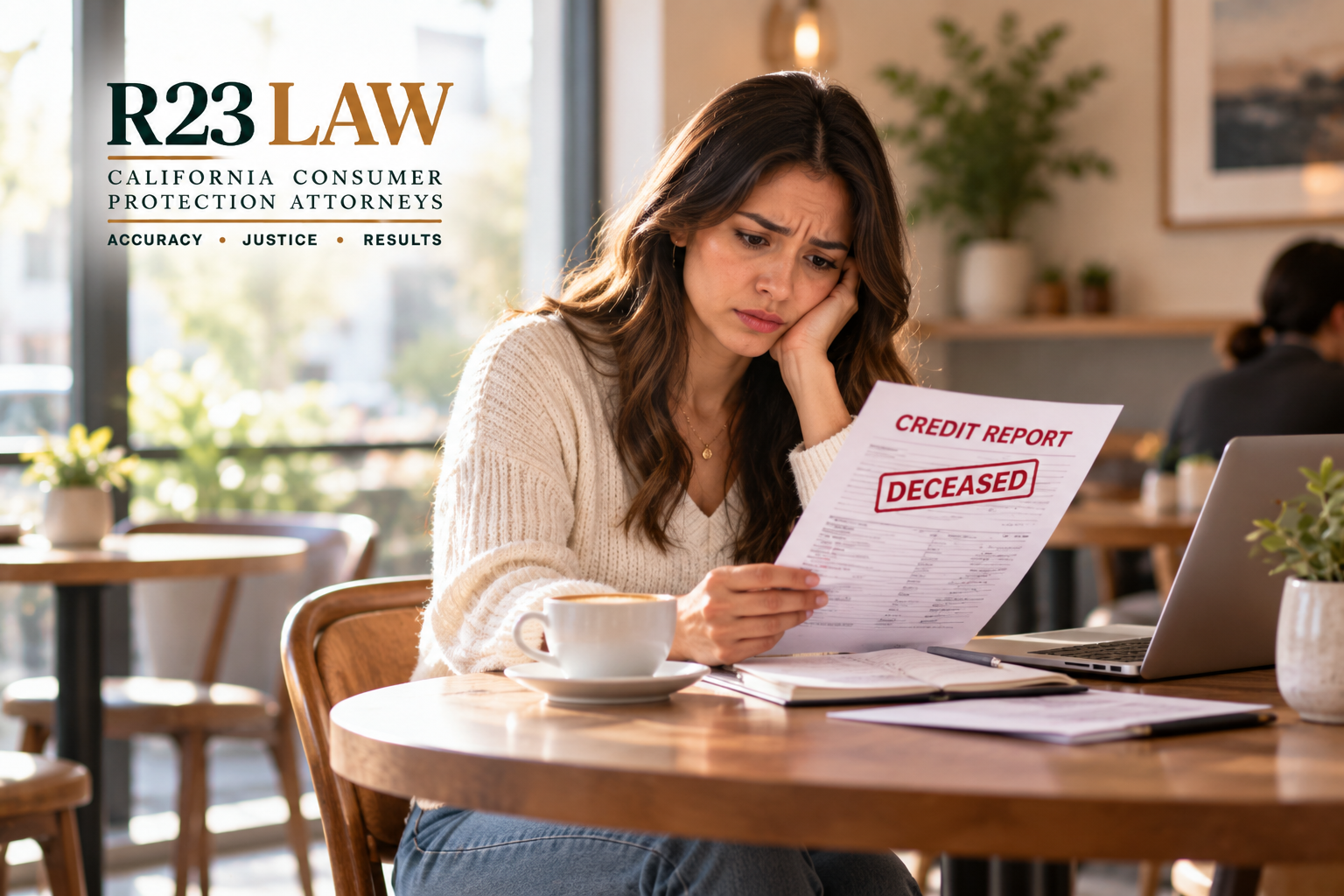
A consumer may discover the error while applying for a mortgage, financing a vehicle, or seeking another form of credit
Instead of receiving an ordinary approval or denial, the consumer learns that the credit reporting system has effectively declared them dead.
The consumer is very much alive. Their credit file says otherwise.
A false deceased indicator can interfere with financing and create significant financial complications. Depending on what caused the error and the consequences that follow, consumers may also suffer economic and emotional harm.
For consumers dealing with this unusual but potentially serious credit reporting error, understanding why it happened is an important first step.
DATA ENTRY ERRORS CAN HAVE OUTSIZED CONSEQUENCES
Credit reports depend on information moving between numerous companies and credit reporting agencies.
Banks, credit card issuers, service providers, and other companies supply consumer information that eventually becomes part of a credit file.
With information moving through multiple channels, errors can occur.
The attached source identifies data-entry mistakes as one potential reason a living consumer may incorrectly appear as deceased. Something as seemingly simple as a typo or incorrect entry can ultimately affect information associated with a consumer's credit report. Why Am I Listed as Deceased On …
The mistake may be small.
Its consequences may not be.
MIXED CREDIT FILES CAN PUT SOMEONE ELSE'S INFORMATION ON YOUR REPORT
Another possible cause is a mixed credit file.
Mixed files can occur when information belonging to different consumers becomes combined. The attached source specifically identifies consumers with similar names and birthdays as an example of circumstances that may contribute to this problem. Why Am I Listed as Deceased On …
If another person with similar identifying information is deceased, that person's information may become incorrectly associated with the living consumer's credit file.
The result can be particularly frustrating because the affected consumer is forced to address information that never belonged to them in the first place.
Mixed files may also involve other inaccurate information beyond a deceased designation, making careful review of the entire credit report important.
A DECEASED CO-SIGNER MAY ALSO TRIGGER AN ERROR
The source identifies another potential scenario involving a co-signer.
When a co-signer passes away, information concerning that person's death may accidentally affect the other consumer's credit report.
Instead of correctly associating the deceased status with the co-signer, the reporting information may be reflected against the wrong person.
The source also notes that this type of error may potentially affect Social Security-related information. Why Am I Listed as Deceased On …
Consumers discovering a deceased designation should therefore carefully review the information associated with their credit file rather than assuming the problem is limited to a single notation.
BEING REPORTED DEAD CAN STOP CREDIT APPLICATIONS COLD
A false deceased indicator can create immediate problems when a consumer applies for financing.
A lender reviewing a credit report containing that information may deny a loan or mortgage.
That denial can create consequences extending well beyond the credit application itself.
For example, a consumer may need financing to purchase a vehicle required for work. If the financing is denied because the credit report incorrectly identifies the consumer as deceased, the reporting error can potentially create additional financial losses.
Similarly, a deceased credit reporting error discovered during a mortgage application may interfere with a planned home purchase.
The practical problem is clear — inaccurate credit information can affect real financial opportunities.
ECONOMIC DAMAGES MAY FOLLOW A FALSE DECEASED REPORT
The source identifies economic damages as one potential consequence when a consumer is falsely reported as deceased.
The particular financial losses will depend on what happened after the inaccurate information was reported.
A consumer may experience a loan denial, mortgage problem, or other financial consequence associated with the false information.
Preserving documentation of those consequences can be important.
Relevant records may include:
Credit reports showing the deceased designation
Loan or mortgage applications
Credit denial notices
Communications with lenders
Correspondence with credit reporting agencies
Records concerning disputes over the inaccurate information
Documents demonstrating financial losses associated with the error
These records can help establish what was reported and what consequences followed.
THE DAMAGE MAY NOT BE PURELY FINANCIAL
Being falsely declared deceased by a credit reporting system can also create significant personal frustration and distress.
The attached source recognizes emotional damage in addition to the potential economic consequences associated with this type of credit reporting error. Why Am I Listed as Deceased On …
The circumstances can be particularly distressing when a consumer discovers the problem during an important financial transaction and then must spend time attempting to establish something that should never have been in dispute — that they are alive.
The existence and extent of any damages depend on the individual facts and available evidence.
DOCUMENT THE ERROR AND ITS CONSEQUENCES
When a consumer discovers a deceased designation or other serious credit reporting error, documentation matters.
Preserve the credit report showing the inaccurate information.
Keep copies of correspondence concerning the error and records of communications with companies involved in the reporting.
If the error interferes with financing or another transaction, preserve the resulting denial notices, applications, correspondence, and other relevant documents.
The objective is to create a clear record connecting the inaccurate information with what happened afterward.
R23 LAW'S EXPERT LEGAL SERVICES FOR CREDIT REPORT ERROR VICTIMS THROUGHOUT CALIFORNIA
R23 Law's California Consumer Protection Attorneys represent consumers dealing with inaccurate credit reporting, including serious errors involving deceased indicators and mixed credit files.
R23 Law handles consumer protection matters involving credit reporting agencies and companies responsible for furnishing information appearing on consumer credit reports.
Our attorneys represent consumers facing matters involving:
False deceased indicators
Mixed credit files
Information belonging to another consumer
Inaccurate personal information
Incorrect account information
Loan or mortgage denials associated with credit reporting errors
Economic losses resulting from inaccurate reporting
Emotional harm associated with serious credit reporting errors
When a credit reporting error interferes with important financial opportunities, understanding how the mistake occurred and documenting the resulting damage can become critical.
VERY MUCH ALIVE — AND READY TO SET THE RECORD STRAIGHT
A credit report should accurately reflect the consumer it describes.
Being incorrectly listed as deceased can interfere with loans, mortgages, and other important financial transactions. The mistake may originate from a data-entry error, mixed credit file, or information associated with a deceased co-signer.
Whatever the source, consumers should preserve evidence of both the error and the damage it caused.
A false deceased designation may begin as incorrect data.
Its consequences can be very real.
Contact R23 Law Today
Being falsely reported as deceased can create financial problems that extend far beyond an inaccurate entry on a credit report. When a deceased indicator, mixed file, or other serious credit reporting error causes financial or emotional harm, R23 Law's California Consumer Protection Attorneys can evaluate the circumstances and the consumer protection rights that may apply.
Toll-Free: 310-598-1588
SoCal: (310) 598-1588
Email: info@R23Law.com
Website: www.R23Law.com
Address: US Bank Tower, 633 W. 5th Street, 26th Floor, Los Angeles, CA
© 2025 R23 Law. All rights reserved. Trusted consumer credit lawyers in Los Angeles.
