
FAKE VOICE, REAL FRAUD — AI’s Growing Role In Identity Theft
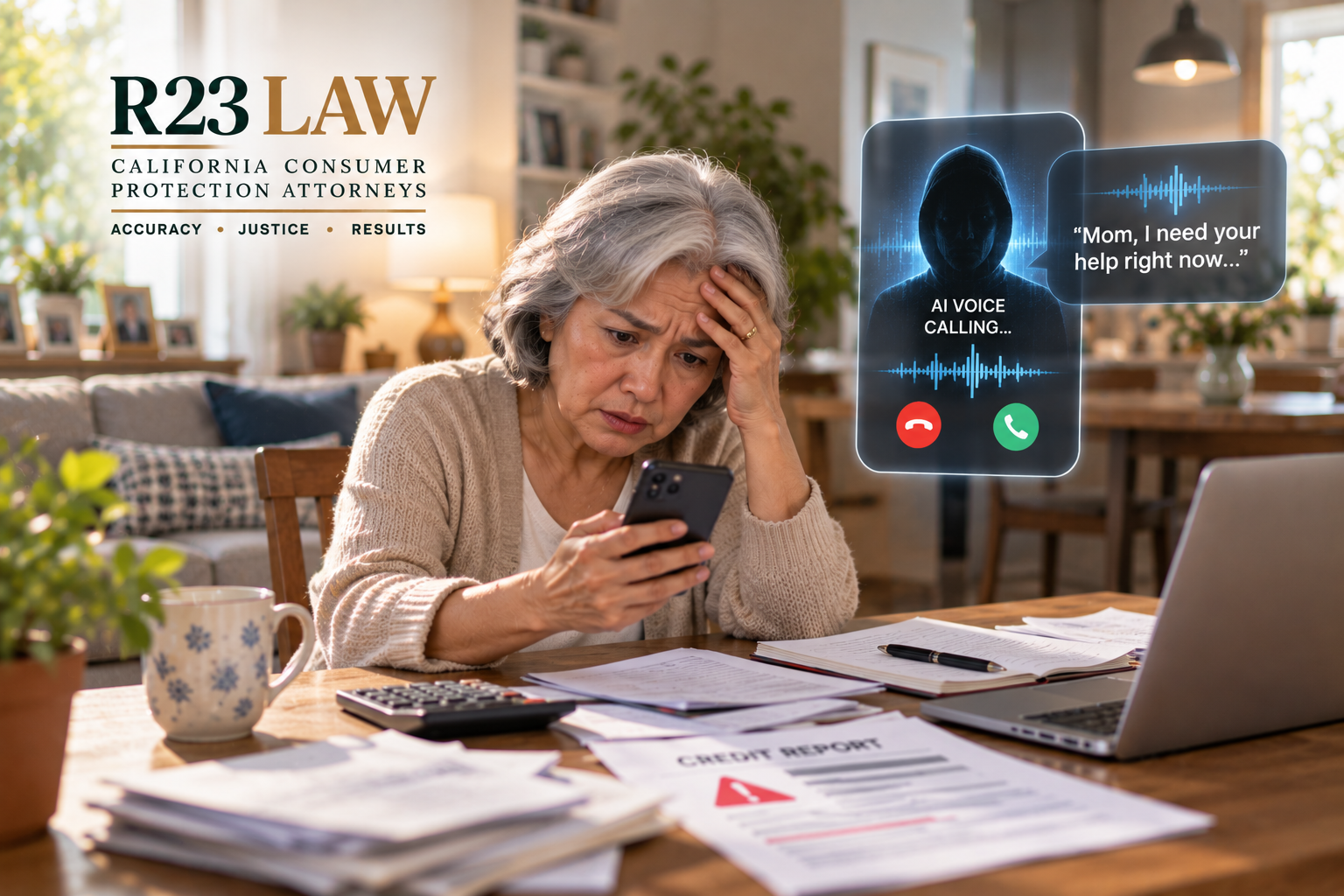
Artificial intelligence can imitate voices, generate realistic images, and produce convincing digital content in seconds
Those capabilities have legitimate applications, but they can also give identity thieves increasingly sophisticated tools for fraud.
AI-enabled voice cloning can imitate someone a consumer knows. Deepfake technology can create convincing images or video designed to make a victim believe they are interacting with a real person. When combined with stolen personal information, these technologies can make traditional warning signs of identity theft harder to recognize.
For California consumers, the growing sophistication of AI fraud makes verification and financial account security increasingly important.
VOICE CLONING CAN MAKE FRAUD SOUND FAMILIAR
One AI-enabled identity theft scheme involves voice cloning.
Audio clips shared through social media or other online sources can potentially provide material for AI systems capable of imitating a person's voice. Scammers may then use the imitation to impersonate a family member or another trusted individual.
The attached source highlights kidnapping and ransom scams as one example. A target may receive a call that appears to feature the voice of a loved one claiming to be in danger, creating urgency and pressure to send money. What Should I Know About Artifi…
The effectiveness of the scheme depends on something fraudsters have always exploited — trust.
AI can make that manipulation substantially more convincing because hearing a familiar voice may cause someone to react before independently verifying who is actually communicating with them.
DEEPFAKES CAN PUT A DIGITAL FACE ON THE SCAM
Voice cloning is not the only AI-enabled threat.
Deepfake technology can generate highly realistic images or visual representations of individuals, potentially making it appear that a real person is speaking or communicating when the content is computer-generated.
That can create another layer of credibility for a financial scam.
A consumer who believes they can see or hear someone they recognize may be more inclined to trust an unusual request for money or sensitive information.
AI therefore changes an important assumption about online fraud — seeing or hearing a familiar person may no longer be enough to establish that the person is actually on the other side of the communication.
VERIFY BEFORE SHARING SENSITIVE INFORMATION
One of the most important protections identified in the source material is also one of the simplest — verify the person's identity before providing sensitive information.
Unexpected requests involving money, banking information, passwords, account credentials, or personal identifying information deserve additional scrutiny.
Consumers should avoid relying solely on the voice, image, or video presented to them when something about the communication is unusual.
Independent verification becomes especially important when a communication creates urgency or pressure to act immediately.
TWO-FACTOR AUTHENTICATION ADDS ANOTHER BARRIER
Consumers can also strengthen financial account security through two-factor authentication.
Two-factor authentication generally requires an additional verification step after the correct login credentials are entered, such as a unique code.
That additional layer can make unauthorized access more difficult even when a fraudster has obtained other account information.
Consumers should consider enabling available security protections on banking and financial accounts, particularly where those accounts contain sensitive financial or personal information.
AI SCAMS WILL CONTINUE TO CHANGE
Artificial intelligence technology continues to evolve, and scams can evolve with it.
That makes awareness an important part of identity theft prevention.
Consumers who understand that voices can be cloned and convincing digital images can be artificially generated may be better positioned to recognize suspicious communications before sending money or disclosing sensitive information.
The source emphasizes staying informed about emerging AI scams because familiarity with common schemes can make fraudulent activity easier to recognize. What Should I Know About Artifi…
Technology may change the appearance of a scam, but many fraud tactics continue to depend on familiar pressure points — urgency, fear, trust, and requests for sensitive information.
WHEN AI FRAUD BECOMES IDENTITY THEFT
Protective measures cannot eliminate every risk.
A consumer may still discover that personal information has been compromised or used without authorization.
Once identity theft occurs, the problem can extend beyond the original scam. Fraudulent activity may affect financial accounts and potentially create other complications requiring consumers to dispute unauthorized activity and document what occurred.
Identity theft victims should preserve records associated with the fraudulent activity, including communications, account information, and documentation concerning disputed transactions or accounts.
A strong paper trail can become particularly important when a consumer must demonstrate that financial activity resulted from identity theft rather than legitimate account use.
R23 LAW'S EXPERT LEGAL SERVICES FOR AI AND IDENTITY THEFT VICTIMS THROUGHOUT CALIFORNIA
R23 Law's California Consumer Protection Attorneys represent consumers dealing with identity theft and the financial consequences that can follow fraudulent use of personal information.
AI may provide identity thieves with new methods of impersonation, but victims can ultimately face familiar consumer protection problems — unauthorized accounts, fraudulent financial activity, inaccurate credit information, and disputes over debts or transactions they did not authorize.
R23 Law represents consumers facing identity theft-related problems involving financial institutions, creditors, debt collectors, credit reporting agencies, and other companies connected to the resulting financial or credit damage.
DON'T LET AI DO THE VERIFYING FOR YOU
Artificial intelligence is making digital impersonation increasingly convincing.
A familiar voice may be cloned. A realistic image may be generated. An urgent request may appear to come from someone a consumer trusts.
Verification therefore matters.
Consumers can reduce their exposure by independently confirming suspicious requests, protecting sensitive information, enabling two-factor authentication where available, and remaining alert to new forms of AI-enabled fraud.
And when an AI scam results in identity theft or financial damage, documenting the fraudulent activity can become an important part of addressing what comes next.
Contact R23 Law Today
AI may change the technology behind identity theft, but victims can still be left dealing with very real financial consequences. When stolen personal information leads to fraudulent activity, disputed accounts, or other consumer protection problems, R23 Law's California Consumer Protection Attorneys can evaluate the circumstances and applicable consumer rights.
Toll-Free: 310-598-1588
SoCal: (310) 598-1588
Email: info@R23Law.com
Website: www.R23Law.com
Address: US Bank Tower, 633 W. 5th Street, 26th Floor, Los Angeles, CA
© 2025 R23 Law. All rights reserved. Trusted consumer credit lawyers in Los Angeles.
