
FRAUD LOVES A CROWD – Identity Theft Hotspots, California Risk, And Credit Report Damage
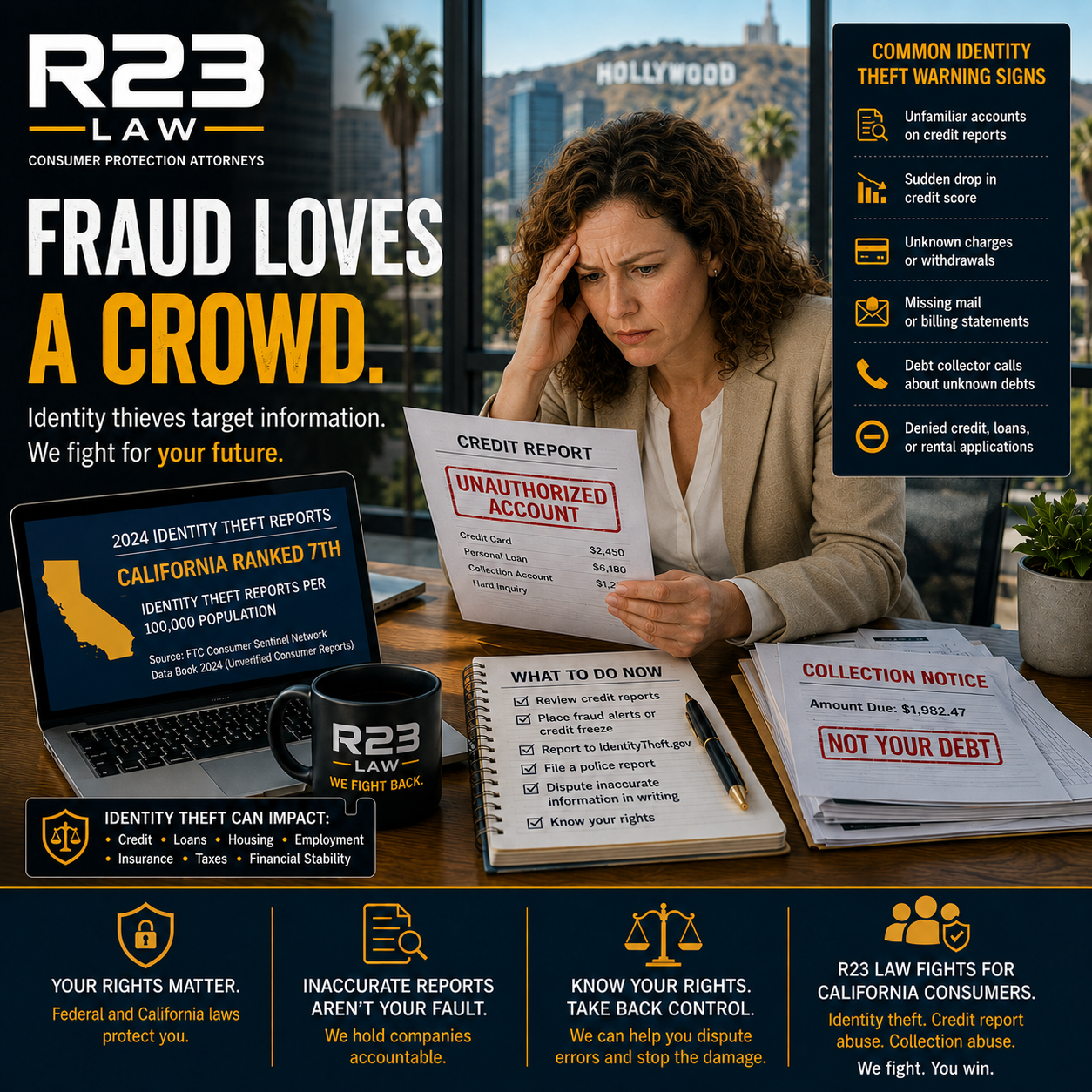
Identity theft risk varies by state, but California consumers remain major targets
R23 Law's California Consumer Protection Attorneys represent identity theft victims facing credit report errors, fraudulent accounts, and unlawful debt collection.
Fraud Loves a Crowd
Identity theft does not respect geography, income, age, or background. Some states see higher report volumes because of population size, digital activity, economic density, and access to consumer data. But the core lesson is simple — identity thieves go where personal information can be found, used, sold, or exploited.
The attached source material explains that identity theft can affect anyone, including children, older adults, working professionals, and consumers whose personal information is exposed through data breaches, phishing, hacked accounts, or stolen records. It also highlights California as a major identity theft hotspot and discusses how population, wealth, online activity, and digital infrastructure can affect state-by-state vulnerability.
R23 Law's California Consumer Protection Attorneys represent consumers throughout California when identity theft leads to false accounts, damaged credit, collection pressure, denied applications, and ignored disputes. Learn more at AboutUs, meet Our Team, or begin a confidential review through ContactUs.
California Remains an Identity Theft Hotspot
California’s size, economy, technology sector, banking activity, and large consumer population make it a frequent target for identity thieves. FTC Consumer Sentinel Network data for 2024 reported 6.5 million total consumer reports involving fraud, identity theft, and other consumer protection topics, and the FTC cautions that its data is based on unverified consumer reports rather than a survey.
In the FTC’s 2024 state rankings for identity theft reports per 100,000 population, California ranked seventh, with 139,665 identity theft reports. Florida, Georgia, Nevada, Texas, Delaware, and Massachusetts ranked above California on a per-capita basis.
Identity Theft Risk Is Not Just a Big-State Problem
High-population states often generate large report totals, but smaller states can still have serious per-capita risk. The attached material notes that identity theft vulnerability depends on more than population alone. Factors may include digital transactions, wealth concentration, retiree populations, urban density, access to public records, and business reliance on online systems.
That matters for California consumers because identity theft does not always begin with a dramatic hack. It may start with a phishing email, a compromised password, a stolen wallet, a data breach notice, a fake loan application, or a fraudulent credit card account.
R23 Law's Expert Legal Services for Identity Theft Injury Victims Throughout California
R23 Law's California Consumer Protection Attorneys pursue cases where identity theft causes real financial and credit injuries. These cases may involve fraudulent credit cards, bank accounts, loans, leases, tax fraud, medical identity theft, debt collection, and inaccurate credit reporting.
In 2024, the FTC’s California data identified credit card identity theft as the largest identity theft type reported by California consumers, followed by other identity theft, loan or lease identity theft, bank account identity theft, and employment or tax-related identity theft.
Fraudulent Accounts Can Become Credit Report Damage
An identity thief may open a credit card, loan, utility account, or bank account using stolen personal information. If that account becomes delinquent, it may appear on the victim’s credit report as if the victim created the debt.
That false reporting can affect credit approvals, mortgage rates, auto financing, rental housing, employment screening, insurance pricing, and financial stability. R23 Law's California Consumer Protection Attorneys evaluate whether credit bureaus, furnishers, banks, lenders, and collectors followed the law after receiving identity theft documentation.
FCRA Rights After Identity Theft
The Fair Credit Reporting Act gives identity theft victims important credit reporting protections. A consumer reporting agency generally must block information identified as resulting from identity theft within four business days after receiving proper proof of identity, an identity theft report, identification of the fraudulent information, and a statement that the information does not relate to a transaction by the consumer.
When a credit bureau or furnisher refuses to correct documented identity theft, keeps reporting false information, or conducts an unreasonable investigation, R23 Law's California Consumer Protection Attorneys may evaluate claims under the FCRA and California consumer protection laws.
California Identity Theft Claims Against False Debt Collection
Identity theft often becomes worse when a company continues trying to collect a fraudulent debt. California law allows a person to bring an action against a claimant to establish that the person is an identity theft victim in connection with the claimant’s demand.
That protection can be critical when a bank, lender, debt buyer, or collection agency treats a fraudulent account as valid despite receiving notice and supporting records.
Common Identity Theft Warning Signs
Consumers should act quickly when they notice unfamiliar credit inquiries, new accounts they did not open, sudden credit score drops, unexpected bills, collection calls, missing statements, denied credit, tax filing problems, medical bills for services never received, or account login changes.
A data breach notice also deserves attention. It may not mean fraud has already occurred, but it can mean personal information is exposed and may later be used to open accounts or access existing ones.
R23 Law's California Consumer Protection Attorneys for Credit and Collection Injuries
Identity theft is often only the first injury. The second injury happens when companies ignore the evidence. A credit bureau may fail to block the account. A furnisher may verify false information. A collector may keep calling. A lender may deny credit based on fraud.
R23 Law’s consumer protection practice focuses on the paper trail — credit reports, dispute letters, FTC identity theft reports, police reports, collection notices, denial letters, account records, and company responses.
Records That Matter After Identity Theft
Consumers should preserve credit reports, bank statements, account alerts, creditor letters, debt collection notices, police reports, FTC identity theft reports, dispute letters, certified mail receipts, screenshots, call logs, denial notices, and any response from a credit bureau, lender, bank, or collector.
Strong documentation can show when the company received notice, what evidence was provided, what remained inaccurate, and whether the company continued reporting or collecting after the fraud was documented.
California Consumers Deserve Accurate Credit Reports
Identity theft may begin with a criminal, but credit report damage often continues because companies fail to correct the record. R23 Law's California Consumer Protection Attorneys represent consumers whose financial lives were disrupted by fraudulent accounts, false reporting, and debt collection activity tied to identity theft.
Fraud may love a crowd, but it still leaves evidence. R23 Law follows that evidence.
Contact R23 Law Today
When identity theft creates false accounts, damaged credit, denied applications, or wrongful collection activity, R23 Law's California Consumer Protection Attorneys can evaluate the records and pursue accountability under consumer protection law.
SoCal — (310) 598-1588
