
STATUS SECURED — Identity Theft Risks for California Immigrants
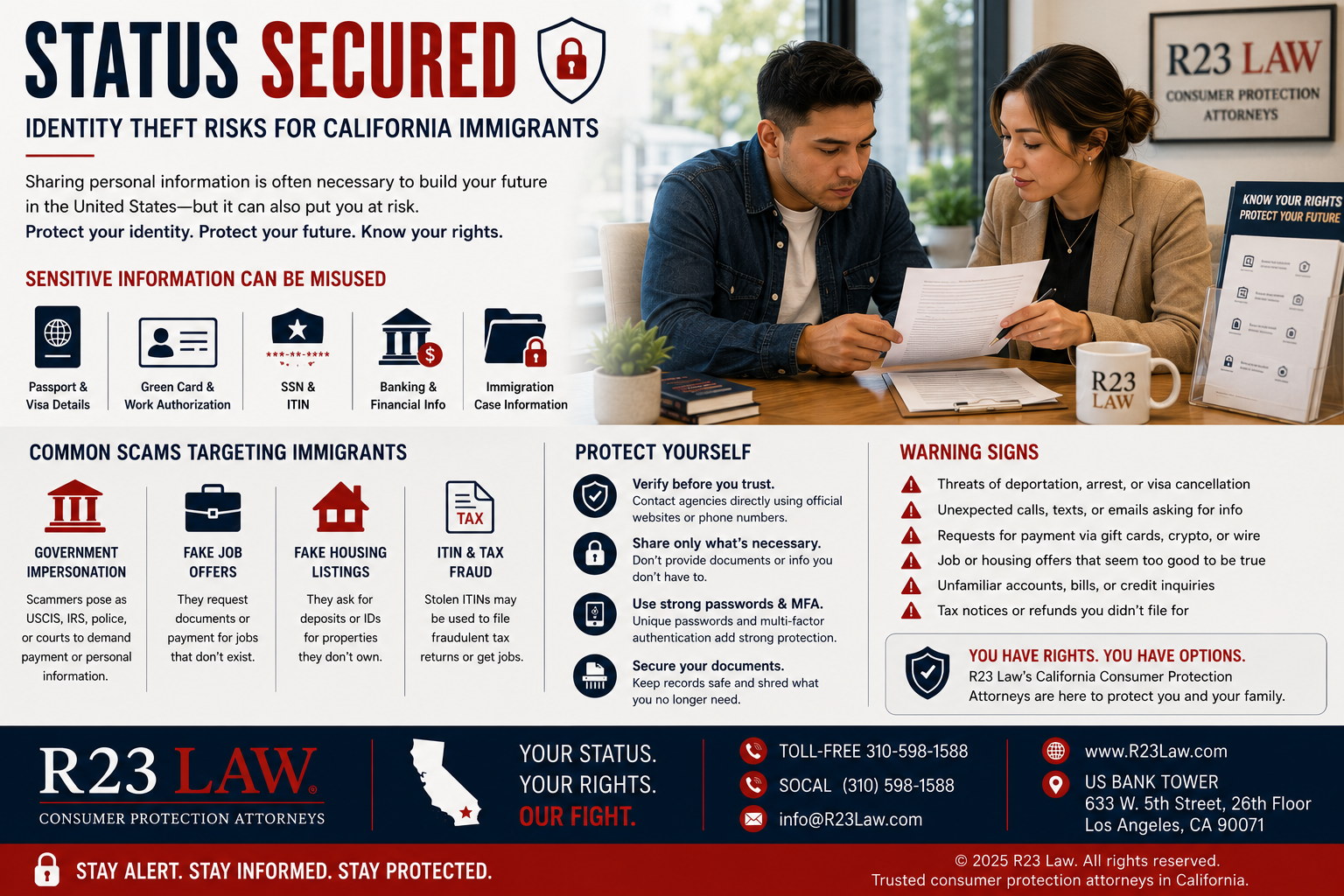
Building a life in a new country often requires sharing sensitive personal information with employers, landlords, banks, insurance companies, schools, and government agencies
For immigrants in California, those records may include passport information, visa documents, employment authorization records, Individual Taxpayer Identification Numbers, Social Security numbers, and immigration case details. When that information is mishandled, exposed in a data breach, or given to an impersonator, the consequences can be severe.
Identity thieves may exploit language barriers, unfamiliarity with American institutions, or fears involving immigration status. Recognizing the most common schemes can reduce the risk of financial fraud, damaged credit, and unauthorized accounts.
Sensitive Documents Can Increase Exposure
Immigrants may be required to provide more documentation than other consumers during employment, housing, banking, insurance, and immigration-related transactions.
Sensitive records may include:
Passport numbers
Visa information
Green card details
Employment authorization documents
Social Security numbers
Individual Taxpayer Identification Numbers
Birth certificates
Foreign identification documents
Immigration receipt and case numbers
Financial and residential information
Each organization receiving this information has a responsibility to safeguard it. However, data breaches, employee misconduct, insecure systems, and improper document disposal can expose personal information to criminals.
Once stolen, these details may be used to open credit accounts, obtain employment, file fraudulent tax returns, access financial accounts, or impersonate the victim.
Unfamiliarity With U.S. Systems Can Create Opportunities for Scammers
Identity thieves often rely on urgency and fear.
A person who recently arrived in the United States may be unfamiliar with how government agencies, banks, employers, and law enforcement typically communicate. Scammers may exploit that uncertainty by claiming that immediate payment or disclosure of personal information is required.
Fraudulent messages may appear official and include government seals, case numbers, employee names, or personal information obtained from public records or data breaches.
Common pressure tactics include threats involving:
Deportation
Arrest
Visa cancellation
Loss of employment authorization
Immigration application delays
Account closure
Tax penalties
Lawsuits or criminal charges
A legitimate-looking message is not necessarily authentic. Consumers should independently verify any unexpected request before providing information or sending money.
Government Impersonation Scams Target Immigrant Communities
Government impersonation is one of the most concerning identity theft schemes affecting immigrants.
A scammer may pretend to represent U.S. Citizenship and Immigration Services, the Internal Revenue Service, law enforcement, a court, or another government office. The caller or sender may demand payment for supposed immigration fees, fines, or outstanding obligations.
The scammer may also request:
Passport or visa numbers
Social Security or ITIN information
Banking credentials
Copies of immigration documents
Account verification codes
Gift card numbers
Cryptocurrency transfers
Wire payments
Threats of immediate arrest or deportation are intended to prevent the victim from pausing to verify the communication.
Unexpected messages through social media, messaging applications, or unofficial email addresses should be treated with caution. Consumers should contact the agency directly using verified contact information rather than replying to the original message.
Employment and Housing Scams Can Expose Personal Information
Immigrants may also be targeted through fake job and housing opportunities.
A fraudulent employer may request identification documents, tax information, banking details, or payment for training and equipment before a legitimate job offer exists.
A fake landlord may request an application fee, deposit, passport copy, or Social Security number for a property the scammer does not own or control.
Warning signs may include:
Pressure to provide documents immediately
Requests for payment before viewing a property
Interviews conducted only through text messages
Job offers without a meaningful interview
Requests to purchase gift cards or send cryptocurrency
Email addresses that do not match the company’s official domain
Refusal to provide written agreements
Payment requests through untraceable methods
Compensation that appears unusually high for the position
Consumers should independently verify employers, recruiters, landlords, and property ownership before sending money or identification documents.
ITIN and Tax Identity Theft Can Create Long-Term Problems
An Individual Taxpayer Identification Number may be used by people who need to file federal tax returns but are not eligible for a Social Security number.
Identity thieves may attempt to use a stolen ITIN or Social Security number to file a fraudulent tax return, obtain employment, open accounts, or create false financial records.
Signs of possible tax identity theft may include:
Rejection of a legitimate tax return because another return was already filed
Tax notices involving unfamiliar income
Employment records from an unknown company
Refund activity the consumer does not recognize
Requests to verify a tax return the consumer did not submit
Victims should preserve all notices, filing records, and communications. Tax identity theft may also create inaccurate credit, employment, or government records that require separate disputes.
Identity Theft Warning Signs
Identity theft may remain hidden until the victim applies for credit, housing, employment, or public benefits.
Consumers should watch for:
Unfamiliar accounts on credit reports
Collection notices for debts they do not recognize
Unexpected denials of credit or housing
Unauthorized bank or credit card transactions
Tax notices involving unknown income
Employment records from unfamiliar businesses
Changes to immigration or financial accounts
Password reset messages they did not request
Government correspondence involving unfamiliar applications
Mail that suddenly stops arriving
Verification codes or login alerts from unknown devices
A single unfamiliar account or transaction may indicate broader misuse of personal information.
Steps After Suspected Identity Theft
Consumers who believe their information has been compromised should act promptly.
Important steps may include:
Secure affected financial and online accounts.
Change compromised passwords from a trusted device.
Enable multi-factor authentication.
Notify banks and credit card issuers of unauthorized activity.
Review credit reports for unfamiliar accounts and inquiries.
Place fraud alerts or security freezes when appropriate.
Dispute inaccurate information in writing.
Preserve emails, text messages, voicemails, and payment records.
Report impersonation attempts to the affected agency.
Maintain a timeline of each report, response, and financial loss.
Victims should retain copies of immigration documents, police reports, identity theft reports, credit disputes, account statements, and government correspondence.
These materials may become important when disputing fraudulent debts or pursuing claims against companies that fail to correct identity theft records.
Language Barriers Should Not Prevent Fraud Reporting
Scammers may assume that a victim will remain silent because of limited English proficiency, uncertainty about legal rights, or fear involving immigration status.
Identity theft should still be reported.
Consumers may request interpreters, translated materials, or assistance from trusted family members and qualified professionals. They should avoid relying on unverified individuals who claim to have special access to government agencies or guaranteed immigration outcomes.
Personal information should only be shared with verified institutions and trusted professionals.
Financial Institutions and Credit Bureaus Must Address Documented Fraud
Identity theft does not end when a scammer obtains personal information. Additional harm may occur when a bank, creditor, debt collector, or credit reporting agency refuses to recognize documented fraud.
Depending on the circumstances, consumer protection laws may apply when a company:
Rejects a valid unauthorized transaction claim
Continues collecting a fraudulent debt
Reports identity theft accounts as legitimate
Fails to reasonably investigate a credit dispute
Reopens or reinserts fraudulent information
Blocks access to legitimate funds
Ignores supporting identity theft documents
Furnishes information it knows is inaccurate
Available remedies depend on the facts, the type of account, the dispute history, and the company involved.
R23 Law’s Expert Legal Services for Identity Theft Victims Throughout California
R23 Law's California Consumer Protection Attorneys represent identity theft victims throughout California in disputes involving fraudulent accounts, unauthorized transactions, inaccurate credit reporting, and improper debt collection.
The firm evaluates matters involving:
Stolen Social Security numbers and ITINs
Fraudulent bank and credit card transactions
Identity theft accounts on consumer reports
Government and financial institution impersonation
Data breach-related identity theft
Unauthorized loans and credit accounts
Debt collectors pursuing fraudulent obligations
Credit bureaus that refuse to remove inaccurate information
Employment and housing denials caused by identity theft records
Financial institutions that reject documented fraud claims
R23 Law’s California Identity Theft Victim Lawyers examine the evidence, identify the responsible companies, and evaluate remedies available under federal and California consumer protection laws.
Learn more About R23 Law, meet Our Team, or submit a confidential inquiry through the Contact Us page.
Strong Verification Practices Reduce Identity Theft Risk
Consumers should avoid providing sensitive information to anyone who initiates unexpected contact.
When a bank, employer, landlord, or government representative requests personal information, the safer approach is to end the communication and independently contact the institution using a verified telephone number or official website.
Additional precautions include:
Avoiding payments through gift cards or cryptocurrency
Using unique passwords for every account
Enabling multi-factor authentication
Reviewing credit reports regularly
Protecting physical immigration documents
Shredding sensitive records before disposal
Limiting personal information shared on social media
Confirming website addresses before uploading documents
Keeping software and mobile devices updated
Reviewing bank and credit card statements frequently
No security practice can eliminate every risk, but verification and regular monitoring can make identity theft more difficult and allow faster detection.
Contact R23 Law Today
Identity theft can threaten a consumer’s credit, finances, employment, housing, and sense of security. Immigrants targeted through government impersonation, document theft, fraudulent accounts, or inaccurate credit reporting may have rights under federal and California law.
R23 Law's California Consumer Protection Attorneys evaluate claims involving identity theft, unauthorized transactions, fraudulent debts, and failed credit reporting investigations.
Connect with R23 Law through the Contact Us page regarding identity theft or related consumer protection violations.
Toll-Free — 310-598-1588SoCal — (310) 598-1588Email — info@R23Law.comWebsite —www.R23Law.comAddress — US Bank Tower, 633 W. 5th Street, 26th Floor, Los Angeles, CA
© 2025 R23 Law. All rights reserved. Trusted consumer credit lawyers in Los Angeles.
Legal Disclaimer — This article provides general information and does not constitute legal or immigration advice or create an attorney-client relationship. Legal rights and available remedies depend on the facts of each matter.
