
OVERSHARING, UNDER ATTACK — Social Media Identity Theft And California Consumer Rights
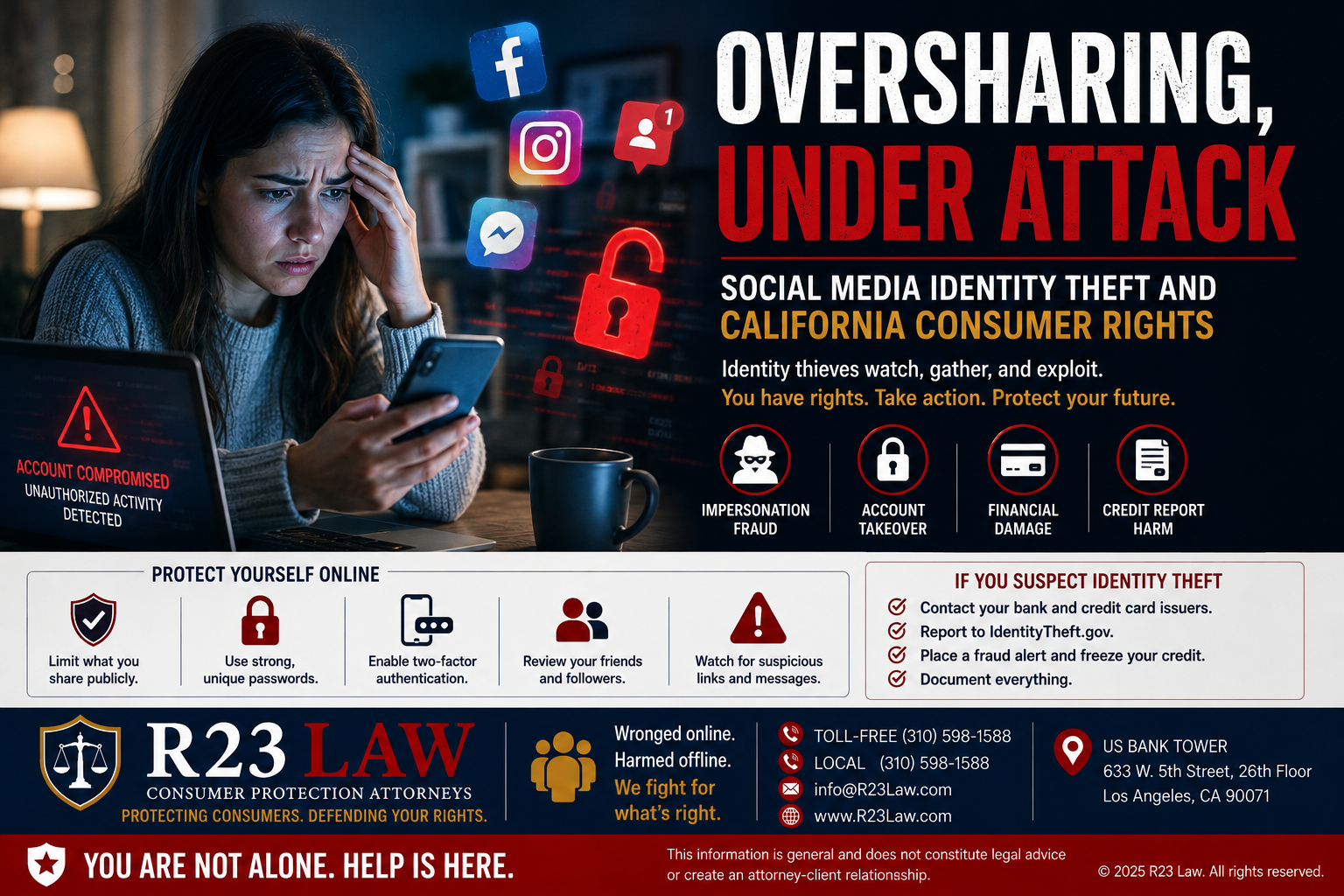
Social media identity theft can expose personal data, financial accounts, and credit
Social media makes it easy to stay connected with friends, relatives, coworkers, and communities around the world.
It can also give identity thieves access to the personal details they need to impersonate a consumer, break into an account, or launch a convincing scam.
A profile may appear harmless. Yet names, birthdays, schools, family information, photographs, and professional details can become valuable tools for a fraudster.
R23 Law's California Consumer Protection Attorneys represent social media identity theft victims throughout California when online impersonation, stolen information, fraudulent accounts, or related financial activity causes measurable injury.
Social Media Profiles Can Reveal More Than Consumers Realize
Many users share personal information gradually.
One post identifies a birthday. Another names a school. A family photograph identifies children. A professional profile lists an employer, work history, and colleagues.
Over time, a social media account may reveal:
Full legal names
Birth dates
Schools and universities
Employers
Job titles
Children’s names
Family relationships
Hometowns
Travel plans
Personal interests
Photographs
Community memberships
The attached source explains that thieves may use these details to gain access to accounts or impersonate the consumer over the telephone.
R23 Law's Expert Legal Services For Social Media Identity Theft Victims
R23 Law's California Consumer Protection Attorneys evaluate the entire course of online and financial activity.
A legal review may include:
Compromised social media profiles
Unauthorized password changes
Fake accounts created in the victim’s name
Fraudulent direct messages
Impersonation of friends or coworkers
Malicious links
Unauthorized bank transactions
Fraudulent credit accounts
Collection activity
Credit reporting damage
The identity theft may begin on a social media platform but spread quickly to banks, lenders, credit card issuers, and consumer reporting agencies.
Identity Thieves Can Build A Convincing Impersonation
A fraudster does not always need every piece of a victim’s personal information.
A combination of publicly available details may be enough to sound credible.
The thief may know:
The victim’s full name
Where the victim works
The name of a relative
A recent vacation destination
The victim’s school
The names of coworkers
A community or organization the victim follows
Those details can make fraudulent calls, emails, and messages appear legitimate.
The scammer may then attempt to obtain additional information, reset a password, gain access to a financial account, or persuade another person to send money.
Fake Friends And Colleagues Can Become Entry Points
The attached source notes that thieves may pose as friends, colleagues, or members of a larger community.
A fake profile may copy:
A person’s name
Profile photograph
Biography
Employer
Mutual contacts
Recent posts
The impersonator may then send a connection request or direct message designed to gain trust.
Once accepted, the account may be used to request sensitive information, send fraudulent payment requests, or distribute malicious links.
Malicious Links Can Turn A Message Into An Account Takeover
A social media message may contain a link that appears to lead to:
A shared photograph
A video
A security alert
A contest
A package notice
An employment opportunity
A login page
The attached source warns that thieves may use links or emails containing malware to steal personal information.
A consumer who enters login information into a false page may unknowingly give a fraudster direct access to the account.
Compromised accounts may then be used to target the victim’s friends, relatives, and professional contacts.
R23 Law's Expert Legal Services For Online Account Injury Victims Throughout California
When a social media account is compromised, R23 Law's California Consumer Protection Attorneys examine whether the attack led to financial or credit-related harm.
Potential injuries may involve:
Unauthorized purchases
Fraudulent transfers
New accounts opened without permission
Loans taken out in the victim’s name
Credit card fraud
Collection notices
Credit score damage
Denied credit
Lost business opportunities
Emotional distress
The firm reviews the connection between the online compromise and each resulting transaction or account.
Contact Every Affected Financial Institution
The attached source recommends immediately contacting affected institutions, including:
Banks
Credit card issuers
Lenders
Consumers should identify the suspected fraud and request information about the institution’s dispute process.
Important records may include:
Fraud claim numbers
Dates and times of calls
Names of representatives
Written confirmations
Account statements
Transaction records
Replacement account information
Consumers should preserve copies of every communication.
File An Identity Theft Report With The FTC
The attached source also recommends reporting identity theft to the Federal Trade Commission.
The FTC report creates a formal record describing the suspected identity theft.
Consumers should retain:
A copy of the submitted report
Confirmation information
The recovery plan
A list of affected accounts
Supporting documentation
The report may become important when disputing fraudulent accounts or explaining the identity theft to financial institutions and credit reporting agencies.
Place Fraud Alerts With The Credit Reporting Agencies
After reporting the identity theft, the source recommends contacting the credit reporting agencies and requesting a fraud alert.
The three major nationwide credit bureaus are:
Equifax
Experian
TransUnion
A fraud alert informs potential creditors that the consumer’s identity may have been compromised.
The alert is intended to encourage additional identity verification before new credit is opened in the consumer’s name.
Consumers should retain confirmation that the alert was placed.
R23 Law's Expert Legal Services For Credit Injury Victims Throughout California
Social media identity theft may result in fraudulent accounts appearing on a consumer’s credit reports.
R23 Law's California Consumer Protection Attorneys review matters involving:
Accounts the consumer never opened
Unauthorized credit inquiries
Fraudulent balances
Collection accounts
Incorrect addresses
Mixed personal information
Rejected identity theft disputes
Continued reporting after notice
The review may include complete credit reports, dispute letters, identity theft reports, account applications, lender records, and adverse-action notices.
Change Passwords Across All Accounts
The attached source recommends changing passwords after financial accounts and credit files have been secured.
Consumers should update passwords for:
Social media accounts
Email accounts
Banking platforms
Credit card accounts
Shopping accounts
Payment applications
Cloud storage
Other accounts containing personal information
A compromised email account can be especially dangerous because password-reset messages for other services may be delivered there.
Each account should use a distinct password rather than recycling the same credentials across multiple platforms.
Enable Two-Factor Authentication
The source also recommends enabling two-factor authentication.
Two-factor authentication adds another security step beyond the password.
Even when a fraudster obtains login credentials, the additional verification requirement may make unauthorized access more difficult.
Consumers should review the available security settings on social media, email, financial, and other sensitive accounts.
Review Social Media Privacy Settings
Consumers should also consider limiting how much personal information is visible to the public.
A privacy review may include:
Removing full birth dates
Restricting visibility of family information
Limiting public access to photographs
Reviewing old posts
Removing unnecessary location details
Restricting friend or follower lists
Reviewing connected applications
Removing unfamiliar devices or sessions
Privacy settings do not eliminate identity theft, but they may reduce the amount of information available to strangers.
Preserve Evidence Before Deleting Compromised Content
A victim may feel an immediate urge to delete a fraudulent profile, message, or post.
Before removing material, consumers should preserve:
Screenshots
Profile links
Usernames
Message histories
Dates and times
Email notifications
Login alerts
Payment requests
Copies of fraudulent posts
Names of recipients
The evidence may show how the fraud occurred and who received the impersonator’s communications.
R23 Law's Expert Legal Services For Financial Injury Victims Throughout California
R23 Law's California Consumer Protection Attorneys examine the conduct of every company involved after the identity theft.
Relevant entities may include:
Social media platforms
Banks
Credit card companies
Lenders
Payment services
Merchants
Debt collectors
Credit reporting agencies
The firm evaluates whether companies accurately investigated disputes, corrected fraudulent records, and stopped treating unauthorized activity as legitimate.
Social Media Identity Theft Can Damage More Than Credit
Online impersonation may affect:
Personal relationships
Professional reputation
Business contacts
Financial accounts
Employment opportunities
Emotional well-being
A fraudster may send offensive messages, request money from relatives, target customers, or publish false information under the victim’s name.
Consumers should document both financial losses and reputational harm.
A Social Profile Should Not Become A Fraudster’s File
Social media can reveal enough personal information for a thief to create convincing scams, impersonate a consumer, or gain access to additional accounts.
Victims should act quickly by notifying affected institutions, filing an FTC report, placing fraud alerts, updating passwords, enabling two-factor authentication, and preserving evidence.
Contact R23 Law's California Consumer Protection Attorneys
Consumers dealing with compromised social media accounts, fraudulent financial activity, identity theft credit damage, or online impersonation should preserve all related records.
Contact R23 Law's California Consumer Protection Attorneys for a free consultation concerning social media identity theft, account takeovers, fraudulent credit accounts, unauthorized transactions, and related consumer-protection claims.
Toll-Free: 310-598-1588 Email: info@R23Law.com Website:www.R23Law.comOffice: US Bank Tower, 633 W. 5th Street, 26th Floor, Los Angeles, California
Disclaimer: This article provides general information and does not constitute legal advice or create an attorney-client relationship. The availability of any claim or remedy depends on the type of identity theft, affected accounts, responsible entities, evidence, and applicable law.
