
POSTED AND EXPOSED — Social Media Identity Theft Risks
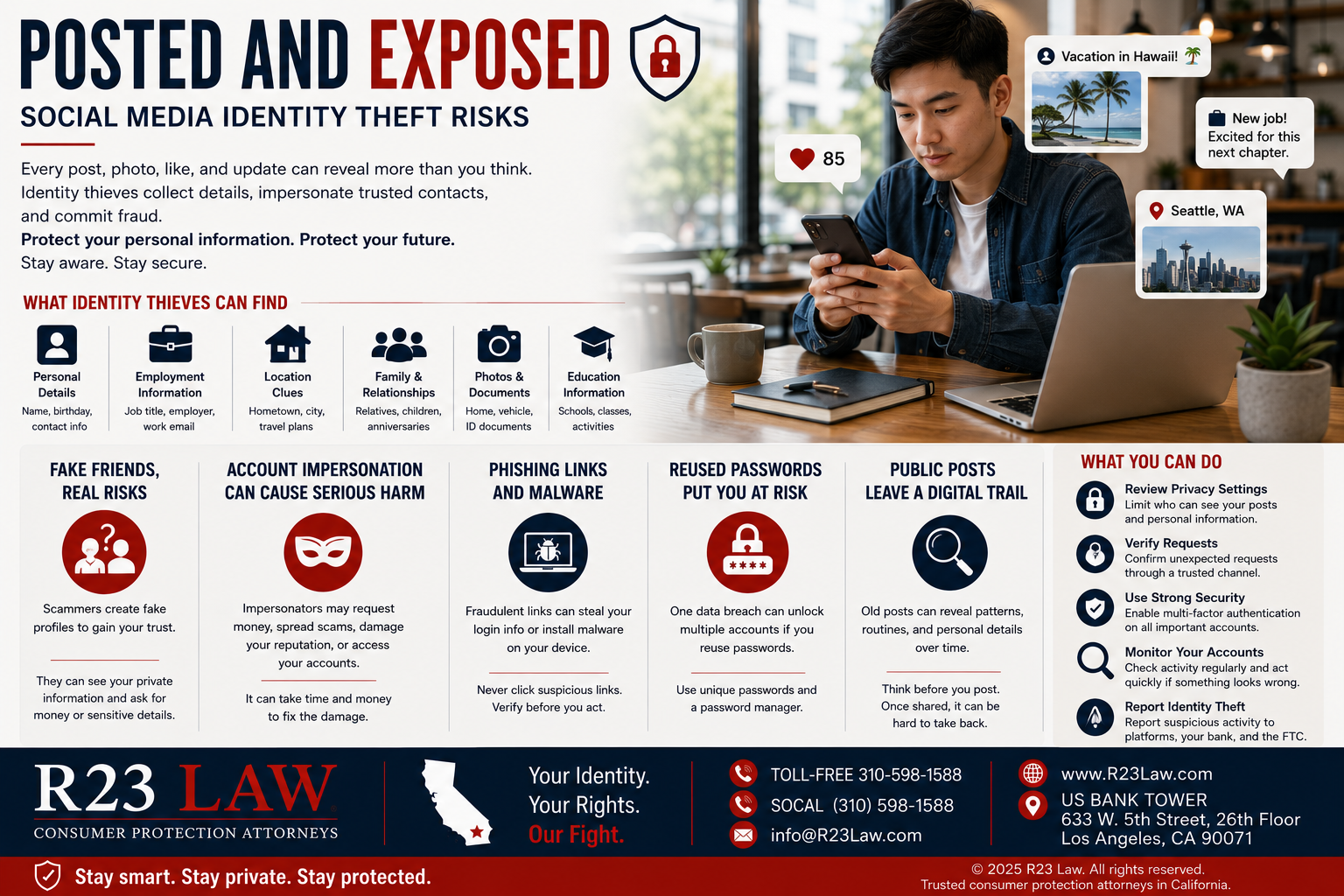
Social media keeps families connected, supports professional networking, and gives consumers an easy way to share important moments
Unfortunately, every birthday post, location update, family photograph, and employment announcement may also reveal information that identity thieves can exploit.
Fraudsters no longer need to steal a wallet to gather personal information. They can review public profiles, impersonate trusted contacts, distribute malicious links, and combine details from several platforms to build a convincing picture of a consumer’s identity.
Once that information is collected, it may be used to access existing accounts, open fraudulent credit lines, impersonate the victim, redirect funds, or create debts in the victim’s name.
R23 Law’s California Consumer Protection Attorneys represent consumers throughout California whose identities, credit histories, and financial accounts have been damaged by online fraud and identity theft.
Social Media Profiles Can Reveal More Than Consumers Realize
Many social media users believe they are sharing harmless personal details. However, identity thieves often collect small pieces of information over time.
A public profile may reveal—
A full legal name
Date of birth
Current city or hometown
Employer and job title
School or university
Names of children and relatives
Wedding anniversaries
Pet names
Travel plans
Telephone numbers
Email addresses
Photographs of a home, vehicle, workplace, or identification document
Some of these details are commonly used in passwords, account-recovery prompts, and identity-verification procedures.
A fraudster who knows a consumer’s birthday, mother’s maiden name, high school, pet name, and telephone number may be able to answer security questions or convincingly impersonate that consumer during a telephone call.
Personal Information Mining Creates A Profile For Fraud
Identity thieves may spend weeks or months reviewing a target’s public activity before making contact.
They may examine older posts, tagged photographs, professional profiles, family connections, comments, and public records. The information can then be organized into a detailed profile that supports a larger identity theft scheme.
For example, a fraudster may learn where a consumer banks from a post about a new credit card. A photograph of a birthday celebration may confirm the consumer’s date of birth. A professional profile may reveal the employer, job title, and work email format.
Individually, these details may not appear dangerous. Together, they may provide enough information to impersonate the consumer or bypass basic account-security procedures.
Fake Friends And Followers Gain Access Through Trust
Not every fraudulent account appears suspicious.
Identity thieves may create profiles that appear to belong to former classmates, coworkers, relatives, professional contacts, or members of a shared community. They may copy a real person’s name and photographs before sending a connection request.
Once accepted, the fraudulent account may gain access to information that is hidden from the public.
The scammer may also send messages requesting money, account information, verification codes, or assistance with an alleged emergency. Because the message appears to come from someone familiar, the recipient may be less likely to question the request.
Consumers should independently verify unexpected requests through a known telephone number or another trusted method before sending money or personal information.
Account Impersonation Can Damage Finances And Reputation
Social media impersonation occurs when someone creates or takes control of an account and pretends to be another person.
The impersonator may use the account to—
Request money from friends and relatives
Promote fraudulent investments
Distribute malicious links
Obtain private information
Damage the victim’s professional reputation
Contact coworkers or clients
Create additional fraudulent accounts
Support applications for credit or financial services
In some cases, an identity thief may use the victim’s photographs and personal details without accessing the victim’s actual account. In others, the criminal may take over an existing profile by obtaining the password or intercepting an account-recovery code.
Phishing Links And Malware Turn Messages Into Traps
Fraudsters frequently use direct messages, advertisements, emails, and social media posts to distribute phishing links.
A message may claim that—
An account has been suspended
A password must be reset
A package cannot be delivered
A payment is waiting
A prize has been awarded
A friend needs emergency funds
A photograph or video features the recipient
A business opportunity requires immediate action
The link may lead to a website designed to resemble a legitimate social media platform, bank, payment service, or retailer. Once the consumer enters login credentials, the fraudster captures the information.
Other links may install malware that records keystrokes, accesses stored passwords, monitors account activity, or collects personal data from the device.
Consumers should avoid opening unexpected links and should access financial or social media accounts through the official application or a verified website address.
Reused Passwords Can Turn One Breach Into Several Account Takeovers
Using the same password across multiple accounts creates a serious security risk.
When login credentials are exposed in one data breach, criminals may test the same email and password combination on social media, banking, retail, and email accounts. This practice is commonly known as credential stuffing.
Access to an email account can be especially damaging because email is often used to reset passwords for other services.
Consumers should use a unique password for every important account. Password managers can make it easier to create and securely store complex credentials.
Two-Factor Authentication Adds Another Security Layer
Two-factor authentication requires a second form of verification in addition to a password.
Depending on the platform, this may involve—
An authentication application
A security key
A biometric identifier
A one-time verification code
A device approval request
Two-factor authentication can reduce the risk that a stolen password will lead to an immediate account takeover.
Authentication applications and physical security keys generally provide stronger protection than text-message codes, which may be vulnerable to telephone-number takeover schemes.
Consumers should never provide an unexpected verification code to another person. A bank, social media platform, or legitimate business generally will not request a private security code through an unsolicited message.
Warning Signs Of Social Media Identity Theft
Identity theft may begin long before the victim receives a collection letter or discovers a fraudulent account.
Common warning signs include—
Password-reset notices the consumer did not request
Login alerts from unfamiliar devices or locations
Changes to an account email address or telephone number
Messages sent from the account without authorization
New profiles using the consumer’s name or photographs
Friends receiving suspicious payment requests
Unrecognized credit inquiries
New accounts appearing on a credit report
Bills for services the consumer never opened
Missing funds or unauthorized transactions
Collection calls regarding unfamiliar debts
Unexpected denial of credit, housing, or employment
Prompt action can limit additional financial damage and preserve evidence.
Immediate Steps After Social Media Identity Theft
Secure The Affected Accounts
Change the password on the compromised social media account and any other account using the same or a similar password.
Review the account’s email address, telephone number, connected devices, active sessions, third-party applications, and recovery settings. Remove any information or device that the consumer does not recognize.
Enable two-factor authentication and save available recovery codes in a secure location.
Protect The Primary Email Account
The email account associated with social media may control access to many other services.
Change the email password, review forwarding rules, remove unfamiliar recovery addresses, and sign out of unrecognized devices. A fraudster may create hidden forwarding instructions that send account notifications to another address.
Contact Financial Institutions
Notify affected banks, credit card issuers, lenders, payment applications, and other financial institutions.
Identify unauthorized transactions and request the institution’s fraud procedures. Keep copies of all claim numbers, correspondence, account statements, investigation results, and denial letters.
Report The Identity Theft
Consumers may create an identity theft report through the Federal Trade Commission and report criminal activity to local law enforcement.
The social media platform should also be notified of impersonation, account takeover, fraudulent advertisements, or malicious messages.
Place Fraud Alerts Or Credit Freezes
A fraud alert directs creditors to take additional steps to verify the consumer’s identity before extending new credit.
A credit freeze restricts access to a credit file and may prevent identity thieves from opening new accounts. Consumers must generally contact Equifax, Experian, and TransUnion separately to freeze each credit report.
Review All Credit Reports
Consumers should review credit reports for—
Unfamiliar accounts
Unauthorized credit inquiries
Incorrect addresses
Names or aliases that do not belong to them
Fraudulent collection accounts
Incorrect balances
Accounts incorrectly marked delinquent
Loans or credit cards they never opened
Errors should be disputed in writing with supporting documentation. Copies of every dispute and delivery record should be preserved.
Social Media Identity Theft Can Create Credit Report Errors
When a fraudster opens an account using stolen information, the account may later appear on the victim’s credit report.
The fraudulent debt can lower the consumer’s credit score and interfere with applications for—
Housing
Employment
Credit cards
Vehicle financing
Personal loans
Insurance
Utility services
Mortgage financing
A consumer may also face collection activity for a debt that was never authorized.
The Fair Credit Reporting Act gives consumers rights regarding inaccurate or fraudulent information in consumer reports. California residents may also have protections under the California Consumer Credit Reporting Agencies Act and California identity theft laws.
The facts of the fraud, the dispute history, and the conduct of the credit reporting agencies, furnishers, creditors, and collectors all matter when evaluating potential claims.
Evidence Strengthens An Identity Theft Claim
Identity theft victims should preserve every available record.
Important evidence may include—
Screenshots of fraudulent profiles
Account login alerts
Password-reset notifications
Emails and direct messages
Telephone numbers
Website addresses
Bank statements
Credit card statements
Credit reports
Fraudulent applications
Collection letters
Identity theft reports
Police reports
Dispute letters
Certified mail records
Responses from credit bureaus and creditors
Denial letters
Proof of lost credit, housing, or employment opportunities
A written timeline can organize the date of each suspicious event, report, dispute, response, and financial loss.
R23 Law’s Expert Legal Services For Identity Theft Victims Throughout California
R23 Law’s California Consumer Protection Attorneys represent identity theft victims throughout California in matters involving—
Social media account takeovers
Online impersonation
Fraudulent credit accounts
Unauthorized credit inquiries
False credit reporting
Identity theft collection accounts
Bank account fraud
Unauthorized electronic transfers
Creditor investigation failures
Credit bureau dispute failures
Debt collection on fraudulent obligations
Fair Credit Reporting Act violations
California consumer credit reporting violations
California identity theft claims
R23 Law’s California Identity Theft Victim Lawyers review account records, credit reports, dispute correspondence, fraud investigations, collection notices, and evidence of financial injury.
The objective is to correct the financial record, identify potentially unlawful conduct, and pursue available remedies against responsible companies.
Learn moreAbout R23 Law, meetOur Team, or submit a confidential inquiry throughContact Us.
Protecting An Online Presence Protects A Financial Future
Social media identity theft can begin with a single public post, connection request, or malicious link. The damage may extend far beyond the original platform.
Stolen information can lead to fraudulent accounts, damaged credit, unauthorized transactions, collection activity, and lost financial opportunities.
R23 Law’s California Consumer Protection Attorneys pursue accountability when identity theft and improper corporate responses cause real financial harm.
Contact R23 Law Today
When social media identity theft leads to fraudulent accounts, unauthorized transactions, damaged credit, or wrongful collection activity, R23 Law’s California Consumer Protection Attorneys can evaluate the available records and potential claims under federal and California law.
Toll-Free — 310-598-1588 SoCal — (310) 598-1588 Email — info@R23Law.com Website —www.R23Law.comOffice — US Bank Tower, 633 W. 5th Street, 26th Floor, Los Angeles, CA
© 2025 R23 Law. All rights reserved. Trusted consumer credit lawyers in Los Angeles.
Disclaimer — This article provides general information and does not constitute legal advice. Rights, remedies, and deadlines depend on the circumstances of each matter.
