
DUTY ALERT — Military Identity Theft And Credit Protection
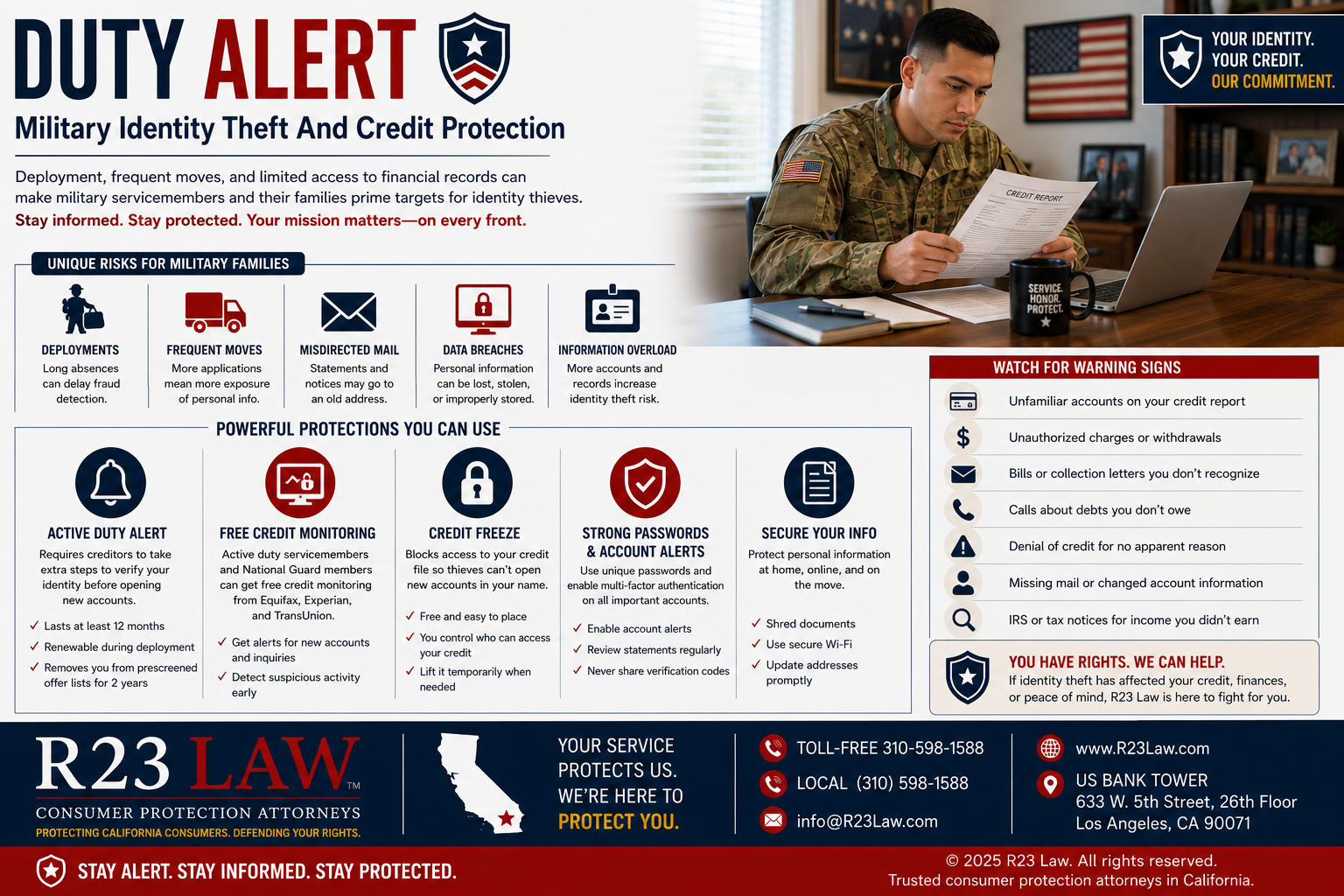
Military servicemembers make extraordinary commitments to protect the country
Unfortunately, deployment, frequent relocation, extended travel, and limited access to financial records can make members of the military attractive targets for identity thieves.
A servicemember may return from deployment to discover unfamiliar credit cards, unauthorized purchases, collection accounts, or a damaged credit score. By the time the fraud is detected, the identity thief may have opened several accounts or accumulated substantial debt.
R23 Law’s California Consumer Protection Attorneys represent servicemembers, veterans, and military families throughout California when identity theft leads to fraudulent accounts, inaccurate credit reporting, unauthorized transactions, or wrongful debt collection.
Military Service Can Create Unique Identity Theft Risks
Servicemembers may spend months away from home with limited opportunities to review mail, credit reports, and financial accounts. Identity thieves may exploit that delay to open accounts, make purchases, redirect correspondence, or misuse existing credit.
Frequent moves can create additional exposure. A permanent change of station may require servicemembers to provide personal information to landlords, utility companies, insurers, transportation providers, financial institutions, and government agencies. Every new application or account creates another point where sensitive information could be lost, stolen, or improperly accessed.
The attached source identifies deployments and frequent relocations as two major reasons members of the military may face increased identity theft risks.
Federal Trade Commission data has also shown that active duty servicemembers were significantly more likely than other consumers to report misuse of an existing bank or credit card account.
Deployment Can Delay Fraud Detection
Identity theft often causes greater damage when it remains undiscovered.
While deployed, a servicemember may not immediately receive collection letters, replacement cards, account notices, or credit application alerts. Paper correspondence may continue arriving at a former residence, while online account notifications may be missed because of limited internet access or demanding service obligations.
During that time, an identity thief may—
Open credit cards or personal loans
Make unauthorized bank withdrawals
Obtain mobile telephone service
Apply for utilities or housing
Use an existing credit card
Redirect account statements
Change account contact information
Create fraudulent collection debts
Submit applications using the servicemember’s identity
Delayed detection does not make the fraudulent accounts legitimate. Servicemembers retain rights to dispute identity theft information and challenge companies that fail to properly investigate documented fraud.
Frequent Relocations Increase Personal Information Exposure
Military families often move more frequently than civilian households.
Each relocation may involve rental applications, mortgage records, insurance policies, utility accounts, employment documents, school records, medical information, shipping arrangements, and address changes. These transactions may require Social Security numbers, dates of birth, financial account information, and copies of identification documents.
Identity theft risks may arise when—
Mail is delivered to an old address
Documents are discarded without shredding
An application is transmitted through an insecure system
Personal information is stored by an unfamiliar company
A former landlord retains sensitive records
A public wireless network is used for financial activity
Account contact information is not promptly updated
A data breach exposes military family information
Before relocating, servicemembers should review their financial accounts, update mailing addresses, secure important documents, and consider placing stronger protections on their credit files. The FTC specifically recommends considering a credit freeze before traveling or moving to a new duty station.
Active Duty Alerts Provide Added Credit Protection
An active duty alert is a special protection available to eligible military consumers under the Fair Credit Reporting Act.
When an active duty alert appears on a credit report, prospective creditors must take reasonable steps to verify the servicemember’s identity before extending new credit. This protection is particularly valuable during deployment, when the servicemember may be outside the country or unable to regularly monitor credit activity.
Federal law requires an active duty alert to remain in the servicemember’s credit file for at least 12 months. The alert may be renewed when deployment continues. A request made to one nationwide credit reporting agency must be referred to the other nationwide agencies.
An active duty alert also removes the servicemember from lists used for unsolicited prescreened credit and insurance offers for two years, unless the servicemember requests otherwise.
Free Credit Monitoring Is Available To Eligible Servicemembers
Active duty servicemembers and members of the National Guard may enroll in free electronic credit monitoring through Equifax, Experian, and TransUnion.
Credit monitoring can notify a servicemember when certain changes appear in a credit file, including new accounts or inquiries. Those alerts can make it easier to identify suspicious activity before the damage spreads.
Credit monitoring does not prevent every form of identity theft. It is an early-warning tool and should be combined with secure passwords, account alerts, regular statement reviews, and careful protection of personal information.
Credit Freezes Can Block New Account Fraud
A credit freeze restricts access to a consumer’s credit file.
Because many lenders review credit before opening a new account, a freeze can make it more difficult for an identity thief to obtain credit in the servicemember’s name. Credit freezes are free and must generally be placed separately with Equifax, Experian, and TransUnion.
A freeze does not prevent misuse of an account that is already open. Servicemembers should continue reviewing bank and credit card statements for unauthorized transactions.
Before applying for legitimate credit, housing, or another service requiring a credit check, the servicemember may temporarily lift the freeze.
Account Alerts Strengthen Financial Monitoring
Banks, credit card issuers, and payment services often allow consumers to create customized alerts.
Servicemembers may consider notifications for—
Purchases above a selected amount
International transactions
Cash withdrawals
Password changes
Contact information changes
New payees
Failed login attempts
Transfers between accounts
Online or telephone purchases
Credit limit changes
Alerts should be sent to an email address or telephone number that remains accessible during deployment.
A trusted spouse or financial representative may also monitor designated accounts when legally authorized. Account access and authority should be documented clearly to avoid confusion or unauthorized activity.
Secure Digital Practices Reduce Account Takeover Risks
Military personnel may rely heavily on remote access to manage finances while traveling or deployed.
Strong security practices include—
Using a unique password for every financial account
Enabling multifactor authentication
Avoiding financial transactions on public wireless networks
Keeping device software updated
Reviewing account recovery information
Removing unfamiliar connected devices
Refusing unexpected requests for security codes
Accessing accounts through official applications or verified websites
Avoiding financial links sent through unsolicited messages
A compromised email account can be especially dangerous because email is often used to reset passwords for banking, credit, and social media accounts.
Warning Signs Of Military Identity Theft
Servicemembers and military families should act promptly after discovering—
Unfamiliar credit inquiries
Accounts they did not open
Purchases they did not authorize
Missing account statements
Unexpected password-reset notices
Collection calls involving unknown debts
Denials of credit based on unfamiliar information
Changes to account addresses or telephone numbers
Tax or benefit notices involving unknown activity
Credit score changes without an apparent cause
Login alerts from unfamiliar locations
Replacement cards they did not request
Even one unfamiliar account may indicate that additional personal information has been compromised.
Immediate Action After Military Identity Theft
Secure Financial And Online Accounts
Change affected passwords and sign out of unfamiliar devices. Update account recovery information and enable multifactor authentication.
Contact every bank, lender, credit card issuer, or payment provider connected to the suspicious activity. Request that compromised accounts be restricted or closed when appropriate.
Report The Identity Theft
Identity theft victims can submit a report through IdentityTheft.gov and obtain a personalized recovery plan. The Federal Trade Commission identifies the service as a central resource for reporting identity theft and organizing recovery steps.
A police report may also provide important documentation, particularly when fraudulent accounts, stolen funds, or ongoing criminal conduct are involved.
Place Credit Protections
Depending on the circumstances, the servicemember may place—
An active duty alert
A one-year fraud alert
An extended fraud alert
A credit freeze
A fraud alert requires businesses to verify the consumer’s identity before opening new credit. A standard fraud alert lasts one year and may be renewed.
Review Credit Reports
Examine reports from Equifax, Experian, and TransUnion for—
Fraudulent accounts
Unauthorized inquiries
Incorrect addresses
Unfamiliar names or aliases
Collection accounts
Incorrect balances
Accounts marked delinquent
Debts belonging to another consumer
Requesting a personal credit report does not damage a credit score.
Preserve The Evidence
Maintain copies of—
Credit reports
Account statements
Collection letters
Identity theft reports
Police reports
Fraud claim numbers
Dispute letters
Certified mail receipts
Creditor responses
Credit bureau investigation results
Loan or housing denial letters
Deployment records
Permanent change of station documents
Notices showing unauthorized account changes
A chronological timeline can connect the deployment, discovery of the fraud, disputes, corporate responses, and resulting financial harm.
Identity Theft Can Damage Credit Long After Deployment
Fraudulent accounts may remain on a credit report after the servicemember returns home.
Those errors can interfere with access to—
Housing
Vehicle financing
Credit cards
Personal loans
Mortgage financing
Insurance
Utility services
Employment opportunities
Security-sensitive positions
Identity theft may also trigger debt collection activity. A collector may demand payment even though the servicemember never opened the underlying account.
Consumers should dispute fraudulent information in writing and include supporting records. Copies of each submission and proof of delivery should be retained.
Federal And California Laws Protect Military Identity Theft Victims
The Fair Credit Reporting Act regulates consumer reporting agencies and provides rights involving inaccurate or fraudulent credit information.
When a servicemember disputes identity theft information, the conduct of the credit reporting agency, creditor, lender, collector, or information furnisher may determine whether additional legal claims exist.
California consumers may also receive protection under—
The California Consumer Credit Reporting Agencies Act
The California Identity Theft Act
The Rosenthal Fair Debt Collection Practices Act
The Electronic Fund Transfer Act
The Fair Debt Collection Practices Act
Other state and federal consumer protection laws
Available claims depend on the type of fraud, the transaction method, the dispute history, and the company’s response.
R23 Law’s Expert Legal Services For Financial Injury Victims Throughout California
R23 Law’s California Consumer Protection Attorneys represent servicemembers, veterans, and military families throughout California in matters involving—
Military identity theft
Fraudulent credit accounts
Unauthorized credit inquiries
False credit reporting
Bank account takeovers
Unauthorized electronic transfers
Identity theft collection accounts
Failed credit bureau investigations
Failed creditor fraud investigations
Debt collection on fraudulent obligations
Fair Credit Reporting Act violations
California credit reporting violations
California identity theft claims
Electronic Fund Transfer Act claims
R23 Law’s California Identity Theft Victim Lawyers review credit reports, fraud documentation, deployment records, bank investigations, dispute correspondence, collection notices, and evidence of financial injury.
The firm focuses on correcting inaccurate financial records, stopping wrongful collection activity, and pursuing available remedies against companies that fail to respect a servicemember’s consumer rights.
Service Should Not Cost A Servicemember Their Identity
Military service already demands sacrifice. A servicemember should not return home to fraudulent debts, ruined credit, or collection activity caused by an identity thief.
Active duty alerts, free credit monitoring, credit freezes, secure account practices, and prompt written disputes can reduce the risk and limit the damage.
When identity theft is followed by an inadequate corporate investigation or continued false reporting, R23 Law’s California Consumer Protection Attorneys pursue accountability under federal and California law.
Contact R23 Law Today
Military identity theft can follow a servicemember home through fraudulent accounts, inaccurate credit reports, unauthorized transactions, and wrongful collection demands. R23 Law’s California Consumer Protection Attorneys evaluate the financial record and identify potential claims against responsible companies.
Toll-Free — 310-598-1588 SoCal — (310) 598-1588 Email — info@R23Law.com Website —www.R23Law.comOffice — US Bank Tower, 633 W. 5th Street, 26th Floor, Los Angeles, CA
© 2025 R23 Law. All rights reserved. Trusted consumer credit lawyers in Los Angeles.
Disclaimer — This article provides general information and does not constitute legal advice. Rights, remedies, and deadlines depend on the facts of each matter
