
THE GHOST OF EVICTIONS PAST — Outdated Records, New Denials, Real Consequences
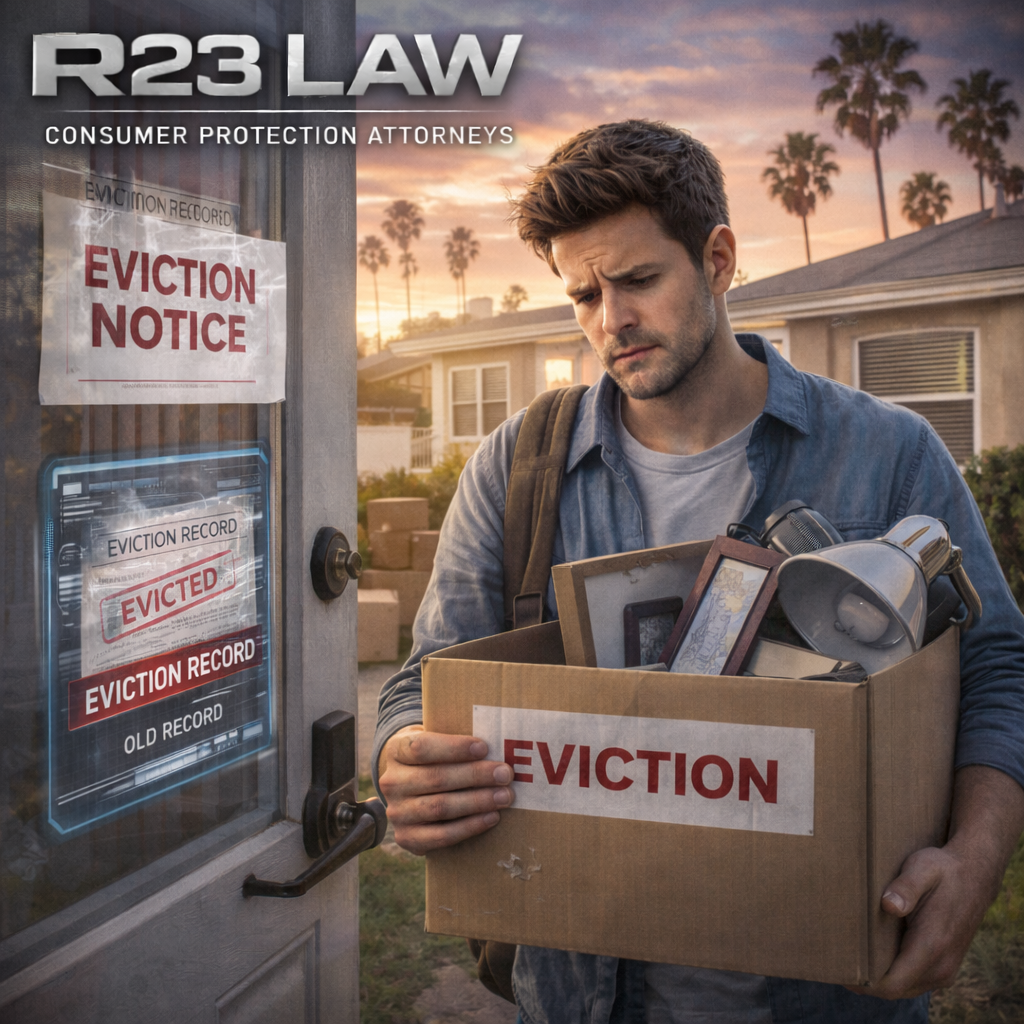
Outdated eviction records can appear on tenant screening reports and trigger apartment denials
Learn FCRA and California tenant screening rights with R23 Law’s California Consumer Protection Attorneys.
Picture this: you finally find the apartment that fits—location, price, commute, the whole package. You apply, expecting the background check to be a formality. Then the denial lands, and the reason is absurd: an eviction record from years ago that you thought was resolved long before your adult life even began.
That’s the core scenario in the attached story: “Alex,” a young professional, loses the dream apartment after a tenant screening report resurfaces an eviction from college-era years—even though Alex had moved on and built a strong rental history.
For consumers, this isn’t a minor paperwork problem. A rental denial can derail moving plans, jobs, family logistics, and finances—fast. For R23 Law’s California Consumer Protection Attorneys, outdated eviction reporting is a consumer protection issue with teeth under federal and California law.
Outdated Eviction Records and Tenant Screening Report Errors
Tenant screening reports are often treated like gospel by property managers. But they’re built from databases, courthouse pulls, and third-party sources that can lag, duplicate, or misstate what actually happened.
In the attached piece, the denial stems from an eviction record that appears years later and doesn’t reflect the consumer’s current reality.
Common patterns include:
Old eviction filings still displayed without context (dismissed, resolved, or otherwise outdated)
Incomplete disposition information (a filing shows up, but the outcome does not)
Mixed or duplicated records that inflate risk on paper
Slow updates where corrected information takes too long to replace inaccurate entries
The FCRA: “Maximum Possible Accuracy” Isn’t Optional
Most tenant screening companies are consumer reporting agencies when they provide reports used to decide housing eligibility. The FTC explains that these housing-eligibility reports are “consumer reports” under the Fair Credit Reporting Act (FCRA).
Under the FCRA, consumer reporting agencies must follow reasonable procedures to assure maximum possible accuracy.
And when a consumer disputes an item, the FCRA generally requires a reinvestigation within 30 days (with limited extension scenarios).
The CFPB has also warned that reporting public record information without adequate procedures can fail the FCRA’s accuracy requirements—especially where records are outdated or incomplete.
Translation: if an outdated eviction record shows up and triggers a denial, “eventually corrected” doesn’t erase what happened during the denial window.
Adverse Action Notices: The Paper Trail That Matters
If a landlord denies you (or imposes worse terms) based on a tenant screening report, the FCRA requires an adverse action notice with key information about the decision and your rights. The CFPB outlines these notice obligations for rental applicants denied due to a tenant screening report.
That notice is more than a formality—it often becomes the anchor for timing, proof, and accountability when rental background check errors cost you housing.
California’s Overlay: ICRAA Disclosures and Rights
California adds another layer through the Investigative Consumer Reporting Agencies Act (ICRAA) (Cal. Civ. Code § 1786 et seq.), which can apply in screening contexts involving character, reputation, and related information used for housing eligibility.
ICRAA includes requirements around disclosures tied to investigative consumer reports—such as identifying the reporting agency and describing the nature and scope of the report being obtained.
R23 Law’s California Consumer Protection Attorneys evaluate both the federal FCRA framework and the California ICRAA requirements—because compliance failures often travel in packs.
A Practical Playbook When an Outdated Eviction Record Triggers a Denial
The attached story walks through a familiar escalation path: consult counsel, gather evidence, send a dispute, document communications, and proceed to litigation if the reporting company refuses to correct the file.
Here’s the consumer-side version of that playbook, built for speed and documentation:
1) Get the full tenant screening report
Request the complete report and file disclosure—not a summary.
2) Lock down the denial timeline
Save the adverse action notice, emails, portal screenshots, and application dates.
3) Dispute in writing with supporting documents
Attach proof that the eviction information is outdated or incomplete (court documents, dismissal/settlement paperwork, satisfaction, or other records).
4) Track reinvestigation deadlines
Disputes have statutory timing expectations under the FCRA, and delays can matter.
5) Watch for repeat reporting
If the same outdated eviction record reapprong signal of broken procedures—not a one-off glitch.
Where R23 Law’s California Consumer Protection Attorneys Fit In
Tenant screening companies move fast, and landlords often rely on the output without meaningful review. When that pipeline pushes outdated eviction information into a decision, consumers pay the price.
R23 Law’s California Consumer Protection Attorneys focus on cases involving:
Outdated eviction records in tenant screening reports
Rental background check errors causing denials or harsher terms
FCRA accuracy and reinvestigation violations
ICRAA disclosure and investigative reporting issues
If a screening report cost you housing because old eviction data refused to stay buried, the legal analysis often turns on procedure: whether the reporting company used reasonable accuracy controls, whether the dispute process was handled lawfully, and what damages flowed from the denial.
Disclaimer: This article is for general informational purposes and is not legal advice.
