
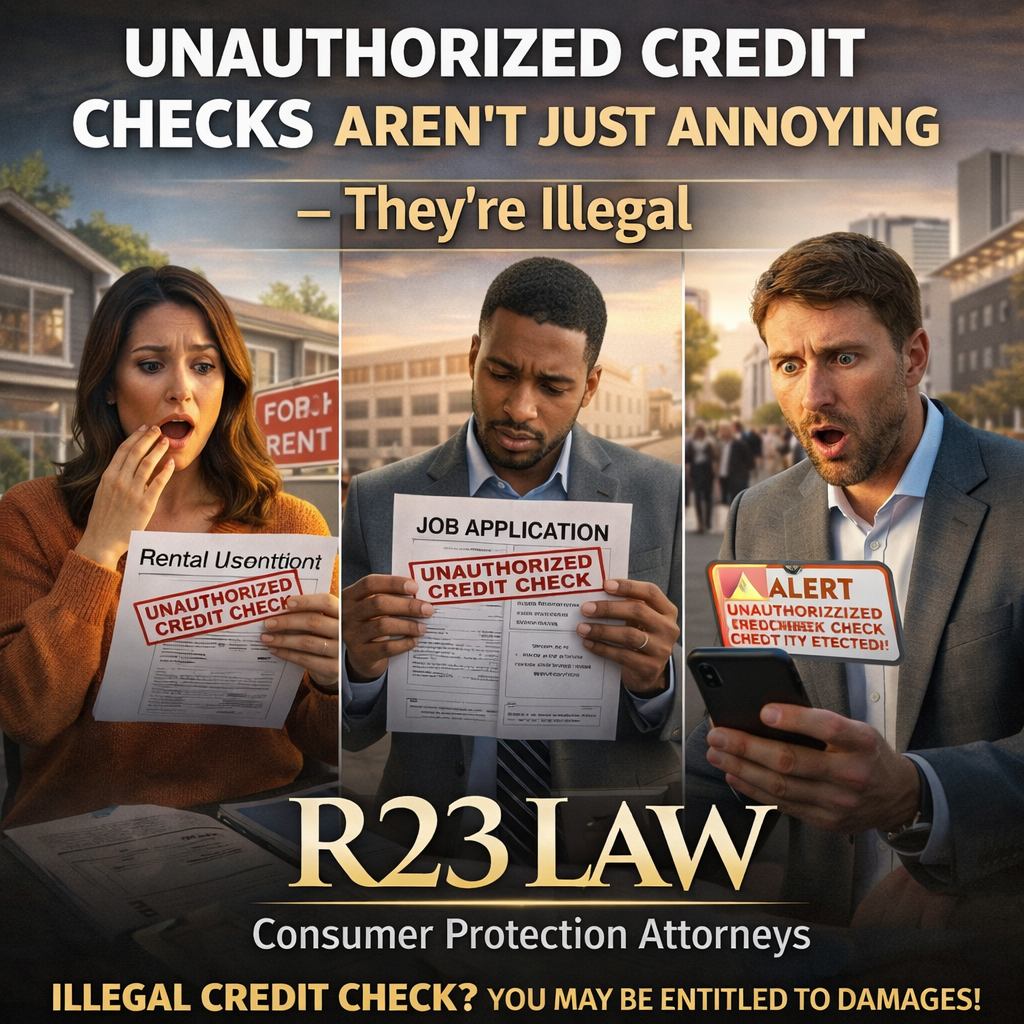
Discover how unauthorized credit pulls violate the Fair Credit Reporting Act
And how R23 Law’s California Consumer Protection Attorneys help consumers claim damages and restore their credit.
When “Just Checking” Becomes a Legal Violation
Your credit report contains some of the most sensitive financial data about you—and under the Fair Credit Reporting Act (FCRA), companies can only access it for very specific legal reasons.
Unfortunately, many landlords, employers, insurance companies, and even debt collectors routinely violate FCRA “permissible purpose” rules, pulling reports without your consent or legal justification. And in California, you don’t need to prove financial harm to hold them accountable.
If your report was accessed without your permission, R23 Law’s California Consumer Protection Attorneys can help you file a claim for damages and protect your credit from further harm.
What Is a “Permissible Purpose” Under the FCRA?
Under the FCRA, a company must have a valid reason—called a permissible purpose—to access your credit report. Valid purposes include:
Applying for a loan or credit card
Renting an apartment (with written consent)
Employment screening (also requires written consent)
Reviewing an existing account
Insurance underwriting based on a request
Certain government agency needs
California law goes even further, often requiring explicit consent for checks where federal law might be silent.
What Unauthorized Access Looks Like in the Real World
Even with these rules, many companies still access credit reports without permission or legitimate reasons, often damaging your score and privacy.
Landlords Pulling Reports Prematurely
Landlords may run a credit check before you’ve submitted a full rental application or without your written consent. This violates federal law—and it’s shockingly common in Los Angeles.
Employers Ignoring Consent Requirements
Employers often download credit reports without written consent, especially for retail or food service jobs where credit history has no relevance.
Insurers Accessing Reports to Raise Rates
Auto or health insurers may use credit data to adjust premiums at renewal time—even without a policy change. That’s not a valid permissible purpose under the FCRA.
Identity Thieves Creating Fake Applications
Criminals can trigger unauthorized hard inquiries using stolen identities. These inquiries often show up in clusters or from unfamiliar lenders, damaging your credit score before you even notice.
Your Rights When Your Credit Is Accessed Illegally
You are entitled to compensation, even if the unauthorized inquiry didn’t cause obvious financial harm.
Statutory Damages
You can recover $100–$1,000 per violation, automatically—no need to prove financial loss.
Punitive Damages
If the violation was reckless or intentional, courts may award additional damages.
Attorney’s Fees
The company may be required to pay your legal costs, making it possible to pursue claims even for small violations.
What To Do If You Find an Unauthorized Credit Pull
If you spot a credit inquiry that you didn’t authorize:
Screenshot the inquiry immediately
Contact the company that pulled the report and request a written explanation
File complaints with the Consumer Financial Protection Bureau (CFPB) and the Federal Trade Commission (FTC)
Contact R23 Law to review your legal options and build a case
The infographic on page 6 of the document highlights these steps clearly: Document everything, act fast (within 30 days), and seek legal help to maximize recovery.
Why R23 Law?
Our team at R23 Law focuses on consumer protection cases, including FCRA violations involving unauthorized credit checks. We know how to:
Identify illegal patterns of behavior
Secure statutory and punitive damages
Prevent further harm to your credit
Handle all communication so violators can’t intimidate you into silence
We’ve helped clients recover from identity theft, protect their credit, and take powerful legal action against companies that broke the rules.
Final Thoughts: Your Credit, Your Control
Unauthorized credit checks aren’t just shady—they’re illegal. Whether it’s a landlord, employer, insurer, or even an identity thief, no one has the right to access your credit report without a permissible purpose.
If you suspect an FCRA violation, don’t wait. Statutory deadlines apply, and quick action gives you the best chance to recover damages and stop further abuse.
R23 Law’s California Consumer Protection Attorneys are here to fight back when your credit privacy is violated.
📞 Call today for a free consultation and learn how to protect your financial future.
